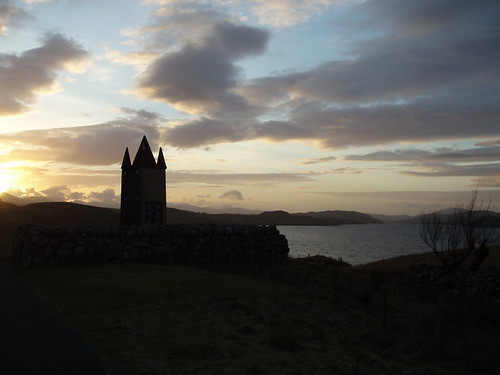
I am typing this as the cloudless evening sky turns from yellow to orange to pink - the sun set a couple of minutes ago. Although it was not vastly warm, I should not complain about 9C. At the moment, the mercury is dipping fast as darkness falls.
It should not be wholly dark tonight: a large solar flare is set to slam into the earth's magnetic field, giving rise to Aurora Borealis (Northern Lights). I'm at relatively high latitude within the UK (58 degrees north, London is at 51°) so I should have a fair chance of seeing the Merry Dancers. I saw them first back in October, and I'll keep an eye on the messaging service from the University of Lancaster - Twitter account @aurorawatchuk (UK).
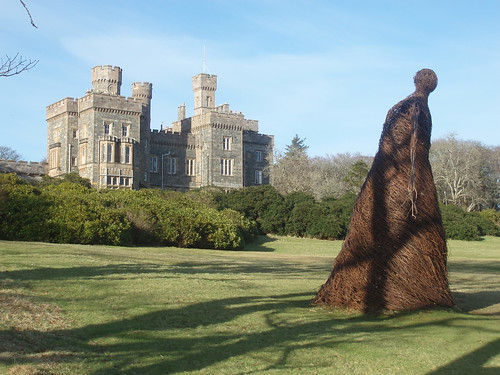
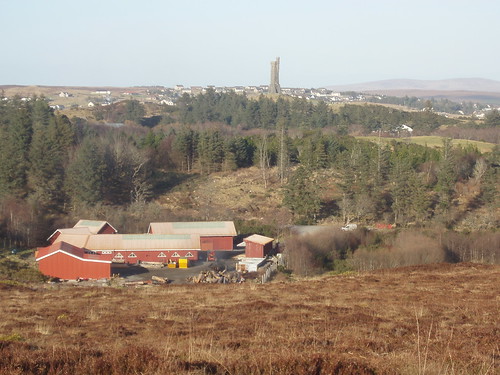
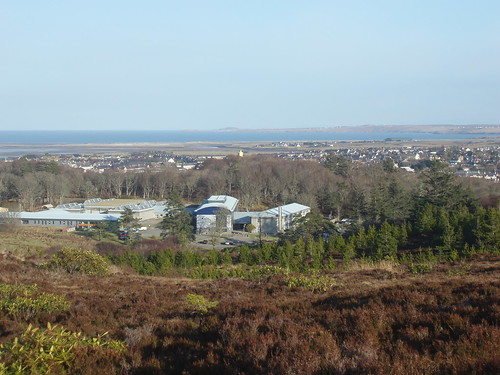
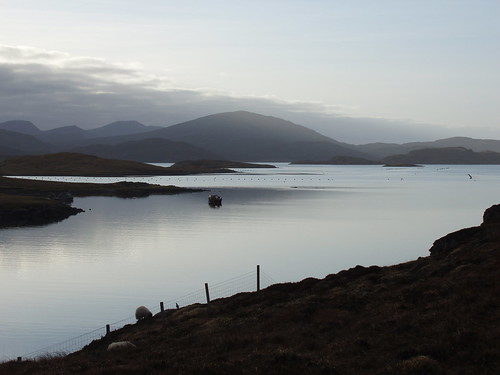
This afternoon I went for a two hour walk in the Castle Grounds (the countrypark around Lews Castle) and managed to get up Strawberry Hill. I have made a guided tour which you can view on Google Earth by downloading this file: http://www.adb422006.com/StrawberryHill.kmz. I am uploading pictures, which I shall put up later. Strawberry Hill is a prominent feature in the Castle Grounds, but singularly hard to get to. It requires a bogslog, then a pretty steep ascent; and a boggy descent of the northern slopes towards the Castle College. Quite strenuous - and I'm rather out of shape.
I was horrified to receive an email from an on-line contact that was not sent by her or by the relative who was quoted as having signed the email. I copy:
Dear Friends of Lori,
This is a short call for support. We need some money for the hospital
bills and the funeral arrangement soonest. A total sum of $10,000 plus
was calculated. You can pay to my parents’ liberty reserve account
using the detail below [rest of email withheld for reasons of privacy]
Anyone who is friends with Alberta Lori: distrust ANY communcation that comes from her Internet presence. Her email is hacked, and her Facebook as well by the sound of it. The matter is being reported to the police in the US and Canada - I have had enough.
A blog in French has lifted the lid on the filth in Belgian politics, where they are still trying to form a government - 8 months after a general election. The leader of a far-right and separatist party in Flanders, Bart de Wever, has described a leading French-speaking newspaper in Belgium "Le Soir" [The Evening] that it is not even fit for use as toiletpaper. This follows from a report in Le Soir on Saturday, which showed an election poster for Mr de Wever from 2003 in the company of his friend and former prostitute Marie-Rose Morel. Ms Morel recently died of cancer and her funeral was a national event in Flanders, where she was referred to as "Mother Courage". Not so in Wallonia, the French speaking part of Belgium. The reasons why the Francophones are so reluctant to do so is Ms Morel's cast-iron connection to the far-right in Belgium. However, Mr de Wever is not just bogrolling Le Soir, but also demanding an apology from the French speaking TV station RTBF for not joining in the outpouring of national mourning that Mr de Wever had demanded.
You may wonder why this is of interest to me. Well, I see certain parallels to the situation in Holland. The far right-wing PVV party, headed up by Geert Wilders, is currently propping up a right-wing coalition there. Mr Wilders was refused entry to the UK two years ago as it was felt that his presence could destabilise community relations in Britain. What really shocked me was the outrage that was expressed by the Dutch Prime Minister. This was before the June 2010 General Election in Holland, when the PVV gained more than 20 seats in the 150 seat lower house of parliament. Why is everybody cow-towing to people like Wilders and De Wever? The former has expressed hatred of islam, and is facing court action over this. The latter is a separatist and ultra-nationalist, who will split Belgium asunder in the most acrimonious fashion if he has his way. I vividly remember the pitched battles on the streets of 's-Gravenvoeren / Fourons-le-Comte on the Dutch/Belgian border in the 1980s. However, in the 1980s there was no question that Belgium could split. That option is certainly there now.
A grey day with some brief clearances and some light rain. I spent most of the afternoon looking up cemeteries on Google Earth, to build a database and map of graveyards where combatants from this island lie buried across the world. Been doing that for a couple of days, so I apologise if I repeat myself.
Local councils are now threatening to fine people who do not separate out recyclable waste (plastic, paper &c) where facilities exist to do so. Like they were also fining those who put their bin out on the road before 7 am on collection day, or leaving the lid of the bin open at an angle greater than 30 degrees. Or if the receptacle was placed too far from the kerb edge. I wonder who is going to wallow throught the dirty nappies, rotting fruit, vegs and meat and all the other pleasant detritus of daily life to make more money for their council.
I was horrified to read just now that former Egyptian president Mubarak had ordered his troops to crush the demonstrators in Tahrir Square, Cairo, on January 30th, using their tanks. The tank crews took off their headsets, through which they had received those orders, and picked up their mobiles to phone home. And their families said: don't do it. Egyptians don't kill Egyptians. And that was Mr Mubarak on his way out. It would appear that he valued his $30bn more than the lives of the people he was sworn to serve. Good riddance.
A very quiet day, with lots of sunshine. I am hearing tales of snow and ice in the Scottish Central Belt, but I spend the afternoon basking in glorious sunshine - behind glass, mind you. 6C is not warm in my book. This nice weather will obviously not last; tomorrow will be dreich and grey.
My main activity has been to trace more cemeteries using Google Earth and a handful of website to help me locate them in the UK, France, Belgium, Hungary, Iraq, Egypt, Canada - and wherever else the list will take me. After doing that for a while, it is good to relax with some Tom and Jerry.
We started fair, but ended wet today. Went out for an amble around the harbour, but as I turned onto North Beach Street, a leaden grey sky and an icy blast heralded the onset of a period of rain.
Today, I looked into the sad stories of the soldiers from the First World War who were executed under the Army Act, for military misdeeds. These included desertion, abandoning the post, cast away of arms - and malingering. It has taken a very, very long time before it was recognised that most of the 306 British soldiers shot at dawn were casualties and victims of the war, as much as the other hundreds of thousands who died between 1914 and 1921. The Canadians recognised this in 2001, the British followed suit in 2006.
There are no men from Lewis who are recognised as having suffered this fate. In this post on my Pentland Road blog, I tell the story of at least one Lewisman who was executed.
This is the memorial, in Alrewas, England, for those who were shot at dawn.
The hours of darkness were punctuated by high winds and heavy rain. These abated by about 5 am. As I glanced across the bay at that hour, I noticed a blur of light beside the lighthouse that is not normally there. On training the binoculars on it, it turned out to be a stationary ship. It appeared to be in a position to the north of the Arnish Peninsula, i.e. a bit too close in to shore for good comfort. However, its lights were on and nobody was rushing out to help, so I concluded that all was well. When daylight came, just after 7, the ship in question was on the other side of the peninsula, to the south, and its superstructure peeped above the low land by the lighthouse. I have often found the perspective to be deceiving here, particularly in the dark. The lighthouse, for instance, is exactly 1 mile from my position (across the water), but appears to be much closer. It is not until you step out on the causeway that you realise the distance.
I have completed the transcription of all the war memorials here in Lewis, with the addition of the 23 panels from the Lewis War Memorial. This contains the names of 1,600 people who were lost in WW1 and WW2. I am now continuing my search for the 400 cemeteries and memorials across the world which are the final resting place or the location of remembrance for all from the island who were lost in foreign fields, or on the seas of the world. This link shows the first 100.
Today, 319 years ago, 38 members of the Clan Macdonald were killed in Glen Coe, when their guests, members of the Clan Campbell, turned on them. Glencoe, a spectacular mountain valley about 80 miles north of Glasgow, is now synonymous with this crime. the details of which are outlined on this Wikipedia article.
The involvement of King William III renders this a black mark on the conscience of the Dutch - he assumed the English throne when he came across from Holland as William of Orange. In the Netherlands, he is referred to as the Father of the Fatherland - translating directly. 23 years ago, there were extensive celebrations on the 300th anniversary of William's marriage to Queen Mary II of England. This lasted for 6 years, until Mary's death in 1694.
William III has another black mark on his record, commonly referred to as the Battle of the Boyne. This battle, which took place on Irish soil in 1689, has been used as a pretext by extremist sections of the Protestant and Catholic communities in (Northern) Ireland for acts of violence in the 20th century.
Mind you, if you think that is bad, it is worth bearing in mind that the war in the Balkans in the 1990s was justified by Serbia's president Slobodan Milosevic on account of the Battle of Kosovo in 1390.
Quite a nice and sunny day, but as the afternoon came to a close, the wind was picking up. We are on warning for winds up to galeforce overnight, and tomorrow will be as wet as Friday. It's a see-saw weather pattern we're in - your average Hebridean winter in other words.
Not so nice is the weather in the Indian Ocean, where tropical cyclone Bingiza is blowing up to a category III hurricane by the time it reaches eastern Madagascar on Monday. We're talking winds of 105 knots, 120 mph. The winds are bad enough, but the main threat for Madagascar tends to be flooding. Hurricane Ivan wreaked havoc in the north of the island in 2008; and hardly anyone knew about it.
I am completing the transcript of the war memorials here in Lewis, all 15 of them. The Lewis War Memorial, at the northern end of Stornoway, is proving a challenge, due to the poor legibility of the panels on my photographs. I'll get there yet.
Egypt's president Hosni Mubarak has stood down and has left Cairo for Sharm el-Sheikh, a resort on the Red Sea coast. His departure follows 18 days of protests in the centre of the capital, broadly condoned by the army. Several attempts by Mubarak to placate his opponents by promising to resign later in the year did nothing to assuage his critics. And today, he left office.
It is a victory for the ordinary man and woman of Egypt, all 85 million of them. Nobody from outside was involved, and outside issues did not feature in the protests. It was an impopular and despotic ruler that was the object of protests. The advent of the Internet has made it possible, it has shown Egyptians what is possible. Tunisia, but other places too, has shed its despots. Who will be next? Gadaffi, Assad, the Arabian leaders?
What will happen next is anyone's guess. But it will be a series of decisions that are up to the Egyptians to make. If free and fair elections, promised by the armed forces, result in an Islamic party coming to power, so be it. The peace treaty between Egypt and Israel, signed by the late president Sadat and late premier Begin in the 1970s, does not appear to be in jeopardy. Tearing it up is in nobody's interest.
Our wet weather pales into insignificance compared to the momentous events in Cairo today.
A bright and sunny day, which makes a change from the dreich and grey conditions of late.
I kept myself busy compiling a map showing the positions of cemeteries and memorials across the world, where casualties from this island lie buried or are remembered, who fell in WW1 and 2. Unfortunately, Google Maps is not the ideal tool for that, and my internet connection ground to a halt after 6pm.
Having watched a programme about the natural wonders of Madagascar, the tropical cyclone centre in La Reunion promptly issued a warning that cyclone Bingiza will hit the island in a couple of days from now. As the forecast stands, maximum sustained winds will be at 85 knots, 90 mph.
The saga surrounding the downgrading of coastguard services around the UK coast took another twist, when the CEO of the MCA admitted that local knowledge would be lost if the current plans were to go ahead. Ever more unacceptable.
It's a grey day in Stornoway, with occasional light rain. At least it's not really cold, with the mercury up a few points to 9C / 48F. The weather will continue to fluctuate, as a battle is being fought between cold air over Scandinavia and milder air over the Atlantic. The mild air looks set to win at this stage. However, it's still only February and three weeks left in that month.
Yesterday, I was thinking that the southern Indian Ocean had been quiet so far, in terms of tropical cyclone formation. Promptly, up pops this disturbance (94S), which is rumbling away some 450 miles north of La Reunion, which looks set to turn into a nasty piece of work. At the moment, it may well intensify to a category II hurricane as it passes just west of La Reunion over the weekend. I should get a flood of visits to my Tropical Cyclones blog - when cyclone Gamede passed by the Mascaregnes in 2007, the record for the number of daily visits was around 3,000.
If you want to read a long and verbose account of speeches to a departing president of the Gaelic Society of London, look no further than my local history blog Pentland Road. Roderick Macleod lost a son in WW1 (hence my interest), and left the presidency of the GSL in 1927. His farewell do attracted about 200 dignitaries.
Not a very inspiring day, weatherwise, with a cold wind blowing and increasing amounts of cloud. Processed information on a Lewis-related item (see Pentland Road blog). I have more, but that will involve copying nearly a dozen pages of small print.
The Coastguard revamp continues to hog the news headlines for us in the Western Isles, because the CEO for the Maritime and Coastguard Agency insists that his staff broadly support the plans for downgrading the service, and it's just the members of the public that cry blue murder - because they are unfamiliar with the workings of the Coastguard service. The only problem with that problem, Sir Alan Massey, is that a lot of criticism of your plans actually come from Coastguard staff. Furthermore, you have only been in office for 7 months, and I think your staff know rather more about their agency than you do.
There was this journalist who thought that everything she wrote on Twitter was only intended for her 700-odd followers. She is obviously not aware that anybody can see your Twitter feed (except if you make it private). Still on the subject of social media, many people have an account on Twitter as well as Facebook, with different contacts on either service. And cross-posting may not always be a good idea!
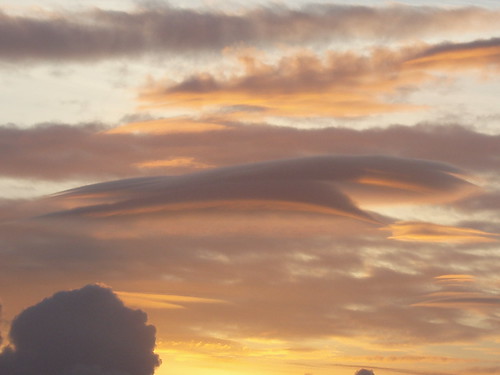
A day of sunshine and showers, and the most fantastic gallery of cloudscapes that graces the southern horizon. Who needs paintings, television, internet when you can just look out of the window and see an ever changing tableau in the sky? Worth more than anything I can think of.
On a related topic, I have been told that my submissions to Blipfoto could feature on the website of the Scottish Government. Nice accolade.
As I have been posting on Twitter and Facebook, I have today reduced the number of Facebook apps from 187 to 44. The excellent social media website mashable.com featured an article on Facebook privacy which I strongly recommend to everyone who uses Facebook. I have heard too many instances where people got caught out by the stuff they innocently put on their Facebook page; only to get into serious trouble over them. Varying from losing a job to family strife or marital breakdowns.
The reduction also showed how my use of Facebook has changed since I started on the site in October 2008. I used to authorise all sorts of apps (hence that high number), but nowadays I can't be bothered to reply to the requests - sorry.
I am presently compiling a website listing the fifteen or so war memorials in the Isle of Lewis. It's a work in progress at the moment, but you can preview on this link.
A sunny day, but with varying amounts of cloud and one or two showers passing us to the south.
I could not believe my eyes when local broadcaster STV reported that Molly Campbell had returned to the UK. Molly made headlines in the summer of 2006, when she vanished from the Nicolson Institute here in Stornoway to be with her father in Lahore, Pakistan. Her mother, Louise, reported her missing, but the daughter later turned up in Pakistan. Molly (now called Misbah) voluntarily went east. She has now returned of her own free will again, and is living with her sister in England. Their mother has travelled south of the border to be with her daughters. Misbah's return is said to be permanent.
The Prime Minister, David Cameron, has enunciated that the multicultural society has failed, and we should return to a sense of national pride. That, to my mind, opens the door to negative discrimination of ethnic minorities and the victimisation of those who adhere to the Muslim faith. It is perfectly possible to be proud of your nationality, and you can take even more pride by being welcoming to those who want to join you from overseas. Mr Cameron's remarks are more redolent of the extreme-right BNP party than of a party in national government.
Was treated to the unusual sight of MV Muirneag hoving into view this morning. Our freight ferry has not put to sea at all this week, and last night was the first time she ventured out. The Muirneag is more than 30 years old, and is not good at manoeuvering in adverse conditions. Long term readers of my blog may remember an episode in 2005, when she was caught in stormforce winds which forced her 60 miles off course, well on the way to the Faroe Islands (250 miles north of here).
I have completed another big chunk of transcriptions from the reports from the Napier Commission (1883), which is a crucial document in the history of the Highlands and Islands. The county of Sutherland was the scene of the some of the worst abuses of crofters. Bear in mind that there was more to the clearances than people being shunted off to Canada or Australia. The session at Bonar Bridge e.g. revealed how the rent of some crofters was bumped up from 1s to £6 - an increase of 1200% [£1 = 20s] over a few years. It is a long read, but if you take the time, you'd be horrified.
The next batch of transcriptions will cover Ross-shire; for Scottish readers, this is strictly speaking Wester Ross, from Ullapool south to the Applecross peninsula; as well as a session at the county town, Dingwall.
The SS Politician was a merchant ship, which was sailing from Liverpool to Jamaica in December 1941. On February 5th, she ran aground on the island of Calvay, between the larger islands of Eriskay and South Uist. She later broke up and sank. Her cargo included tens of thousands of bottles of whisky - which inspired Compton Mackenzie to write his famous book Whisky Galore, the word Galore being one of the few Gaelic words that are in common usage in English today. Gu Leor means plenty.
The whisky was salvaged by the islanders. Although a near-endless supply of whisky may seem like heaven on earth, it did cause serious health problems in the longer run. Alcoholism and all its attendant problems, for instance.
The Politician did not just carry whisky. She also had a consignment of Jamaican banknotes, a grand piano, bathroom fittings and bicycles. The fittings were put to good use outside one islander's home, and were still being used decades later - in an outhouse beside a stream.
Even here in Lewis, there are stories around, if you know where to listen. Of the odd case being 'smuggled on request', and the skipper of the ferry distracting the 'polis' whilst the runner makes his get-away.
Yesterday's storm finally abated after midnight, but not before blasting the north of Lewis and Shetland with gusts of 104 mph. A fishing vessel broke free from its moorings in Scalloway, Shetland, and had to be tied up again - in 90 mph winds. There appear to have been no casualties. The weather continues inclement in central Scotland, but is not too bad here in the islands. There was a thin drizzle this afternoon.
Events in Egypt continue to develop unpredictably. Liberation Square remains the focal point for the movement which seeks to oust president Mubarak, whose followers tried to remove the protesters with violence yesterday - unsuccessfully. It would appear that this is an issue for the Egyptians themselves to resolve, and there is no way to predict how it will end.
The fishing vessel Jack Abry II which ran aground on the Isle of Rum earlier this week is still stuck fast. There appears to be an oil leak within the vessel, but no oil is leaking out. Dutch salvage equipment is on its way to the island, but the winter weather may delay the recovery of the boat.
This image courtesy hebrides-news.com.
It was windy in the night, and a fall of snow brought the airport to a halt first thing. That was nothing. At 1pm, the weather turned increasingly savage, and at the moment the anemometer is spinning to 86 mph at the Butt of Lewis, 25 miles north of here. Curtains of spindrift are blown across the harbour, in front of my position, and angry white riders adorn the wave crests. Almost all ferry services in the west of Scotland have been withdrawn, in the face of hurricane force winds. Flights are still operating normally. The wind is from the south; as the runway at the airport is north/south orientated, planes can still take off. It will be a very bumpy ride though. There will be a springtide at 7pm tonight, clocking in at 4.8 metres / 16 feet, which coincides with the height of the storm - sandbags at the ready in the flood-prone areas of Stornoway. As I type, I can see huge curtains of spindrift crossing the basin in front of me, indicating that we're heading for force 11. Two poor collar doves were blown around so hard that they had to land in a tree (which doves don't like doing) before finally taking off for their roost in one of the buildings nearby.
Tropical cyclone Yasi has roared ashore in Queensland, with winds well in excess of 200 km/h (125 mph). The impact is as yet unknown, but as day breaks, this should become clearer.
Events in Egypt have taken a turn for the worse, with clashes between supporters and opponents of president Mubarak. Although the president pledged not to stand in the elections later in the year, this has not served to placate his opponents, and quite ugly scenes ensued in the square which has been the focal point of the popular uprising over the past week or so.
Here in the Hebrides, we can expect a fully-fledged storm, with winds up to force 12 in the next 24 to 48 hours. Gusts are anticipated to be in the range of 80 to 90 mph. Nowhere near as bad as in Queensland, but sufficient to cause damage. We'll be battening down the hatches.
A bright day with good sunshine - and equally good, heavy, showers. The wind turns squally in the showers, but otherwise it's not too bad. We are on warning for severe gales on Thursday and Friday.
Queensland is on warning for tropical cyclone Yasi, which will strike near the northern city of Cairns during Wednesday local time. At present, maximum sustained winds near the centre are at 135 mph, gusting to a puny 160 mph. This is likely to increase further, and the cyclone could carry winds of 150 mph at landfall, gusting to 180 mph. For the hurricane savvy among you, this is equivalent to a top-end category IV system. I don't think I'd like to be in Queensland just now. Because a category IV hurricane does this:
There is a very high risk of injury or death to people, livestock, and pets due to flying and falling debris. Poorly constructed homes can sustain complete collapse of all walls as well as the loss of the roof structure. Well-built homes also can sustain severe damage with loss of most of the roof structure and/or some exterior walls. Extensive damage to roof coverings, windows, and doors will occur. Large amounts of windborne debris will be lofted into the air. Windborne debris damage will break most unprotected windows and penetrate some protected windows. There will be a high percentage of structural damage to the top floors of apartment buildings. Steel frames in older industrial buildings can collapse. There will be a high percentage of collapse to older unreinforced masonry buildings. Most windows will be blown out of high-rise buildings resulting in falling glass, which will pose a threat for days to weeks after the storm. Nearly all commercial signage, fences, and canopies will be destroyed. Most trees will be snapped or uprooted and power poles downed. Fallen trees and power poles will isolate residential areas. Power outages will last for weeks to possibly months. Long-term water shortages will increase human suffering. Most of the area will be uninhabitable for weeks or months.
Still on weather-related topics, the Chief Coastguard, Sir Alan Massey, made some breathtaking remarks on Scottish TV last night. He said that local knowledge should be pooled onto Google Earth. Well, that's bonny. There is such a thing as the Gaelic language in these parts; and anyone who has ever done a search on Google generally knows what a pile of results can crop up. Secondly, he said that coastguard stations are often overmanned in relation to the amount of work. Accidents and emergencies do not occur on schedule, and do not wait for daylight, when the proposed satellite Coastguard Stations may be manned. Sir Alan also admitted that the cutbacks in service were purely money-related, and if the demand for savings had not come down from upon high, nothing would have changed.
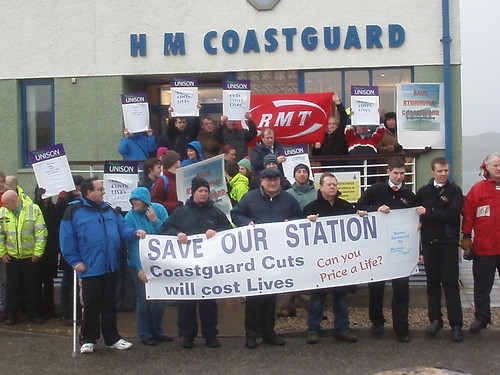
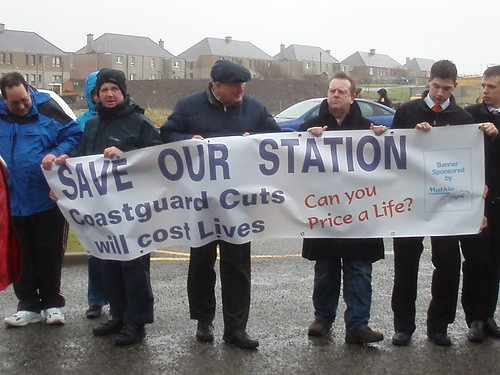
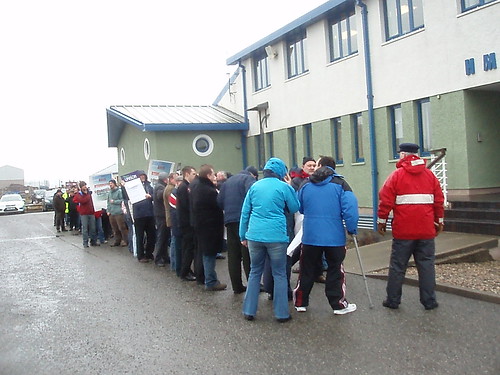
Atrocious weather today, with strong winds (up to galeforce) and persistent rain. I nonetheless ventured out at lunchtime for a rally at the Coastguard Station to join a protest against the proposed closure of the station. They held a short march in front of the station, with banners and placards protesting against the closure. A handful of people held speeches, some very powerful, and with the chant "Save Our Station", the rally was closed at 1.30pm.
After a spell of heavy rain and high winds, the sun has come out to grace us with its presence for the last hour of daylight. There was a cloud of seagulls over the harbour outside my window, and when I went down to find out what attracted 400 gulls it turned out to be BIRDSEED. Lewis Crofters stock birdseed and other stuff, and as we have not had any heavy rain for a while, a lot of it got washed down the stormdrain and ended up in the harbour.
A moutain walker in the Highlands is the luckiest man alive, after he fell down 1,000 feet off a mountain top, east of Ben Nevis. He was spotted by the crew of a helicopter, who had been sent to his rescue. They did not believe he was the casualty, as he was standing up and reading his map. However, when the chopper crew saw the trail of debris, leading from the summit to the point where the man was standing, it did become clear he was the casualty.
Not so lucky were the passengers on a train in the German state of Sachsen-Anhalt, when it collided head-on with a goods train near Magdeburg. Ten of them died, and 33 were injured. The cause of the crash, which headed on a single-track line, is not clear. German railways (DB) have a good safety record.
I have completed the website for the casualties from the Uists and Barra from WW1 and WW2, replacing two separate webpages. I do not have as much information on the Uists as I had for Lewis, so hope it does serve some purpose.
And today brought more sadness to J-land, when I was told that Angie Marshall (Can you all hear me at the back?) had passed away unexpectedly. I was not a regular reader of her blog, but the expressions of grief over the past few hours have shown she was well loved in the community, and will be sorely missed.
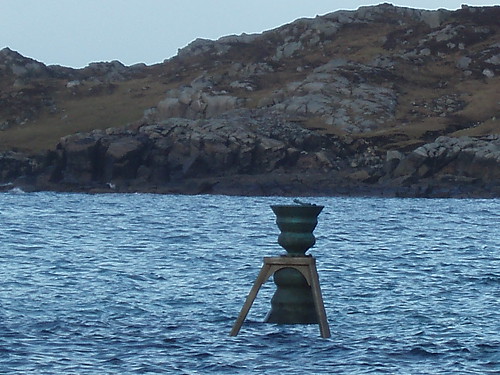
A bright day, but the high cloud does not bode too well for the near future. Went outside Stornoway for the first time this year, to Bosta Beach in Great Bernera. That's about 30 miles by road. Bosta is one of my favourites in the island; I also wanted to go there to see the Time and Tide Bell that was installed there last July. It was not working, as the clapper appeared to be missing. In the evening, we gave the restaurant in the An Lanntair [Lantern] arts centre another try, and this time everything was good. Prompt service, good food and a decent price. I'll spare you the disasters that have befallen me there over the past five years.
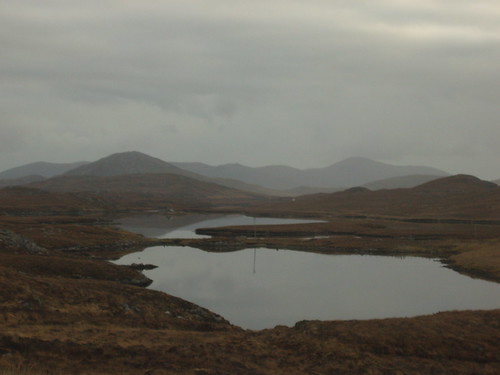
Looking towards Roineabhal from the Bernera road
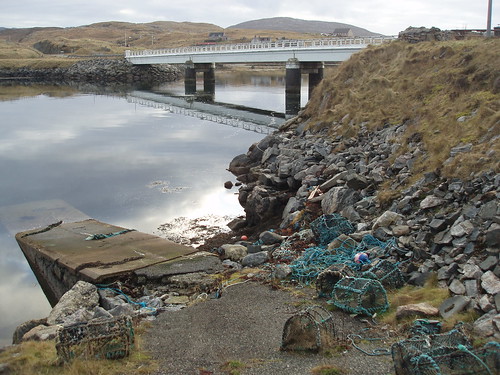
Old and new: the slipway for the pre-1950s ferry to Great Bernera, and the bridge
The Australian state of Queensland will take delivery of two tropical cyclones this week. Anthony is headed for landfall near the town of Ayr later today or early tomorrow. Its highest winds are at 45 knots, that's 50 mph or equivalent to force 10 on the Beaufort scale. The Australian weather service is issuing warnings.
I am far more worried about tropical cyclone Yasi, which has formed between Vanuatu and the Solomon Islands, 1500 miles east northeast of Queensland. The Joint Typhoon Warning Center is forecasting that this storm will blow up to an upper-end category III hurricane, striking the Queensland coast near Cairns with winds of 110 knots, 120 mph, on Friday of this week.
The day started fairly bright, but cloud increased and when the sun went down, just after 4.30pm, there was some rain. We'll get more of the wet stuff through the night. Did I mention we had the saltboat and the coalboat in at the same time on Wednesday? Well, the coalboat usually leaves the town painted black, with lumps of coal scattered along the streets.
I spent a few hours in the library, to look up the croft histories for South Uist. I am not very familiar with that island, and I had to check the Gaelic names of the townships there against the English ones I have on file. I shall now incorporate those on my Berneray to Vatersay tribute site.
I have blogged about two things, Auschwitz Memorial Day and the ditching of an RAF Tornado jetfighter off Rubha Reidh lighthouse. I spent the day processing the information I gleaned from the Berneray and North Uist croft histories, and putting a tribute to Barra on the Net as well.
Croft histories show each and every person who has occupied a croft since about the middle of the 18th century, in some cases. A croft is a piece of land that is leased from a landowner. It is not by definition a farm. Neither does it automatically include buildings. Houses, sheds or whatever are regarded as improvements. Crofts in the 21st century may well have a ruin of a blackhouse on it, which was rendered uninhabitable in order for the crofter to be able to apply for a grant to built a modern house on it. To my knowledge, nobody lives in a blackhouse the way it was done up to the middle of the 20th century. Apart from the crofter, the leaseholder, there used to be cottars (a peasant farmer), who would work for the crofter, but did not hold land as such.
A Tornado jetfighter has crashed northwest of Rubha Reidh lighthouse, 18 miles southeast of Stornoway. Two crew ejected and were recovered from the water by Coastguard helicopter, and flown to hospital in Inverness. RNLI lifeboats were launched from Stornoway and Portree. Coastguard tug Anglian Earl is on the scene of the crash to try to recover the wreckage - as shown on this image from AIS Minch.
It's ironic that there is a vigorous debate over the closure of Coastguard Stations, and of the RAF base at Lossiemouth, where the Tornado was based.
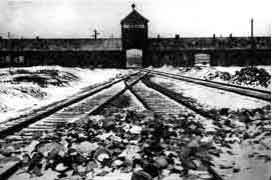
Today it is 66 years ago since the infamous Auschwitz Birkenau concentration camp was liberated by Soviet forces. More than a million people, mainly Jews, were killed there during the Second World War. The process was conducted as an industrial process. To date, some of the goods left behind by the victims of the Holocaust remain on display. These include suitcases with name tags, spectacle frames, hair and shoes. I have never visited Auschwitz and am not likely to. January 27th is Holocaust Memorial Day, remembering all the victims of the Nazi's policy of extermination of all those they considered to be sub-human. We must never forget.
An overcast and cold day, although it has stayed dry.
Scottish politician Tommy Sheridan, who once headed the Scottish Socialist Party, has been sentenced to 3 years in jail for perjury. He lied under oath whilst fighting a defamation case against the Sunday tabloid News of the World which had alleged that Mr Sheridan had visited a sex-club in Manchester. The trial was a sordid affair, and I could not get over that Monday evening news bulletin on Radio Scotland, last November, when a list of people was read out who had had sex with each other.
Sordid is the word to describe the News of the World, which is gutter press at its worst. I was positively astonished that British prime minister David Cameron appointed a former editor of that rag to be his communications advisor. Do you know why he needs somebody like that? Mr Cameron has been educated at Eton (a private school for the very privileged) and therefore hasn't got a clue what goes on for Johnny Average. Anyway, Andy Coulson got sacked over allegations over phone hacking / tapping, that his journalists are said to have carried out over the years. Some of their alleged victims are high-ranking politicians like former PMs Gordon Brown and Tony Blair.
Sordid is also the saga around two sports commentators, who were caught on microphone as saying that a female linesman at a soccer football match would not know the off-side rule, because she was a woman. The person concerned to be a very capable linesman at a Premier League football match. It got worse, when one of the commentators was seen asking a female production assistant to tuck a microphone into his trousers, and discussing (on camera) a woman, in such language that the broadcaster concerned would not show us anymore. Although one of the men concerned has apologised to the linesman, the other would only offer his excuses over his contribution to the furore, not over his language or his attitude to women.
I thought we had come a long way in society with regards to sex discrimination, bearing in mind that women now get to high positions just as easily as men. I am even more disgusted with football than I already was now that I see this rampant sexism coming into the open.
I am extremely angry tonight at the announcement that more than 600 staff at the BBC World Service are to be made redundant (that's a quarter of its workforce), and five of its language services shut down. This follows a 16% cut in its budget, as supplied by the UK Foreign and Commonwealth Office. I have gone so far as to describe this as state-sponsored vandalism, which takes no account of the invaluable work that the BBC WS does around the world.
I have been a supporter of the BBC WS since the early 1980s, and although I do not listen to the station at the moment, that does not diminish my appreciation of its work. In many areas of the world, its output is often the only source of reliable information, particularly before the advent of the Internet. But as anyone with a modicum of common sense will realise, you have to be careful which sources to use on the Net.
I fully support any (lawful) action taken to reverse these cuts, and do hope that a reversal will take place.
Overcast with occasional light rain. 'Nuff said about the weather here.
It's Burns Night in Scotland, and it's haggis and whisky galore. Tortured renditions of Burns prose and poetry will be the order of the night, made even more tortured by the water of life. Haggis is an offal-based meat dish, and various bits and pieces of a sheep's innards are turned into basically mutton mince, packed into a sheep's stomach. This is served with neeps (turnips). I've tasted it once, and it's not far off mincemeat; but knowing how it's made it is not something I'd care to repeat in a hurry. Our local supermarket has shelves, laden with haggis. Leaving my slight sarcasm to one side, I would like to state that Robert Burns did not just write in Scots, he also wrote in perfect English. This is in Scots, with verses 1, 3 and 5 read by Scotland's First Minister, Alex Salmond:
Is there for honest Poverty
That hings his head, an' a' that;
The coward slave-we pass him by,
We dare be poor for a' that!
For a' that, an' a' that.
Our toils obscure an' a' that,
The rank is but the guinea's stamp,
The Man's the gowd for a' that.
What though on hamely fare we dine,
Wear hoddin grey, an' a that;
Gie fools their silks, and knaves their wine;
A Man's a Man for a' that:
For a' that, and a' that,
Their tinsel show, an' a' that;
The honest man, tho' e'er sae poor,
Is king o' men for a' that.
Ye see yon birkie, ca'd a lord,
Wha struts, an' stares, an' a' that;
Tho' hundreds worship at his word,
He's but a coof for a' that:
For a' that, an' a' that,
His ribband, star, an' a' that:
The man o' independent mind
He looks an' laughs at a' that.
A prince can mak a belted knight,
A marquis, duke, an' a' that;
But an honest man's abon his might,
Gude faith, he maunna fa' that!
For a' that, an' a' that,
Their dignities an' a' that;
The pith o' sense, an' pride o' worth,
Are higher rank than a' that.
Then let us pray that come it may,
(As come it will for a' that,)
That Sense and Worth, o'er a' the earth,
Shall bear the gree, an' a' that.
For a' that, an' a' that,
It's coming yet for a' that,
That Man to Man, the world o'er,
Shall brothers be for a' that.
Over in Shetland, it is Up Helly Aa tonight. The streetlights will be turned off at around 7.30pm, after which a torchlit procession will carry the boat through the town. It will then be put in place and all the torches tossed into the boat, which will duly burn to a cinder. Celebrations will last until and beyond first light (around 8.30 am). I dread to think what the combination of Burns and Vikings will do to the Shetlanders; but when asked what Burns meant to Hebrideans, the answer was a simple 'not much'.
An overcast and at times wet day, with a cold wind blowing. Not very enjoyable to be outside, to be honest.
I was just watching a documentary on the people who keep sheep in remote islands, off Lewis and Harris. On the Shiant Islands, this is extremely hard, partly on account of the crazily angled terrain, partly on account of the fickle weather conditions.
Tomorrow, I intend to start compiling a map, showing all the Commonwealth War Graves Commission cemeteries around the world where casualties from Lewis lie buried. That is 400 locations, including war memorials. I also want to check up on the Harris casualties of both world war. There is far less documentation on their number than on their Lewis comrades.
A second blogger has passed away; yesterday (Saturday 22nd), Daria Maluta lost her fight with cancer. This is a profoundly sad day for our community, and I'm having to pull myself up by the bootstraps quite sharply.
My father is 77 years old today, and is having a full house over in Holland. I sent him a present (courtesy Amazon) a week or so back, which I hope will come in useful this coming summer.
I was very sad to learn of the death of fellow blogger Bill Janssen, who died two months ago after a sudden but short illness. Others had been asking how he was, after he did not post after November 21st last. It appears he died a week after that. I tried to email Bill, but got a reply back from his son, Bill Jr, with the message. I have posted on Facebook and on the Call for Support journal, and the messages are flooding in. Not all my readers will be aware of my affiliation with the J-land [AOL Journals] Community, which goes back to 2005. Until October 2008, there were hundreds of bloggers in the US and the UK who were linked together courtesy their on-line blogs. When AOL deleted the journals in '08, we emigrated en-masse to Blogger (and other providers), losing many along the way. But courtesy Facebook and Twitter, the strands are pulled together again, and the community is resurfacing. I have noticed that there are people who scoff at the notion of on-line friendships and the like - but I am preaching to the converted if you are reading this. Bill's journal will remain on the Net, as a tribute to him. In the years to come, people will call round and leave a message in remembrance, as is commonly done with the many other journals left behind by those who went before. Bill - Rest In Peace.
Stornoway had a bright and sunny day - except for that one rogue shower at lunchtime - and there are promising buds on the trees and shrubs. However, it's very early days, we still have two months of winter ahead of us.
Not a bad day by any standard. Although it was mostly cloudy, there were some chinks in the overhead cloud cover, and neither was it really cold. 9C this afternoon. At the moment, we're having spring tides, with the most interesting aspect being the low tide. Tomorrow afternoon's ebb tide will clock in at 0.3m (1 ft), which should allow for some exploration of the tide line for any shellfish.
These men are two of the kidnappers of Linda Norgrove, who was kidnapped last autumn. She died when American troops mounted a rescue bid, which went disastrously wrong. The picture was taken by Linda herself, and is one of several found on her camera and mobile phone. The image has been released by Linda's parents, John and Lorna Norgrove, to highlight the humanitarian issues that are current in Afghanistan. Apparently, Linda was kidnapped for money. It also puts the US rescue mission in a different perspective. Whilst I do not fault them for mounting the rescue bid, I maintain that a peaceful, negotiated, settlement could have been reached. And at the end of the day, the responsibility for Linda's death lies squarely with the two pictured above - and their comrades. They paid the price.
Over the past decade, I have felt that American troops have gone barging into places like Iraq and Afghanistan without doing their homework - shoot first, think of the consequences later. Perhaps I should qualify this, as it's the politicians that send the poor sods in without giving them the proper background information.
(Image courtesy scotsman.com)
Quite a nice day, with good spells of sunshine. And I cannot grumble about daytime temps of +8C, 46F, in spite of the breeze that was blowing. In the afternoon, I jumped on the bus to Lochs to visit the Ravenspoint Centre at Kershader, 22 miles (by road) from Stornoway. The journey takes about 40 minutes. Once at the Ravenspoint Centre, it took me the grand total of five minutes to realise that I would not find any of the information required about 18th and 19th century residents of Cromore, 8 miles east of Kershader. So, I had a little while to go on a short walk. The bus journey back was punctuated by primary school kids who all had to pile out of the people carrier in order to let me on. I was back in Stornoway at 5pm, and it was not yet fully dark. We are now one month from the shortest day, and the days are lengthening nicely.
I've taken about 40 pics, and will post those in a separate entry shortly.
The fishing boat, belonging to a Shetland fisherman, reported missing last night, was found wrecked on rocks on the Isle of Bressay, just east of Lerwick. I'm awaiting further details.
A passenger has been reported missing from a ferry, which had sailed from Larne in Northern Ireland to Cairnryan in southwestern Scotland. The vessel, the European Highlander has been thoroughly searched, and air and sea searches are underway.
This lady was murdered on December 17th, after she had gone out to buy some food in the city of Bristol. On Christmas Day, her remains were recovered along a frozen country road near the city. She had been strangled. Initially, her landlord was arrested on suspicion of her murder, but he was later released on bail. Yesterday, a Dutch architect, Vincent Tabak, was apprehended in Bristol. He was Jo's next-door neighbour. Vincent came to Bristol in 2007 and according to Dutch broadcaster NOS lived there with his girlfriend.
I was taken aback by ITV [a commercial broadcaster in the UK] which had cameras in Mr Tabak's hometown of Veghel, north of Eindhoven in Holland. I'm not surprised people there were reluctant to discuss the case. Under Dutch law, a suspect is not identified by his full name, only by first name and the first letter of the surname.
This morning, police were granted more time to interrogate Mr Tabak, and further investigations at addresses in Bristol continue.
A cold January day, but at least it was dry. Went to the library, where even the librarian had to search high and low for the booklet I was wanting - only for me to discover it did not hold the information I required. So, a visit to the community centre in South Lochs is imminent. I also continued my searches on the Internet for another aspect of local history, the results of which are posted on my Pentland Road blog.
Still on aspects of local history, I discovered that WW1 and WW2 casualties from Lewis are buried and / or remembered in 400 different locations across the globe. I intend to compile a Google Map with them all, a nice little project. Oh, I made a very nice discovery in the library (no details), which (to my mind) has endorsed and vindicated my activities in the field of local history in Lewis.
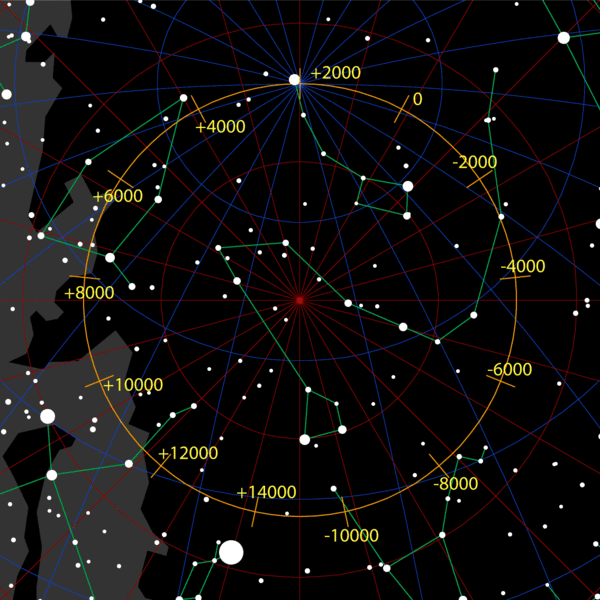
We all heard about the shifted zodiac signs? Well, you may be interested (or not) to hear that the Pole Star at the time of the Pyramids was called Kochab, a minor star in the constellation of Ursa Minor. And even longer ago, it was Vega, the primary star in Lyra.
What happens is that the Earth wobbles around its axis in a cycle of about 23,000 years. This means that the axis will veer round over that period of time to point at a different part of the sky. In other words, there will be a different North Star over the millennia, see image below.
Apart from this perhaps obscure aspect of astronomy, it has had the astrologers in a tizz in recent times. Since the signs of the Zodiac were defined, the above described phenomenon has moved the apparent star signs round by one position. And someone has also ordained that there is now a 13th star sign, Ophiuchus (the Snake Bearer), which can be found near Scorpio. The sun moves into each star sign a month later than in the distant past. Fortunately, someone else has ordained that nothing has changed, so you can stick to your original star sign in your horrorscope, and your future has not changed.
If you Google about "Zodiac shift" you'll find some articles written in atrocious English.
Another acceptable January day in the Western Isles, with some sunshine about. It's not warm and there is a bit of a breeze blowing. But dress up well, and there is little to complain about. I spent a little while in the library, looking up some information on 19th century residents of the village of Leurbost, some 8 miles south of Stornoway. There is one more look-up pending, this time for 18th century residents of Cromore, which lies 12 miles south of Stornoway by sea but 30 miles by road.
Separate from that, I am going to compile a map of places where Lewis servicemen lie buried who gave their life in WW1 and WW2. I was pointed to a similar map of casualties from Portsmouth.
Last week, my father told me about a problem in his town by email. Last night, I received a text from him, suggesting that the problem had surfaced again. His puzzled response led me to the conclusion that the problem had only occurred once, and that his text message had taken FIVE DAYS to reach me.
I have mentioned that fuel prices here in Lewis are at a ridiculous level. This has prompted at least one person of my acquaintance to relocate closer to their place of work, with the object of ditching the car. An average car would take about £60-£70 to fill up with fuel at the £1.49 / litre rates for diesel at the moment. The relocation is apparently a common occurrence at the moment. One thing that annoys me is the variation of fuel prices across the Highlands and Islands. A tanker leaves the refinery at Grangemouth, east of Edinburgh, and supplies fuel oil to the north of Scotland, places like Aberdeen, Inverness, Scrabster (on the north coast) and Stornoway. Why is it though that petrol costs less in Inverness than in Stornoway? There is no justification for this at all.
There is one positive slant - fewer cars around, and possibly people taking to their bikes or shanks' pony. Good for health, unless the pavements and roads are icy.
Quite a nice day, but not very warm. The sun set an hour ago, with some clouds over the horizon. It's been a calm and quiet day, as I process the results from my researches in the island croft histories. Tomorrow, I shall look at these books again, this time at the request of another researcher. I may also have to go out of town to check records that have not been published by an island genealogist, Bill Lawson. It is these books that I am currently using for reference, but the range, covering all of Lewis, is by no means complete.
Did I mention that fuel prices here in Stornoway are close to £1.50 a litre? That, for my American readers, equates to $9 per gallon. The fact that remote communities will not get a so-called fuel-derogation has led to an angry outburst by local MPs against the Treasury. Funnily enough, the UK government is going to introduce a minimum price for alcohol, a measure opposed by members of the Scottish Parliament in 2010. Oh well, just as well I don't drink much (alcohol), and that I don't own a car.
Without the internet? I would not be able to do what I have been able to do over the past decade, and especially over the last 7 years or so. But who am I in the grand scheme of things. No, I am writing this post with several events in mind.
Without the Internet, Julian Assange would never have been able to globally publicise the documents that were leaked to his organisation from the American government. That in itself has only led to embarrassment to the US authorities, not just because of the leak, but also over the persecution of Mr Assange. Worse is yet to come. Today, it was revealed that a former Swiss banker has leaked data on 2,000 secret Swiss bank accounts to Wikileaks. These could implicate dozens of people in high office; any pertaining to UK residents could lead to investigation by the Serious Fraud Squad and prosecution. Without the Internet, this would never have happened.
Without the Internet, the people of Tunisia would never have been empowered to rise up against their autocratic leader, forcing him to flee the country. Without the Internet, the demonstrations in Iran against alleged fraud in the reelection of its president last year, would never have made it onto the world stage. They would have been brutally suppressed, and hardly a beep leaked to the outside world. And, on the subject of Iran, without the Internet, the Stuxnet worm would not have been conceived, or been able to disrupt the workings of Iranian uranium enrichment plants.
Without the Internet, seemingly impenetrable bastions of power are now vulnerable. Swiss banks, thought to be the safest in the world, are now shown to be as strong as their weakest links: the much feared disgruntled employee. And he can be prosecuted, fined, jailed, even put to death. But the information is out there; and even disrupting the website does not help, as the establishment of dozens if not hundreds of mirror-websites will render that defence futile.
The Internet has come of age, and the second decade of the twenty-first century is opening to a whole new, brave world, which operates to new rules. The old ones are becoming defunct.
This video shows the opening credits to the 1995 BBC series "People's Century". Which person, alive in 1900, would ever have been able to envisage what the world would be like 111 years later? And who, alive today, will be able to imagine the world in 2122? We won't be there to see it.
The flurry of tropical cyclone activity in the southern oceans has come to an end - for now. TC Zelia has turned into a storm depression which will lash New Zealand over the next day or so. Nothing else appears to be forming, but the southern hemisphere season is yet young - equivalent to July in the northern season.
Here in the far north of Scotland, it has turned perceptibly colder. After 10 degrees over the weekend, the 5C this afternoon felt quite cold. The hat and gloves came in handy as I made my way into town for a stint in the library. I went through the croft histories for several townships in order to glean more information on some of the WW1 casualties, for whom I only have scant information. I have already made amendments to more than half a dozen names, and more are to follow as I continue to process the information.
Quite a nice day, but breezy and feeling cold in the wind. There were a few showers out and about earlier, but it has turned dry through the afternoon.
The weather remains the main topic, as I continue to monitor the one tropical cyclone currently left in the southern hemisphere: Zelia is racing southeast across the Pacific at a breathtaking 24 knots (nearly 30 mph), with winds near its centre of 105 mph. The storm will cease to be a TC within about 48 hours, before it reaches New Zealand. As I type, Zelia is west of New Caledonia, which will experience strong winds and heavy rains in the north.
I intend to gather some more information on some of the WW1 casualties from Lewis, by taking a look at the croft histories for parts of the islands. These show the people that lived on each croft since it was established as such - usually in the late 18th century. There are about 80-90 names that I have too little information on, and I hope to get some clarity for about half of that number.
I am typing this blogpost whilst trying not to be annoyed over the murder being committed on a Chopin piano concerto on Classic FM. The interpretation is laboured, heavy and the pianist sounds as if he has his nose pressed against the score, wondering how he is going to reach the end of that lot of peasoup that Frederic jotted down a century and a half ago. Classic FM tells me that it comes from an album entitled "Bullets and Lullabys", compiled by James Rhodes. Well, how apt.
Saturday started decidedly wild, and it's been a while since we had a gale. The ferry crew wasn't sure they were going to do all the runs today first thing, but I saw the Isle of Lewis heading out at half past two, and no further indication on the Calmac website that there was going to be further disruption. After today's high, 10C, the highest for nearly two months, we are likely to see slightly colder weather with night frosts into the new week.
Here in Scotland, we are due elections to the Scottish Parliament, and the pary-political skermishing is already starting up as the main parties are selecting their candidates. Please don't ask me to explain the system of proportional representation they have in place in Scotland. In practice, you have constituency MSPs and regional MSPs. Yes, I know, it's easier to explain that the universe is based on the square root of minus one. For the next four months we're going to be subjected to all sorts of rubbish, not just from the candidates but also from everybody else who is a party faithful and thinks they know it all.
I am slowly getting rid of another bout of cold, which crept up on me through the week. Just as well I had this new box of hankies in, they've been going at a rate of knots. Nonetheless, I have not really got any reasons for complaint, if I see what nature is throwing at Queensland and Brazil.
Here in the Western Isles, it is a day of brightness and showers (I have not seen the sun as such today), and we are on warning for a gale tonight. The overnight freight ferry, MV Muirneag, has been cancelled.
There is a bit of a wrangle going on regarding the closure of local schools. Eleven had been earmarked for closure, but the junior secondary schools in Lionel (Ness) and Shawbost have been reprieved by the Scottish Government, as have the primary schools in Carloway and Seilebost (Harris). The council is displeased, because this puts a spanner in their works of revamping education in the isles. Local parents are pleased though, as it means that children can be taught closer to home.
Again on the subject of natural disasters, there are two tropical cyclones around that people should be wary of. TC Vania is currently traversing New Caledonia, an island some 1,000 miles east of Cairns, Australia. The storm carries winds of about force 10 on the Beaufort scale. More worrying is TC Zelda, which has blown up off the eastern tip of Papua New Guinea. This system will reach hurricane force within 24 hours as it marches southeast across the Pacific. New Caledonia could (again) get a swipe from it, and New Zealand will probably see the storm when it has ceased being a cyclone - but still a nasty storm depression.
Darkness has fallen on an indifferent day, very grey and lightless. Although the days are lengthening, it is still very much mid-winter.
I am not very pleased with my on-line travelagents, whom I contacted to submit a claim for compensation after my delayed journey to Holland last month. They got back to me today, telling me to send my claim to the wrong airline. Wonderful. I can see an insurance claim coming up.
Floods seems to be the order of the day. The flood at Brisbane, Queensland, Australia, has peaked at nearly 3 feet below the predicted level. The devastation remains huge, and I anticipate the loss of life to rise further. Two or three tropical cyclones surround Australia, although none will affect the landmass of that continent directly.
A much milder day in Lewis today, and not too bad in terms of weather. The ice has nearly all gone now, and for the first time since November 26th, I am seeing green grass again. That is seven weeks... I'm nonetheless not complaining about weather, certainly not after seeing the devastation wrought in Queensland. An area of about 300,000 sq miles is inundated there, after rainfalls of 11 inches within 24 hours in places. The death toll continues to rise slowly, but once this is all over, it will be much, much higher than the dozen or so currently on the list. This video shows the incredible power of the water as it rises in a flash flood, emptying a car park of cars and not in the conventional manner.
Meanwhile, two tropical cyclones are around Australia as well. Vince is headed for the west coast of Australia, but is not expected to affect mainland WA. Vania is expected to pass near or over New Caledonia by Friday. My tropical cyclones blog is taking its usual high number of readings, with nearly 700 today. The one-day record of 2,300, taken when cyclone Gamede threatened Mauritius in 2007, is yet to be bettered.
Not had a hurricane update post for more than two months, but we're now having the first tropical cyclone of 2011. It currently goes by the prosaic title of 05P, meaning it is in the Southwestern Pacific Ocean. The system is located in the archipelago of Vanuatu, where the southern provinces are on alert. 05P will move southwest and cross the Grand Ile of New Caledonia [Nouvelle Caledonie] on Thursday (Friday local time) at nearly hurricane force. I am posting updates on my Tropical Cyclones blog.
The floods in the Australian state of Queensland are getting worse and worse. It all started before Christmas with a tropical storm near Cairns, which was followed by a protracted period of rain. This led to extensive and deep flooding, with the situation around the town of Rockhampton, 700 miles further south, being particularly dire. This now appears to have been eclipsed by flooding around the state capital, Brisbane, where 6 inches of rain fell within 75 minutes last night. Walls of water, up to 20 feet (6 m) deep have come crashing down the river valley, sweeping away everything in its path. A dozen people have died in the floods, although the casualty toll may not be known accurately until the floods subside. Queensland's state government publishes emergency updates on this link.
Elsewhere in Australia:
Over the next few days, the state of Western Australia will have to look over its shoulder, as a tropical cyclone appears to be forming 900 km to the north of Exmouth. Once it has formed, it will double back on its present westerly course and could pose a threat to the Pilbara or Kimberley coasts.
A similar hazard exists some 700 miles east of Queensland, where a tropical cyclone could form in the island state of Vanuatu. Four provinces of Vanuatu are on Yellow or Blue Alert at present.
A bright and sunny day, although the sun has now disappeared behind a veil of high cloud that is moving in from the west. Rain and sleet are on the menu tonight, and a gradual thaw is forecast for tomorrow. Today's max was +5C just after midnight; five hours later, the mercury had dipped to -3C. We're just above freezing, but that has not done much for the perilous state of the pavements. Yesterday morning, the presenter on local radio station Isles FM broke her arm whilst walking along the road to the station. I copy the story from the station's website:
Isles FM presenter Kathleen MacIver was a casualty of the winter ice yesterday morning - but she didn't let it stop her presenting live radio for two and a half hours. Kathleen slipped and fell on icy pavements on Newton Street at 5.30am, breaking a bone in her elbow and bruising her leg badly. After crawling to a kerb and getting back on her feet, she limped in to the radio station and was on air at 7.30am. "I did the show with one arm and between gritted teeth," said Kathleen, who did not tell listeners of the pain she was in. Fellow presenter Lionel Sewell took over soon after 9am and Kathleen went to Western Isles Hospital, where a broken elbow was diagnosed. Managing director David Morrison said: "That she still went in to do the breakfast show with a broken arm says a great deal about Kathleen. Not many people would have done that." She's now on bedrest and forbidden to work until she has recovered completely!
11 January 2005 is one of those days that everybody who was in the Outer Hebrides at the time will not forget. A deep Atlantic depression moved past our islands, bringing with it winds of force 12 on the Beaufort scale, with gusts in excess of 130 mph. At the time, I was staying in Kershader, 12 miles south of Stornoway as the crow flies - more like 22 miles by road. At 6.22pm, the power went off, not to go back on again for 48 hours. The wind was already howling around the building. Blue flashing lights penetrated the darkness from across Loch Erisort - police cars were stopping traffic on the Stornoway to Tarbert road after a lorry driver reported a sheep flying past his windscreen. The driver of the South Lochs bus that night was mightily relieved to make it home in one piece, he told me later. Trees were downed, roofs taken off, vehicles crushed under trees - and hundreds of them toppled in the Castle Grounds in Stornoway. High tides lapped at the doors of people on Cromwell Street and Bayhead in the town. Boats were torn off their moorings and smashed into the ferry terminal. Slates became like missiles, and pedestrians blown off their feet. Some who sought refuge were denied entry; others were taken inside.
The next morning dawned breezy and bright. Everybody heaved a sigh of relief. That was a bad one, but it's only damage. By 9.20 am however, reports start to emerge from the Southern Isles. Five people are missing in South Uist, after they fled their home the previous evening at around 7pm. Rising tides had started to approach their home, and pebbles were hurled against walls and windows. They enter two cars and drive from their home at Eochdar towards the causeway, linking South Uist and Benbecula. A fatal decision. That road parallels the stretch of sea that separates the two islands. The southeasterly storm, combined with a springtide from the northwest pushed the waters of Loch Bi up; but on account of the floodtide they could not drain into the sea. The loch flooded a small causeway, sweeping the cars into the water. By morning, the five missing people are found dead. They include a mother and father with two young children and a grandfather.
This is a repost from an entry I made on 11 January 2010.
An overcast and chilly day, although the mercury is slowly creeping up. The pavements in this town are in a hazardous state, but as the thaw progresses, this should steadily improve. Whether the weather contributed to an accident involving a school bus at Galson is not known. Nobody was injured when the vehicle went into the ditch on its way to town.
I am very pleased to hear that the harsh rhetoric in American politics is finally being called to account. Since Barack Obama came into office, two years ago this month, I have been quite frankly disturbed by the highly charged tone of political debate in the States in that time. It is a good thing that there is an open debate, and that politicians are criticised, where criticism is due. But people like Glenn Beck and the Teaparty Movement should really examine their consciences as to whether the tone of their criticism could have contributed to pushing the murderer of the six at Tucson over the edge. Jared Loughner is accountable for his own actions - if his mental state is deemed to be such that he can stand trial. I hope we will see some change in tone from here on.
Kept a quiet day today, with lots of television (not all good). The weather was reasonable, with good spells of sunshine but low temperatures. Some freezing rain this evening, but it would seem that the mercury will rise during the week. At least we'll be rid of the ice-locked pavements. I've "enjoyed" that since late November, and the fun is wearing thin.
I was horrified to hear of the shooting of US congresswoman Gabrielle Giffords, who was shot in Tucson, Arizona, yesterday. The death of six bystanders was even more shocking. Whatever the reasons for the gunman, I am pleased he was captured alive to face justice. I am aware of a strident debate within the state of Arizona, which borders Mexico, on the subject of immigration. Whether that had any bearing on this incident is not known; some people appear to think the polarisation of that debate may have contributed to it. I can obviously not comment.
A nice sunny day, after yesterday's heavy snowfall. We are due more heavy snow showers tomorrow. Perversely, I am told by my family in Holland that the mercury there has leapt up to 11C / 52F. Not so here; the thermometer at the airport has not risen above freezing all day, and is currently plunging down: -4C a quarter of an hour ago. The snow on the pavement turned to ice overnight, making the walk into town a slip-sliding affair. Pavements are not cleared of snow or ice. The wintry conditions have also caused travel disruption in the air.
The American government has demanded that the Twitter.com website hand over all details of supporters of Wikileaks. This has been endorsed by a court order, which has prompted Twitter to describe the action as harassment. I am of the opinion that this court action is not so much upholding the law of the land as upholding the illusion that the emperor wears clothes, if you catch my meaning. Whilst releasing classified documents is an offence, it seems that thus far, the only casualties of the whole operation has been one diplomat's career and the good standing (what good standing) of the US government overseas. I am quite frankly appalled.
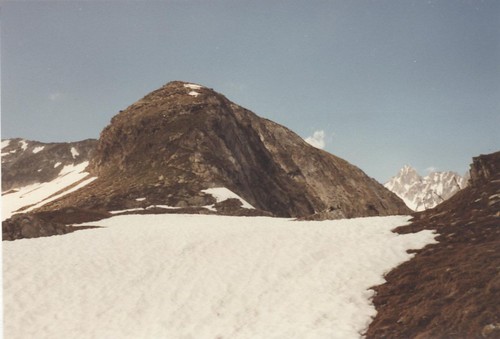
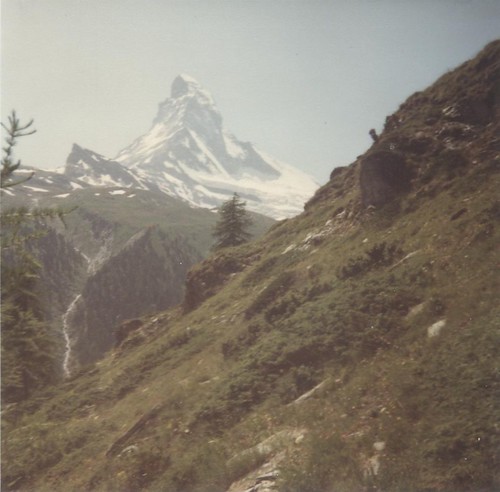
In July 1983, we went on a family holiday to Switzerland, at the resort of Blatten, marked on the below map. I am sharing a handful images from that time.
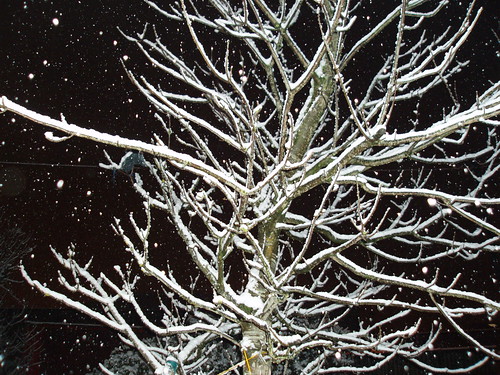
The dominating theme of today is the snow, and I'll let the imagery do the talking. Suffice to say that the airport shut late in the afternoon, and there is a nice blanket of the stuff now that darkness has fallen.
I could not help but smirk when I read that the clapper for the main bell in Cologne Cathedral had fallen down. You may recall from my 23 December post on the Shell Gallery that I was less than impressed with the reception in the Cathedral. It is of course no laughing matter that an 800 kg metal object comes crashing down from a height of about 400 feet; but its fall was fortunately broken by a metal structure further down the tower. The main bell itself weighs 24 tons. "Fat Peter" is only rung on a few occasions, and the clapper broke into pieces on January 6th (yesterday) as the bell was rung for Epiphany. Nobody was hurt in the incident. The clapper is likely to be recast. [source: NOS.nl, in Dutch].
Epiphany today; some Orthodox Christian churches celebrate Christmas today. Pope Gregory put the calendar forward by 12 days in 1582, but Orthodox churches did not adopt this change.
It was a wintry day today, with frequent snow showers sweeping over Stornoway. The ferry is sailing normally, after being repaired following a breakdown on Hogmanay. The Muirneag, which carries our freight, is not going out tonight due to adverse weather conditions.
During my absence in Holland, I received a large amount of information on a former president of the London Gaelic Society, who originated from the Isle of Lewis. Roderick Mcleod was involved with the LGS for decades, between 1882 and 1930. I shall summarise his information on my local history blog Pentland Road.
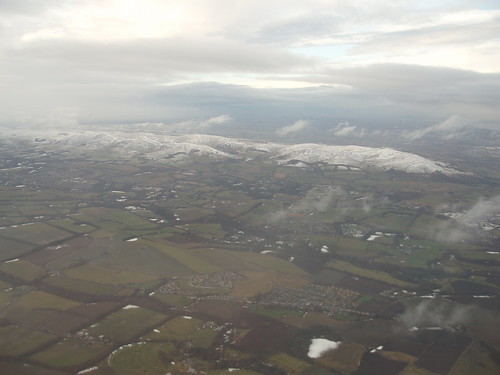
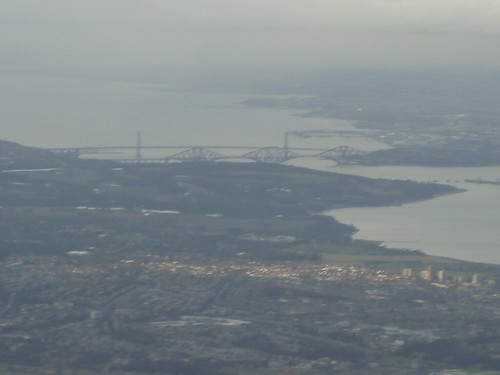
The journey back to Stornoway went without a hitch, unlike the outward trip. The taxi came as booked around 5.45 am and took us to the railway station in Arnhem, 4 miles away. The direct train to Schiphol Airport departed at 6.16 am, and filled up with commuters for the cities of Utrecht and Amsterdam along the way. Arrived at the airport at 7.30 am, and breezed through check-in to gate D21. Plane was a tad late, but everybody got on fine and we left for London Gatwick at around 9.30. After a flight above clouds, the weather at Gatwick was clear and fine; big banks of snow a vestige of the all the snow bother from before Christmas. I am a bit annoyed that I had to go through the security rigmarole again; I could just as easily have gone through a side-door if I had known which gate. But I did not, so I kicked my heels in the departure lounge between 9.45 and 11.45. Bought an Independent and did all the Sudoku puzzles. Flight 8922 to Edinburgh was pretty full, but it got us there nicely on time at 1.45. Had some lunch at Edinburgh, but the Christmas jingles drove me up the wall. It's January 5th, for goodness' sake. I asked the Flybe desk to reprint my boarding pass (which was not possible before I left Holland), then spent two and a half hours watching planes come and go. Darkness fell after 4 o'clock, and my flight was finally called at 5 pm. Once they managed to lock the hold door, we took off for Stornoway at 5.30. Could still see some daylight on the southwestern horizon, but that soon faded. Showers greeted us across the Minch, and we landed at Stornoway at 6.30. A taxi took me back to town for the usual £6.
Wishing all my readers a happy Hogmanay, and a healthy and prosperous 2011.
At the moment, my local history blog Pentland Road is paralleling the Iolaire Disaster of 1919, so keep checking there until 9.10 am (GMT) tomorrow morning.
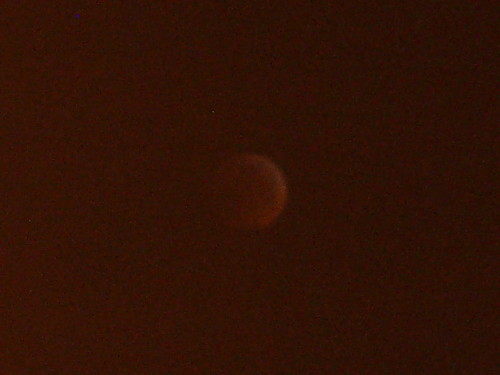
I had promised to post a picture of the lunar eclipse, which occurred on Tuesday 21 December (last week, in other words). Well, this was the sight around 8 am that morning.
As I've said before, I'll resume posting on here on Thursday 6 January 2011.
It is early evening when PanAm flight 103 takes off from London's Heathrow airport, bound for New York. Not an hour into the journey, a homemade bomb, built around a radio-cassette recorder, explodes in the hold of the aircraft. This blows a hole in the fuselage, and the shockwave of the explosion disrupts the integrity of the aircraft. At 37,000 feet up, the Boeing 747 disintegrates, and the wreckage rains down on the small town of Lockerbie. The cockpit lands in a field near the A74 (Carlisle to Glasgow) road, but a large segment of the aircraft crashes into a small housing estate on the outskirts of Lockerbie. Houses are destroyed or set on fire. All passengers and crew on flight 103 are killed, although some were thought to have been alive as fell to the ground. Eleven townspeople were killed as well. Later, the evening became increasingly unreal, as newscrews descended on Lockerbie, reporting events - with the townspeople watching the 9 o'clock news on television to learn what had happened to their small town.
It was later determined that a bomb had been placed on the aircraft by Libyan security agents, acting on behalf of Col Ghadaffi. More than a decade later, Libya yielded two security agents for trial under Scots law, but only agreed to do so if they were tried not on British soil. So, an impromptu court was set up at Camp Zeist in Holland. Abdelbaset Ali Al-Megrahi was convicted of the crime and sentenced to life in jail. He was released in August 2009 on humanitarian grounds as he was terminally ill and only had 3 months to live. Well, it's 16 months later and he's still alive. Not everybody was happy with that decision, as he had treated his victims with inhumanity.
This entry is dedicated to the memory of the 270 victims of Lockerbie.
The BBC has a separate webpage "On this day"
Another post from me on Atlantic Lines, for the simple reason that my travel plans fell apart this morning. The plane to Glasgow I was to have taken at 8.30 am was cancelled, along with all other flights before midday. The reason was black ice on the runway. The later departure at 2.30pm would have left me with insufficient time to make my connection at Edinburgh. The two cities are only 45 miles apart, but transferring between the two airports requires two 30 minutes bus journeys, a 45 minute rail trip, and that with a decreased frequency of trains. Leaving to one side the joys of travelling on the M8 in Glasgow and the A8 in Edinburgh, and the weather conditions. So I returned to Stornoway, awaiting tomorrow morning's plane. If things go to pot again, I'm quite prepared to cancel the trip.
The one benefit of this morning's excursion was the lunar eclipse, pics of which I will post separately. Otherwise, the overnight frost combined with a fall of rain had turned roads and pavements into ice rinks.
Another quiet day, and as I type this, the sun is sinking towards the southwestern horizon, due to set at 3.34pm. It'll be the shortest day of the year tomorrow, and it'll start in a spectacular fashion: with a lunar eclipse just before sunrise in the UK. The lunar eclipse starts in earnest just after 6 am (UK time), with totality just after 8 am and ending at around 10 am. This means that the moon sets during the eclipse. Here in Stornoway, the moon will set just after 9 am, leaving me with a pretty good display.
There will be a partial solar eclipse at sunrise on 4 January 2011, visible from Europe.
I'll be admiring tomorrow's lunar eclipse from Stornoway Airport, as I'm flying across to Amsterdam. I'm so glad I've changed my booking, as British Airways appears to be in meltdown. Its website is going round in square circles and doesn't do what it's supposed to do. I am positively horrified at the scenes at Heathrow, where people are resigned to sit on the floor until Thursday.
Unless something else crops up, this will be my last posting for 2010 on Atlantic Lines. I expect to resume entries from Stornoway on Thursday 6 January 2011. During my stay in Holland I'll be blogging on the Shell Gallery; updates on my journey tomorrow will be made on Facebook and Twitter.
The disruption on the travel front is showing no signs of abating. Again hardly any flights leaving the main London airports, with thousands of people unable to go on their Christmas breaks. Personally, I am booked to travel to Holland on Tuesday, through Heathrow and Gatwick. That's proving to be a mistake. The situation is so dire, that I have rebooked my outward journey to go straight from Edinburgh to Amsterdam. I count myself lucky that there was still a seat, and I don't mind having to wait for a number of hours. The alternatives were growing thinner and thinner on the ground, with Eurostar no longer accepting new bookings before Christmas and the English rail network subject to delays and cancellations. I am planning to return to Stornoway on Wednesday 5 January 2011.
Complete and utter mayhem, that's what the traffic situation in England can safely be described as today. Up to 10 inches (25 cm) of snow have fallen in various parts of the country, and the major airports around London have ground to a halt. Here in Stornoway, we awoke to a good snow shower, but as day broke, it cleared to a nice sunny day - but a cold one. A lot of events have been called off, and people are advised against all non essential travel. Although the boat with roadsalt did dock, we're still a tad short on the stuff.
No, I'm not going to watch Strictly Come Dancing (which I dub: Strictly Come V*m*t*ng) or the X-factor (better described as X-rated, due to the awfulness of it all). I'm sorry if there is anyone out there that genuinely likes it, that's fine. I just go off this sort of programs to which entire newsitems are devoted on BBC etcetera. Who is Simon Cowell when he's at home? A loudmouth? Who is Bruce Forsyth? Thought he'd been put out to pasture long ago. Mind you, I wish they'd put Terry Wogan out to pasture long before now, he's been known to go on stage drunk or farting.
I am closing with images of two of the family cats, who have long since departed over the Rainbow Bridge. Have a look at the posting on Call for Support, and you'll see what prompted me.