View across the Outer Harbour of Stornoway

Wednesday, 9 June 2010

Wednesday 9 June

A nice bright morning, with a stiff northeasterly breeze going. Although a max of 17C is forecast, I think we'll be hard pressed to reach that.

I'll have another post later today, but just wanted to share this slightly disconcerting image which was circulated on Twitter this morning.

Tuesday, 8 June 2010

Monday 8 June

Today started bright and early, with some excitement to boot in the morning. Someone decided to light a bonfire just outside Stornoway, and the thick smoke billowed into town on the easterly breeze. It was visible from Swordale, 4 miles to the east. If the wind had been in the west, I doubt that the airport would have been very happy about it.

I managed to complete the initial transcription of the 700-odd Canadian servicemen whose roots lie in the Isle of Lewis. The majority volunteered, and mostly before 1917. In 1917, following various bloody battles, military draft (National Service) was introduced, under which 27 Lewismen were called up. Two defaulted (did not turn up) and were dragged in by the military police. I came across one gent, not from Lewis, who had defaulted - because he was a trapper and probably never got his papers in the first place. He died in hospital before any details could be taken.

Tomorrow, I intend to go through the blogs for the first time in many weeks. My Google Reader is shamefully full, although I have kept up with those of you who merit special attention.

As I close this post, the sky is coloured a nice pink colour - sunset at 10.20pm tonight. We had the best weather in the country, with downpours in Balallan (15 miles away) and heavy rain in the Highlands.

Monday, 7 June 2010

The Vatican

No offence intended
The Roman Catholic Church has taken a battering in recent months, particularly after priests in the Irish Republic were found to have been involved in child sexual abuse over many years. And not just in Ireland either. So it will not come as a major surprise that the authority of the Church has suffered a decline.

However, rather than indulging in a spot of introspection and recognising that there is some truth in the phrase "mea culpa", the Vatican has decided that investigators need to be sent to Ireland to reassert its authority and reestablish the standing of the Church in everyday life. Liberalism is to be stamped out at every cost. See this article in the Irish Times.

In 1984, I was invited to a lecture by some followers of the strict Jesuite order Opus Dei, with the object of converting me to Roman Catholicism. It managed to convince me that Roman Catholicism is not for me. I cannot accept that the Pope is infallible, for a start. He is a man, very much like every other of the 3 billion males of the species. As are each and everyone of his priests, as shown with the child sex abuse scandals - I condemn the sexual abuse of children in the strongest possible terms by the way. I feel that Pope Benedict XVI has made a serious error of judgment in slapping down on "liberals", rather than acknowledging that the Church made mistakes and working towards change.

Not being prepared to embrace change places the Vatican in the same league as the dinosaurs. Heading headlong for extinction.

Monday 7 June

A brilliantly sunny day, with a cool northeasterly breeze. The mercury topped at 15C, but the sun kept it nice and warm. Apart from sitting in the sun, I also made good progress with my transcription of Canadian servicemen who originated from the Isle of Lewis. Their total has now crept above 700. I have about 40 left to do, and hope to complete the listing by the middle of the week.

During last Wednesday's deadly shootings in Cumbria, police officers saw the man actually shooting people, but were powerless to act. Specialist fire arms constables were immediately summoned, but at no time did the unarmed officers have opportunity to stop Derrick Bird. 
> For the benefit of my American readers, British police are NOT routinely armed.

A train was derailed in the West Highlands last night, when the 6.20pm from Glasgow Queen Street to Oban hit boulders on the track near Falls of Cruachan station. The rocks are presumed to have come down in a landslip, but caused the train to leave the tracks. A fire broke out in the front carriage, but nobody was safely hurt. The driver led his passengers to safety as soon as the train had come to a halt, perched precariously 50 feet above the A85 road below. Picture courtesy BBC.

Picture post - 6 June

As promised, a few pictures of Sunday's foray to Uig.


The boundary between cloud and sun


The B8011(M) - Enaclete by-pass


Lonely house at Carishader


Carishader


Kneep Beach campsite


Traigh Theinig (off Kneep Beach)


Valtos Beach from a hill above Kneep Beach


Church at Miavaig


Stonecircle at Garynahine

Sunday, 6 June 2010

Sunday 6 June

It is 66 years ago today that Allied forces landed on beaches in Normandy, France, heralding the beginning of the end of years of occupation by Nazi forces of large swathes of western Europe. The rapid advance through France, Belgium and southern Holland following D-day was only checked after the failed attempt to capture bridges at Arnhem, Holland, three months later. The Second World War closed in Europe in May 1945, but not after millions of people had been murdered on an industrial scale - because their religion courted displeasure with the German dictator, Adolf Hitler.

I went on a trip to Uig, western Lewis, this afternoon. It took 15 miles to emerge from under the blanket of cloud and showers that cloaked the eastern side of the island. We had a pleasant lunch at a stonecircle not far from Callanish, then proceeded to a beach in Uig. Beautiful area, particularly on a day like today. I have not yet finished uploading my 119 pictures, but will share a number of them in an entry tomorrow.

Saturday, 5 June 2010

Saturday 5 June

A very nice bright day, although not fully sunny. A bit of cloud about, a spot or two of rain as we went up the road through the village of Barvas. Temperature around 14C, with a high of 16C in late morning.

After lunch, it was up the road to Ness (North Lewis) to start with. A distance of 25 miles, which is commonly covered in an hour. The object of the trip, lunch at the Eoropie Tearoom, was thwarted as the Tearoom was closed whilst the owners find a buyer.


We duly diverted to Port of Ness, where a cup of tea and a couple of biscuits awaited. First though, we went to the Butt of Lewis, just over a mile from Eoropie (pronounce Yo-ropee).


Port of Ness


A drive of about 37 miles then took us to the Callanish Stones and attendant wildlife.


after which the Pentland Road was our route back to Stornoway. Some strange objects along there.


Friday, 4 June 2010

Friday 4 June

As my previous postings from today have indicated, I have now completed the transcription of the evidence from the 1883 Napier Commission Inquiry from the island of North Uist. In case you are wondering what it is all about, a brief summary.

In the 1880s, living conditions for crofters (subsistence farmer, who leases land from an estate owner) were atrocious. They could not expect to stay on their land for any length of time, had handkerchief-sized patches of land to raise crops on, and their livestock was usually starving to death as a result. A lack of milk meant they gave their children tea to drink. A riotous uprising in the Isle of Skye, 50 miles south of Lewis, opened the eyes of the government to the plight of its poorest residents, and Lord Napier of Ettrick was sent up to investigate.

Today saw a few light showers in Stornoway, but it is still reasonably warm. Tomorrow will see a trip out into the countryside in a car (not driven by me, I should hasten to add), and hope to have a picture or two to show.

Quote from the Napier Commission

This summarises what the Clearances were all about – for those who were on the receiving end of them. I quote the Reverend Alexander Davidson, aged 70, at Leverburgh in Harris.

It is most unnatural that man should be chased away to make room for sheep and deer ; that the land should lie uncultivated when men are perishing for lack of food. It is very unnatural that old or young should not be allowed to cast a hook into a standing lake or stream to catch a trout without being pursued by an officer of the law.

Attitudes to Gaelic - 1883

The estate factor in North Uist gave a good insight into why the Gaelic language continued on its long, slow decline in the latter years of the 19th century. I quote the relevant parts of his submission to the Napier Commission, sitting at Loch Eport on 30 May 1883.

12793. There was a statement made by some of the people here with respect to teaching the children Gaelic. Has the school board any educational views on that question? Other things being equal, would they consider that an advantage in the education of the children?
—I do not think they would.

12794. The great object is to endeavour to get as much English as possible ?
—As much English as possible.

12795. And the belief of the board is that anything done in the way of teaching the children Gaelic rather stands in the way of teaching English ?
—Well, if the teacher had plenty of time it would not do the children any harm to be taught their native language.

* and *

12854. You said something which I consider very heterodox about Gaelic. You speak Gaelic yourself?
—Yes.

12855. And have done so all your life?
—Yes.

12856. You read it?
—Yes.

12857. And write it ?
—I cannot say I can write it well

12858. You would not wish that you never had Gaelic?
—No, I would not.

12859. Then why is it that you discourage the teaching of it in schools, and therefore prevent Gaelic scholars from having that proper knowledge of the language which could be so easily given ?
—Without an additional staff of teachers, it could not be done. It would take up too much of their time.

12860. It is only a question of expense ?
—It is only a question of expense.

12861. You would not go to the length of saying that Gaelic is of no importance in the Highlands ?
—I believe the importance is getting less every day.

Boreray

Boreray is a small island in the Sound of Harris (between Harris and North Uist), which was home to 150 people in the 1880s, as testified in this submission to the Napier Commission. Nowadays, only one person lives there – as a crofter. The complaint in 1883 was overcrowding. The below map shows how small the island is.

Thursday, 3 June 2010

Thursday 3 June

A beautiful summer's day, with a veil of high cloud slowly moving up from the south. I'm expecting rain some time through tomorrow. Spent most of the day out in the garden, assisting in various improvements.

An emergency was declared at Stornoway Airport just after 3pm, after a small plane left the runway. I could hear the sirens blaring away down Sandwick Road. Nobody was hurt, and the plane did not catch fire.

The police are continuing their investigations into the gunman who killed 12 people in western Cumbria yesterday, before turning the gun on himself. ITV television is not showing an episode of a popular soap, as it features a storyline involving gunfire. I cannot be bothered to relay the various scenarios being debated, I just want to express my sympathies to the families and friends of the dead and injured. I have never visited that area of the country myself, but my parents have in the early 1990s, at the start of the Coast to Coast walk.

Wednesday, 2 June 2010

North Uist, 1883

My transcription of the Napier Commission, which I have been doing over the past week or so, is slowly progressing and we are presently in North Uist. Once more the issue appears to be the size (or lack of it) of the land that each crofter holds. Malcolm Mcinnes, a crofter from the township of Tigharry, summarises it in his reply to question 12298.

12298. Then what I understand is that though you are not dissatisfied with your present holdings, you wish to have such large holdings as would enable you to live as farmers on a farm, and not be dependent upon labour
to maintain your families?
—That is it exactly—the very thing we want—that we could make a living out of our crofts by our own labour. We don't want to be gentlemen.

Gentlemen, in his perspective (I remind you of the date, 1883), were people who made a living out of other people's labours. It appears to have been a matter of pride to Malcolm that he be able to make a living by his own hard graft. 

Hurricane update - 2 June

Tropical cyclone Phet (pronounce: pet, Thai for diamond) is currently strenghtening very rapidly in the Arabian Sea, west of India. The storm is currently equivalent in strength to a category IV hurricane, and will reach a maximum strength of category V, with winds of 140 knots or 160 mph by tomorrow. In the early hours of Friday, Phet will make landfall in Oman at that intensity and track overland to reemerge over the Arabian Sea on a northeasterly bearing and a lot weaker.

This is the second cat V storm in the Arabian Sea in three years; Gonu devastated Oman in 2007. The waters of the sea are very warm, not surprising if you know that Pakistan is suffering an extreme heatwave, with temperatures reported at 53.6C (128F) in the south. The monsoon will move in during July, but it is common for extremely high temperatures to occur ahead of its coming.

My tropical cyclones blog, which copies advisories from various hurricane agencies around the world, has suddenly become very popular, with nearly 1,400 hits in the past 16 hours. The Indian TC agency's website is inaccessible, and people in the area are very concerned.

The first tropical cyclone in the Eastern Pacific has exacted a fearful toll in human life, with more than 100 people reported killed in Guatemala, El Salvador and southern Mexico. Tropical storm Agatha unleashed 30 inches of rain on the mountainous terrain there, causing flashfloods and mudslides.

Wednesday 2 June

The news in the UK is dominated today by a shooting spree, conducted by a taxi-driver in the west of Cumbria, northwestern England. The man has taken his own life, after shooting at people in 11 different location in Whitehaven, Egremont and Seascale. Five people are presently known to have died. A police operation is still on-going to establish what happened and make sure that not more casualties are found along the route taken by the man on his way. He shot himself in woods at Boot in Eskdale, southeast of Whitehaven. People had been ordered to stay indoors and out of sight, but have now been allowed to resume normal daily activities.

Here in Stornoway, the weather is windy and with a fine drizzle blowing along. A controversy is on-going at the moment with regards to the provision of public conveniences. Due to the refurbishment works on Perceval Square, at the very centre of the town, the public toilets there have been closed. The intention is not to reopen the loos and refer the needy to the library (where they can read for a pee) and the bus station, which is not open all hours. Councillors are now beginning to veer towards reopening the public toilets, providing someone is prepared to spend 30,000,000 pennies. And that's a lot of wee-wees.

Tuesday, 1 June 2010

Tuesday 1 June

The day started wet, but the rain soon moved away. We had a brief spell of sunshine in the second half of the afternoon, but it did not last. It should be better tomorrow.

I have continued the transcription of a 19th century document, which details the conditions in which crofters and cottars were living in the Western Isles. Lord Napier spent the summer of 1883 going all over northern and western Scotland, mainland and islands, hearing the grievances of the people - about forced evictions, lack of land, no security of tenure - and the platitudes being bandied about by the landlords and their agents. Today's entries focus on the island of Benbecula.

I was horrified to hear yesterday about the attack by Israeli forces on a convoy of ships, which were bringing aid to the Gaza strip. It appears a botched affair, which is backfiring on the Israeli government. It has also brought home to many Israelis that their perception of their own nation is sharply different from the perception of Israel in the outside world. The hostility from the Arab nations is well known, but the way the Gaza strip has been blockaded has not earned them any brownie points in the "western" world either.

The Israeli government, headed up by Benjamin Netanyahu, has justified the blockade saying it is there to prevent armaments reaching the militant Hamas faction, whose stated aim is to destroy the state of Israel. However, the blockade has been so "successful", that it has choked off humanitarian supplies to ordinary residents in Gaza. It would appear likely that the Israeli blockade of Gaza will be relaxed in days and weeks to come.

I am casting my mind back four months, to 27 January, when Mr Netanyahu delivered a speech at the 65th anniversary of the liberation of the Auschwitz deathcamp in Poland. It was a speech characterised by strident zionism - the God given right of the people of present-day Israel to hold the land they do, and defend themselves by any measure, and under any pretext whatsoever.

I recognise that Israel is under threat from militant Palestinian groups, and other "terrorist" organisations, some sponsored by other states, seeking its destruction. But the world of 2010 is different from the world of the late 20th century. Israel will gain more support through being seen to work towards a diplomatic solution of the Middle East problems, rather than bombing their way towards such a resolution.

Monday, 31 May 2010

Monday 31 May

Another beautifully sunny day, which saw the mercury at a very pleasant 18C / 64F this afternoon. Went on a stroll round the Castle Grounds earlier on, about 5 miles once more, which took me an hour and a half. The shore path between the Bridge Centre and the Woodlands Centre was closed due to repairs to the seawall, which means you have to divert to Lews Castle - up the hill. As a result, my planned walk round the Creed went counter-clockwise - first to the Iron Fountain, then down the Creed and back along the shorepath. Quite a few other folk out and about who had had the same idea.

Sunday, 30 May 2010

Afternoon stroll

Did a 5 mile walk this afternoon, through the villages of Sandwick and Steinish, and taking in parts of Stornoway. The weather was fabulous, even if the mercury did not exceed 13C.

I am quite familiar with the 15 minute walk to Sandwick, having often trodden that path on my way to the cemetery there. Only on one occasion did my plans founder - on a sheet of ice. Not so today.


Lower Sandwick

Walked up the street in Lower Sandwick, crossed the main road and continued up North Street.


This picture shows the view down North Street towards Lower Sandwick and the outer reaches of Stornoway harbour.

At the top of North Street, Constable Road turns right and winds its way through the Carse of Melbost towards Steinish. I heard a cuckoo calling, and promptly saw the bird fly off towards Plasterfield. Along the road here, you have a nice view of the airport, and one plane took off and one landed whilst I walked north.


Steinish is a one-horse town with perhaps a dozen or little more houses. Pleasant enough place, very quiet on a Sunday afternoon. It borders the Cockle Ebb, the tidal estuary to the River Laxdale.


And yes, that's my feet again. You have to wade across some shallow waters in order to gain the Cockle Ebb.You leave the estuary at Sand Street, where I heard (but not saw) a corncrake.


And finally, a twenty-minute walk through the town, north to south, leading past two remarkable gates. One to the football pitch, the other leading to the site of the old hospital.

Jane / A journey of another kind


J-land has lost another of its number, to cancer. Jane Thompson, who kept the journal "A journey of another kind", passed away this afternoon after a long battle against renal cell carcinoma.

On her blog, she described the slow deterioration in her condition, in spite of new drugs, new treatments and the valiant efforts of various parts of the NHS. She campaigned for the admission of expensive medications for use within the NHS. After a holiday in Brazil last year, Jane's condition took a sharp turn for the worse, which ended with the final result today.

Sunday 30 May

Sunny and breezy today, a welcome change from the mist and rain of recent days. Last night was the Eurovision Song Contest, which has been going for more than 50 years. The UK entry came last, and the Dutch entry never made it to the final. The voting went as per usual, less on merit, more on neighbourliness. I'll have more later today, but will close this post with a breathtaking quote from the Napier Commission Report on South Uist.

Due to sheer poverty, the people of that island were reduced to feeding their children tea, rather than milk in the 1880s. A translator, acting for the Gaelic speaking witnesses at the inquiry, had this to say on the subject.

11529. Do you find that the children are properly clothed generally 1
—Well, upon the whole they are. You meet with exceptions, but upon the whole, they are fairly well clad. Of course there are cases where clothing is pretty scanty.

11530. You don't think they are so badly clothed that it has any generally injurious effect upon their growth or health ?
—I don't think so. It is insufficient feeding that has to do with their health, as I find, especially tea-drinking.

11531. A man to-day spoke about giving tea to the children. Is it common ?
—Quite prevalent.

11532. I suppose you don't consider that good for children ?
—I think it most injurious.

11533. In the absence of milk, what would you recommend them to drink?
—Beer, if they had cheap beer; certainly anything but tea. I think it is doing a great deal of harm to the people, especially to the rising generation.

11534. [...] At what age would you begin to give beer to the children ?
—At a year or two or three years of age. I think if there was cheap beer made it would be much healthier than living upon tea.

Saturday, 29 May 2010

Land of the firey mountain and the flood

And that is a description that will fit Guatemala, in Central America. It is currently affected by two natural disasters at the same time. The volcano Pacaya, 20 miles from the country's capital Guatemala City, is erupting, sending thousands in flight. The city is covered in 3 inches of ash, and several people have died.

As if that isn't enough, tropical storm Agatha has brewed up some 170 miles south of the country in the Pacific. Agatha is too close to land to form any threat in terms of high wind, but it constitutes a major hazard in terms of rainfall. The projected rainfall total for the next few days is quoted as 10 to 20 inches (250 to 500 mm), with isolated totals of 30 inches (750 mm). The National Hurricane Center in Miami, which covers the Eastern Pacific region, is warning against life-threatening flash-floods and mudslides.

Late light

It is the same every year: when the nights grow short, or cease to be proper nights, I am out with my camera at all hours, showing the amount of light there still is at (e.g.) 1 am. These are both extended exposure (4s) pictures.


Moon behind clouds, 12.50 am


Looking northwest, 12.50 am

Stornoway Half Marathon 2010 - picture post


Saturday 29 May

An early post after a week of late ones. It is the Saturday of the Half Marathon here in Stornoway. As a result, it is raining and windy. There are two runs: the Half Marathon, 13 miles round Stornoway and environs, and a 10k (6 miles) fun run for the younger ones. The fastest runners did the 2 miles to near my position in 8 minutes. I'll post more about this as soon as I have my pictures and further info sorted.

Friday, 28 May 2010

Hurricane update - 28 May

The southern hemisphere is in the spotlight, 4 weeks after their tropical cyclone season closed. Subtropical cyclone Joel is currently located to the southwest of Madagascar and slowly moving south whilst weakening. Winds are at 35 to 40 knots (that's equivalent to a force 9 gale). Only the regional monitoring centre on nearby La Reunion is acknowledging Joel, but even that does not expect the storm to live much beyond tomorrow afternoon.

Here's to the 2009/2010 southern hemisphere season, finally signing off.

Don't forget: the Atlantic hurricane season commences next Tuesday, 1 June. They are forecasting a (hyper)active season, yeah sure. Seeing is believing - they were expecting something similar last year, but it all came to nothing thanks to El Nino and a shedload of dust from the Sahara desert. However, El Nino is gone, so keep abreast through the National Hurricane Center if you live in Hurricane Alley.

Clearances: South Uist

These quotes from the Napier Commission's report from South Uist, describe the clearances there. It starts with an excerpt from a statement of complaint from the township of Kilpheder in the far south of South Uist. The Commission then proceeds to quiz John Mackay from question 11143 onwards on the actual events. John is 75 years old at the time of the Commission's visit in May 1883.

[People were] compelled to emigrate to America; some of whom had been tied before our eyes, others hiding themselves in caves and crevices for fear of being caught by authorised officers.

11143. Will you relate what you heard and saw?
—I saw a policeman chasing a man down the macher towards Askernish, with a view to catch him, in order to send him on board an emigrant ship lying in Loch Boisdale. I saw a man who lay down on his face and nose on a little island, hiding himself from the policeman, and the policeman getting a dog to search for this missing man in order to get him on board the emigrant ship.

11144. What was the name of the man ?
—Lachlan Macdonald.

11145. What was the name of the previous person you referred to?
—Donald Smith.

11146. Did the dog find this unfortunate youth
—The dog did not discover him, but the man was afterwards discovered all the same. He had got into the trench of a lazy bed.

11147. What was done with him ?
—He was taken off.

11148. And really sent off like an animal that was going to the southern markets ?
—Just the same way.

11149. Did you hear that the same thing was done to others, although you did not see it ?
—A man named Angus Johnston, whose wife gave birth to three children, and another child was dead before, he was seized and tied upon the pier of Loch Boisdalc ; and it was by means of giving him a kick that he was put into the boat and knocked down. The old priest interfered, and said, ' What arc you doing to this man ? Let him alone. It is against the law.' The four children were dead in the house when he was caught and tied, and knocked down by a kick, and put on board.

11156. Were they in the habit of sending away husbands without their wives? —No. I never heard any instance of that kind, unless a man voluntarily left his wife when they would disagree.

11157. But you understand that one man was put on board a vessel by force with four dead children in the house, where was the wife at that time ?
—She followed him on board.

11158. The dead children would be buried before that ?
—The four dead bodies were buried before the mother went on board.

Friday 28 May

A day without much sunshine, but plenty of rain and showers. It is very busy in Stornoway nonetheless, as tomorrow is the day of the half-marathon, an annual event on the last Saturday in May. Apart from the 13 miles of the Half Marathon, there is also a 10 km (6.2 miles) funrun for the younger ones. By about 10.20 tomorrow morning, I expect the first runners to come past.

In my historical researches, I have found the attestation of a Canadian man who was discharged from the service a week after being drafted in on the grounds of being undesirable. I wonder what this poor chap had done. But we shall never fully know what the reasons for that were.

Thursday, 27 May 2010

Poverty

If you want to read a description of what poverty was like in the Isle of Barra in 1883, read this account by Allan McIntyre, aged nearly 60 at the time. Contrast that with the condescending attitude of one of the major farmers in the island, Dr McGillivray of Eoligarry comes out with this beauty of a statement in his interrogation by the Commission, only a few minutes before McIntyre's questioning.
10803. [...] Do you think there is more disinclination to emigrate now than there was at that time?
—Well, I think that if the people saw they were to be assisted they would go. The general impression now is that the population is getting thronged again.

10804. How is it getting thronged ?
—In the way I have mentioned, by their intermarrying, and not leaving the country.
It was perceived by some of the ruling classes that the sovereign remedy against overcrowding and poverty in their landed property was to get the people to emigrate. As the Commission correctly highlights elsewhere in Dr McGillivray's quizzing, many of the emigrants arrived in Canada in a state of destitution.

Don't forget to collect your jaw from the floor before you leave this blogpost. 

Thursday 27 May

Fairly bright day, but with occasional downpours - which include hail. That is not uncommon in Lewis at this time of year, and no surprise given the low temperatures (10C / 50F) at the moment. The rainfall radar shows a rash over mainland Scotland, so we're not doing too badly. Temperatures are set to rise into next week.

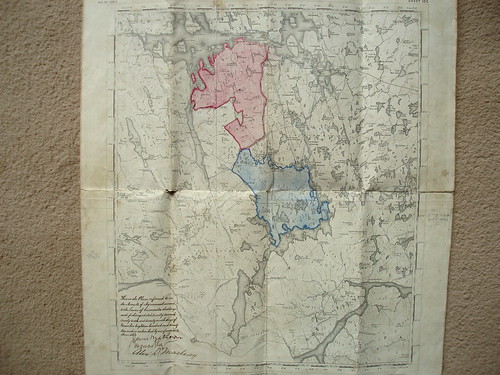
A few years ago, I came across a map of central Lewis, showing the division of an uninhabited area for the purposes of shooting and fishing in 1874. Shown on the periphery is the village of Callanish. As I continue my transcription of the 1883 Napier Report, this again demonstrates the gulf that existed between the ordinary islanders and the wealthy landowners. The former were scraping a living off some poor land, whilst the latter diverted themselves with the bullet and the rod.


Wednesday, 26 May 2010

Views of a dead industry

In the late 19th and early 20th century, the herring industry was a cornerstone of the island economy, here in Lewis. The same applied up and down the coasts of the United Kingdom as a whole. In my transcription of the findings of the Napier Commission, I came across the testimony of a fish-curer from Burghead, on the east coast of Scotland. Thomas Jenkins had been plying his trade at Castlebay, Barra, for 13 years when he was quizzed by Lord Napier and his commission. It makes faintly sad reading to see the earnest and detailed outlining of the problems afflicting the herring trade in 1883 - and knowing that within a hundred years, there would be hardly any herring left. The only tangible memory of the herring trade in the Western Isles is in the statues of the herring girls along the harbour front in Stornoway, as shown on the left.

In the early years of the 20th century, young women would flock to the fishing ports of the UK to gut herring at a rate of 60 a minute, packing them into barrels, with copious amounts of salt. The barrels would go as far afield as Russia, where they were considered a delicacy by the ruling classes. Like the herringtrade, the ruling classes in Russia would be swept away within fifty years.

Wednesday 26 May

It started so nice this morning, blue skies and all that. But showers bubbled up pretty quickly, and some nice cumulonimbus clouds marched up and down the horizon. One brought hailstones to the north of Lewis, and another drenched the town - fortunately, just as I was in the library.

On June 12th, it will be 70 years ago since the 51st Highland Division, part of the British Expeditionary Force, was captured at St Valery-en-Caux in northern France. Many were taken prisoner of war for the duration of WW2, a few managed to escape. I was in the library to dig out the names from the WW2 rolls of honour, which took me an hour and a half.

Tuesday 25 May

Been very busy today, in spite of the nice-ish weather we had, with the research projects - Canadian soldiers from Lewis and the Napier Commission report. On the latter subject, I am currently going through the report for Barra, which shows outright theft, wilful neglect and capricious evictions "because the policeman wants the land" being the order of the day in the 1880s.

A cruiseliner, the Braemar, came to call today and discharged its passengers ashore using tenders. By evening, it set sail in the direction of Kirkwall, 150 miles to the northeast, for a visit to Orkney. Apparently, the town centre here was heaving with the folks off the liner. This first month of the cruiseliner season is proving to be a very busy one.