View across the Outer Harbour of Stornoway

Thursday, 15 April 2010

Not remembered - 3

You may remember from a few weeks ago that I am working to get a casualty of the First World War on the Commonwealth Wargraves Commission register. Things have progressed, and the last piece of the jigsaw is about to fall into place. In the next day or so, I shall receive confirmation that Norman Morrison, formerly of 10A South Dell, was buried at the Swainbost Cemetery on 16 March 1917. He died 9 months after contracting turberculosis.

Once I have confirmation, a case will be submitted to the CWGC to have Norman entered onto their records. A CWGC wargrave stone will then be erected at the cemetery.

In connection with this, it has come to my attention that reservists who died after being discharged from war service do not qualify for CWGC status. Not fair, is it?


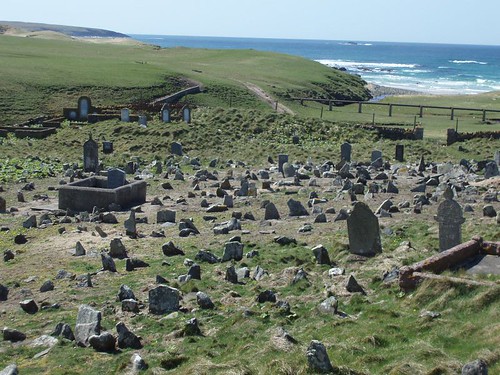
This is the Swainbost Cemetery, where 9,000 people have been buried since the 16th century.Norman Morrison's grave is somewhere in here - each stone represents a grave.

Thursday 15 April

When I have finished writing this post, all flights within UK airspace will have been suspended due to a cloud of ash in the upper atmosphere. The ash is being pumped out by a volcanic eruption in southwestern Iceland. The disruption is considerable, with tens of thousands of passengers unable to fly. People in Shetland are presently reporting a sulphurous smell. The cloud is expected to pass across northern Britain in an hour or so. It is not known how long the disruption will last, as this is tied to the volcanic eruption. Flights are grounded, because volcanic ash can cause considerable damage to aircraft engines.

Here in Lewis, we will therefore not have any mail, and the papers will be in this afternoon, on board the ferry. Not smelling any rotten eggs outside - yet.

More information on the BBC and many other websites.

Wednesday, 14 April 2010

Wednesday 14 April

A very nice sunny day in Stornoway, albeit slightly on the cool side. Mercury at 11C, but we are under warning for more * wintry * weather next week. Right.

I was outside earlier on when I noticed two large columns of smoke, rising to the northeast of the town. That is actually towards the airport. I then heard sirens. My twitter contacts advised me that it was most likely to be muirburn - people are allowed to burn patches of moorland in early spring.

A ship has docked at the Arnish Fabrication Yard across from my position and is loading those strange contraptions that have been sitting on the quayside for a week. I don't know what they are.


A few days ago, I learned a new expression from the field of military history. "Disembodied". It turns out that this means that a reservist is embodied when he is called up into active service. When he is discharged, he reverts to being a civilian immediately, which renders him disembodied. Weird. 

Tuesday, 13 April 2010

Retrospective - II

The sun is sinking towards the horizon on what has been a gloriously sunny if slightly cool day. The ferry is just preparing to dock on its customary 8.20pm arrival, now in broad daylight. I guess I'm in reflective mood today, with no fewer than two retrospectives.

The J-land Central blog lists the names and blogs of those that have gone before, and I went round their journals, now transferred to Blogger. The year 2007 was not good for our community, but 2008 was not much better, if for a completely different reason.

Lahoma's Laments - Lahoma, RIP 25 December 2007
The Diatom Project - Walt, RIP 27 April 2007
My Reason for Reasoning - Barbara, RIP 20 November 2007
Dribble by Chuck Ferris - Chuck, RIP 1 July 2008
There are no Sundays - Jim, RIP April 2007
I shaved my legs for this??? - Kim, RIP 26 December 2007
One Girl's Head Noise (UK) - Pam, RIP 16 April 2006
Pennie's Pieces of Ohio - Penny, RIP 1 October 2007

Please call round our old friends. Their writings will be there for us all to enjoy for as long as we want.

Retrospective

Every once in a while, I do a retrospective on this blog, and today you're going to get one from me again.

I started blogging in October 2004, as a way of keeping a travel diary. At the time, I was flitting back and forth across the north and west of Scotland, until I settled down in Stornoway. I became aware of a community of journalers on AOL, and was propelled into that when I learned that one of their number, Pamela Hilger (his1desire) had died after a lengthy struggle against breast cancer.

In the two years following that Easter Sunday in 2006, I came quite actively involved in J-land - until AOL decided to commit corporate suicide and pull the plug on various services, including its journals. Since then, most people who wanted to continue blogging went to Blogger, but quite a few have given up. Or moved to Facebook, Myspace, Twitter or other social networking sites.

I was very pleased to note the response to an appeal on Call for Support and Facebook for one of the former bloggers, Joyce, who lost her daughter last week. It only goes to show that the community spirit is still alive, although the blogging and commenting has fallen off.

Tuesday 13 April

Nice bright day with good sunshine although with a veil of haze and some cloud about.

The piece below relates to the Harris Tweed industry. It may benefit some of you to know that Harris Tweed is a trademark, and the tweeds have to comply with standards, set out by Act of Parliament. Simply put, wool is processed by  Harris Tweed mill in the islands into yarn. This is then taken to the weaver's home, who will weave it into a tweed. The tweed will then be collected by the mill and processed to a cloth that can be turned into garments or whatever. When reading my critique, it should be borne in mind that until now, the skill of weaving was passed on between people informally.

It was with very mixed feelings that I read on Hebrides News that as of 2011 all Harris Tweed weavers will require a formal qualification before they are issued with tweeds by the Harris Tweed mills. Whilst it is a good thing that people’s skills are recognised, I am just wondering whether this is not one more nail in the coffin of the Harris Tweed industry.

In the past, weavers learned their skills informally and did not have to gain a formal qualification for the Harris Tweed mills to send them materials to turn into tweeds. They would have been only too happy for any weavers to do work for them, as their order books were bulging and could hardly keep up with demand. And I do not recall that there were major problems with the quality of the work.

I am fully aware that in this day and age, you can only do most jobs if you hold the requisite paperwork (diploma, certificate, whatever) issued by a recognised college. I do not fault anyone for going down this path in the case of Harris Tweed weavers - but only for the reasons given in this paragraph alone.
The Harris Tweed industry has been decimated, with dozens of weavers giving up their looms for lack of work. The closure of the Stornoway mill due to the (lack of) activities on the part of its owner, Brian Haggas of Keighley, exacerbated the situation further. To place a further impediment in the way for people to rejoin the industry is not very wise at all. It shows in a painful manner how skills are being lost that used to be passed down the generations, and commend those in charge of the course for endeavouring to keep them alive.
In my opinion, it would have been much better to have built up a substantial workforce first, and maintain it in later stages using the system of qualifications.

However, there is a final point which is NOT being addressed - the lack of industrial capacity. The mills at Shawbost and Carloway have nowhere near the capacity that used to exist in this island and I am very cynical indeed when I read of all the promotional activity that is going on for Harris Tweed. What is the point of doing all that, including training people to be weavers, if you don’t have the capacity to process the tweeds in the volumes that you need to make it a viable industry that will make a substantial contribution towards the economy of these islands.

Monday, 12 April 2010

Hurricane update - 12 April

There are no tropical cyclones (hurricanes, typhoons) anywhere in the world, as the Southern Hemisphere season moves to a close at the end of the month. By the second half of May, the Northern Hemisphere season cranks into gear with the East Pacific beginning to spawn hurricanes. The Atlantic follows suit in June.

Those in Hurricane Alley probably don't need reminding to start preparing for what will follow in the summer. Although a forecast for the 2010 hurricane was issued today, it is not held to have any accuracy. The above average sea surface temperatures in the area where hurricanes commonly form (1.26C above normal) does not bode well, but there are many other factors that will determine how many hurricanes will form.

Monday 12 April

Morning all. Later this week turns out just a day later, so nothing unusual after all. Felt quite tired yesterday, hence the notice.

Yesterday, I was able to sit outside for lunch and enjoy the warm sunshine. The midges were out there as well, as was a large bumblebee. That one was a queen, looking for a nest site.

This morning is overcast and not as mild as yesterday. I'll make another posting later this afternoon.

Sunday, 11 April 2010

Sunday 11 April

It was a brilliantly sunny day, and we went up to 18C / 64F this afternoon.

I am resuming updates on Atlantic Lines later this week.

Saturday, 10 April 2010

Saturday 10 April

A beautiful spring day, which saw the temperatures reach the dizzying heights of 60F or 15C. The highest this year so far. The garden table and chairs were put outside and mould removed from same. The birds are busy building their nests and the doves cooing lovingly around the backyard.

A plane crash near Smolensk in western Russia has claimed the lives of all on board, which included the Polish president Lech Kaczynski and senior members of his government. Poland has declared a week of mourning, and I join in the worldwide expressions of condolences to the country on its sad loss. Mr Kaczynski was headed for a commemoration of the massacre at Katyn, then in Poland, where Soviet forces murdered 20,000 Polish intellectuals at the start of the Second World War. It is now 70 years since that dreadful event and today's tragedy cast an even blacker pall over the Katyn event.

It is suggested that the crash was caused by fog. The air traffic controllers at Smolensk had suggested the plane divert to Minsk in Byelo-Russia (to the west), but this was refused by the pilots. Visibility was down to 500 metres at Smolensk, and the plane made several attempts to land before its wings clipped treetops and crashed, killing all 96 on board.

I hardly ever play the geegees, but today I stuck some money on the Grand National. Chance had it that my horse won!
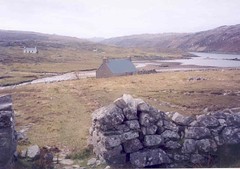


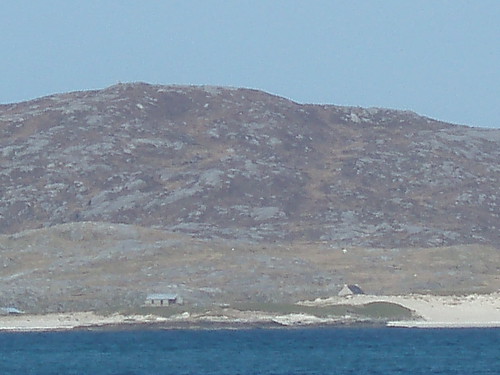
Two interesting findings in the course of my local history research (see map above, click on markers to see locations). First was an interesting census record of the village of Crola. This is no longer inhabited. It stands at Kinlochresort, the head of Loch Resort, in the remote west of Lewis. In 1891, a shepherd's family resided there. Catherine Macdonald, aged 63, is quoted as a shepherd's widow, living there with her two fishermen sons John (41), Malcolm (26) and daughter Annie (22). There is also a granddaughter Ann, aged 13, presumably (but not certain) the child of John. Catherine's home is marked as having two rooms with windows. The noteworthy thing is that her offspring is marked as living in Lewis, whereas she and her granddaughter Ann, aged 13, are marked as being born in Harris. This is significant, because Lewis used to be part of Ross and Cromarty, and Harris was part of Inverness-shire.The confusion arises on account of the fact that the county boundary ran at Kinlochresort. On the Harris side of the river lies Luachair, also uninhabited today (white house in image to the right). Would you believe that there was once a school at Crola, which was a so-called side school to the main village school at Loch Croistean, a mere ten miles away. More stories on the local historical society website.

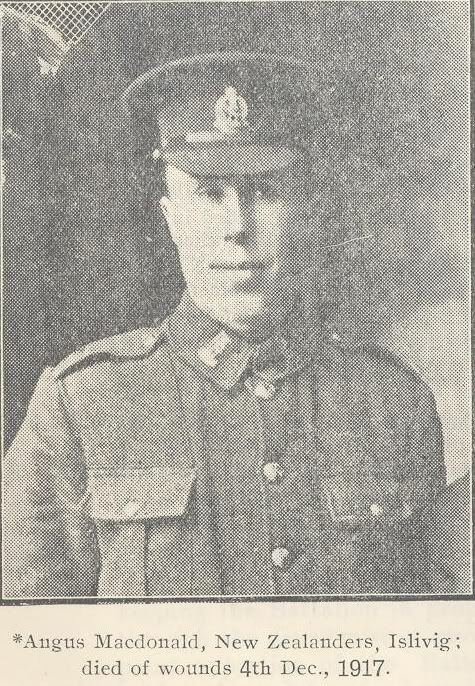
One of the nearly 1300 local casualties was Angus Macdonald, who served with New Zealand forces in France. He died of wounds on the Western Front on 4 December 1917. A naturalised American national, Angus must have crossed the Pacific after emigrating to the States. He was born in the hamlet of Islivig in the district of Uig, 40 miles west of Stornoway.
Friday, 9 April 2010

Friday evening

As the evening fades towards sunset, now by about half past eight, I can look back on a successful day's catch-up on local history tracing. With the aid of a more experienced researcher elsewhere in Scotland, I have been able to amend the details of several dozen WW1 casualties.

My mission statement remains unaltered: this is a piece of heritage which is not exclusive, it is inclusive. Everybody owes a debt of gratitude to the people who died in war, whether it be the wars from 1914-1919 and 1939-1945, or any conflict before or after. They laid down their lives in the service of King and country. They died so we can live in peace and prosperity These men and women should be, must be remembered, and keeping their memory alive is a duty to all who are in a position to do so. I count myself among those, even if I am free-lance and not allied to any specific group. I would be quite prepared to help anyone who seeks assistance in this field - or any other.

Wisdom

A local contact posted this on their Facebook page, and I take the liberty to copy it:

A grandfather is telling his young grandson a story. "Inside everyone there are two wolves who are always fighting - one wolf is full of evil (jealousy, hatred, greed, etc) and the other one is full of good (tolerance, kindness and patience). "And which one wins?" asks the grandchild. "The one you feed!" replied the old man. :)

Friday 9 April

Overcast with a cold wind today. It's supposed to get up to 12C, but we're a notch or two short of that.

A notch or two short of the mark was the candidate for the Labour Party in the constituency of Moray, east of Inverness. He tweeted himself into oblivion by writing offensive comments on Twitter. Stuart Maclennan was promptly deselected by the party. An object lesson to treat social media with caution. People have got sacked by blogging in the past, thinking they were just talking to themselves. Nope. You're talking to the world on here.

We shall have our newspapers delivered at a normal hour again as of tomorrow. Since Highland Airways folded, our papers came on the ferry (with the exception of the P&J) and in the shops after 3pm. Outlying districts did not get any papers before 9pm in some instances. Loganair will now take the papers in first thing in the morning, and we'll have our reads again by 10.30 am.

Thursday, 8 April 2010

Recognising a stroke

Susie is recovering at an incredible pace for someone who suffered a massive stroke, all because Sherry saw Susie stumble - - that is the key that isn't mentioned below - - and then she asked Susie 3 questions. So simple - - these 3 questions literally saved Susie's life. Susie failed all three so 999 / 112 was called. Even though she had normal blood pressure readings and did not appear to be having a stroke, as she could converse to some extent with the Paramedics. They took her to the hospital right away.

Sometimes symptoms of a stroke are difficult to identify.
Unfortunately, lack of public awareness can spell disaster.
The stroke victim may suffer brain damage when people nearby fail to recognize the symptoms. Now doctors say a bystander can recognize a stroke by asking three simple questions:

* Ask the individual to SMILE.
* Ask him or her to RAISE BOTH ARMS.
* Ask the person to SPEAK A SIMPLE SENTENCE (Coherently)
(eg. "It is sunny out today")

If he or she has trouble with ANY of these tasks, call 999 / 112 immediately and describe the symptoms to the dispatcher. After discovering that a group of non-medical volunteers could identify facial weakness, arm weakness and speech problems, researchers urged the general public to learn the three questions. They presented their conclusions at the American Stroke Association's annual meeting last February. Widespread use of this test could result in prompt diagnosis and treatment of the stroke and prevent brain damage.

Thursday 8 April

Reasonably bright day today, with a little wind and some sunny intervals.

Here in Stornoway, the Golf Club is applying for a license to serve alcohol on Sundays. The Club says this is separate from the vexed issue of playing golf on the Sabbath. Actually, it runs a nice parallel to the current controversy over opening the Stornoway Sports Centre on Sundays. At the moment, it is closed - but you can drink yourself legless in any of the town's hostelries. So, we can look forward to having a fantastic booze-up at the Nineteenth Hole at the Golf Club, without having to tire ourselves out chopping our way around the 18 holes first.

I am already heartily fed up with the General Election campaign, even if we still have 4 weeks to go. Here in Stornoway, the election posters went up within hours of the election being called. The party faithful did not always check carefully enough where they stuck their posters - as shown in this article on Hebrides News.


A few days ago, I highlighted (on Facebook) the fact that our friends at AOHell were planning to ditch another piece of their service: Bebo. They acquired that social networking site two years ago, but it is failing badly in the States. So, AOL is going to shut something down again (provided they are not able to find a buyer - which is pretty likely in the face of competition from Facebook and the like).

Wednesday, 7 April 2010

Wednesday pics


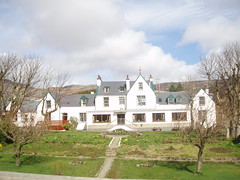
Harris Hotel (left) and First Fruits Tearoom, Tarbert


Tarbert


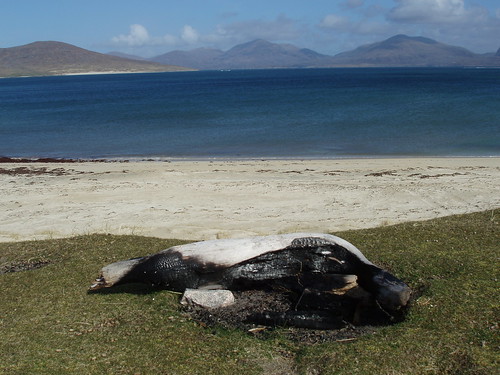
What on earth is this?


On the beach at Horgabost


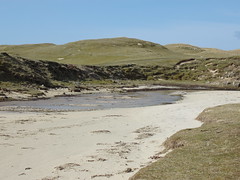
Taransay from Horgabost

Wednesday 7 April

The weather today has seen a slow, steady and inexorable slide towards the rain and wind we are experiencing at present. Went on the bus to Harris at 9.35 am when the sun was out, albeit accompanied by a cold wind. Reached the beach at Horgabost just after 11, a trip of 50 miles which costs £7.05 return on the bus. The tourism season has taken off, with the A859 relatively full of cyclists, and two tourists (each way) alighting at the Luskentyre road-end. Luskentyre [Losgaintir] lies 8 miles southwest of Harris's main village, Tarbert, and has a beautiful beach. What the tourists usually don't realise is that the beach is 3 miles from the main road, and the bus doesn't go into the village.

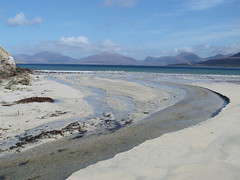
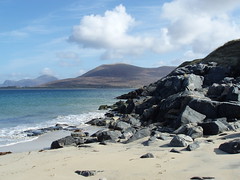
Horgabost has a nice beach too, a minute's walk from the road and adorned (ahem) by a campsite. Fortunately, the toiletblock lies out of sight of the beach. A prohibition on campfires is blatantly flouted, with nearly half a dozen charred holes on the top of the dunes. As per usual, I was the one to spot the dead sheep: what looked like a lamb that had fallen down a cliff and collided with a rock at the bottom. The Harris hills looked beautiful, with the range from the Clisham west to Tirga Mor in sight.

The return bus pulled up at 12 o'clock and took us back to the metropolis of Tarbert. The name of that village means portage, where the Vikings would carry their longboats across the 400 yards of land that separate East Loch Tarbert from West Loch Tarbert. We had lunch in a small tearoom and rejoined the northbound bus at 1.30pm. By the time we returned to Stornoway, the clouds were beginning to cover the sky from the west and a very cold wind was blowing.

I took some 40 pictures, a selection of which I'll post in the next entry.

Tuesday, 6 April 2010

Tuesday 6 April

A day with varying fortunes in terms of weather. Although it is not really cold, there are showers about. Varying fortunes is also the order of the day down in London, where the Prime Minister has called a General Election for Thursday 6 May. The politicking that's been going on for a few months now will reach fever pitch, and I'll be heartily fed up by the end of today.

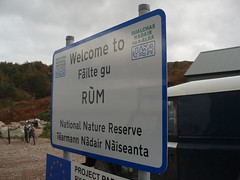
I am very pleased to be able to report that Scottish Natural Heritage, who own and manage the nature reserve of the Isle of Rum in the Inner Hebrides, has signed over assets worth £257,000 to the island's community association. Rum has a checkered history, and it is a good thing that the island's residents, after 190 years, get control of their homes and village.

Rum's indigenous Hebrideans were expelled from the island in 1821, to make way for sheep, later deer. In the late 19th century, the island was bought by a Lancashire family of industrialists, the Bulloughs, who made their fortune in the textile industries. They built a folly-type castle at Kinloch, filled with the most mind-boggling and jaw-dropping artefacts. Some amongst the ugliest pieces I've ever clapped eyes on. After the First World War, the castle began to fall into disuse, and the last member of the Bullough family passed away in 1957. Lady Monica was carried the hard eight miles to Harris, on the island's southwest coast, to be interred in the family mausoleum.

Rum was bequeathed to the nation, and (what is now) SNH took over. The island became a nature reserve, with a colony of red deer being studied. Its only residents were SNH staff. The present take-over clears the way to increase the island's population from 30 to 80.

Monday, 5 April 2010

Monday 5 April

A wild day, with a near gale blowing the ferry back out to sea. It was nearly an hour late this afternoon. White horses ride the waters of the basin across the road and there is widespread disruption on the Calmac ferry network in western Scotland.

I have decided to maintain the website for "Faces from the Lewis War Memorial", but have taken the papercopy version off the Internet. I do not want to get  more aggravation than I already have. I have received various expressions of support away from the pages of this public blog, for which I am grateful.

Sunday, 4 April 2010

Easter Sunday 4 April

Happy Easter to all.

Not a happy Easter for myself - I am deleting my postings of the past two days regarding "Faces from the Lewis War Memorial". The Stornoway Historical Society has declared its disapproval of my work, as it is full of errors that they, nor any of the other historical societies, have any inclination, money, time or manpower, to help me to correct. I am also accused of inappropriately using their research for my own financial gain. It helps if people actually address their concerns at the time (in 2007), rather than three years down the line.

The Faces from the Lewis War Memorial will probably be removed from public viewing in the course of this week, alongside the other local history websites that are under my control.