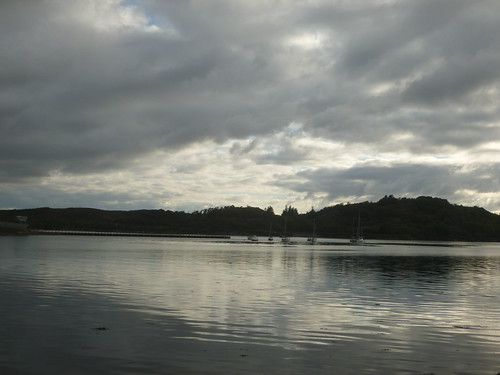
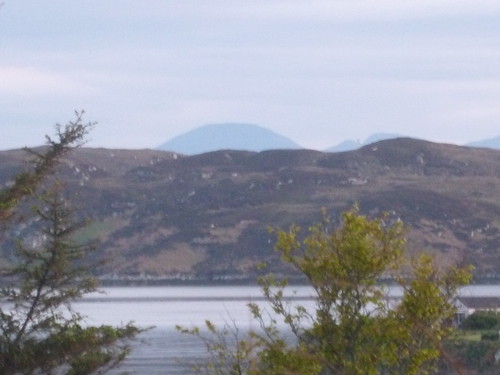
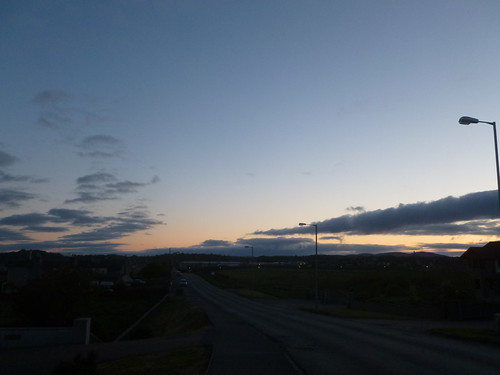
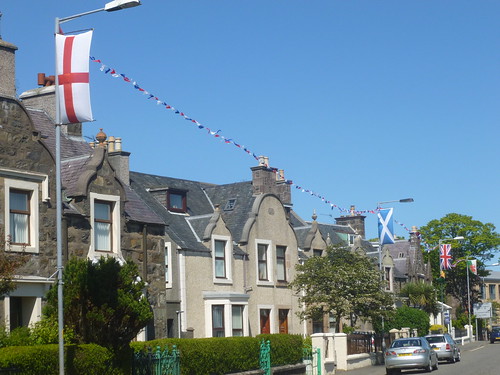
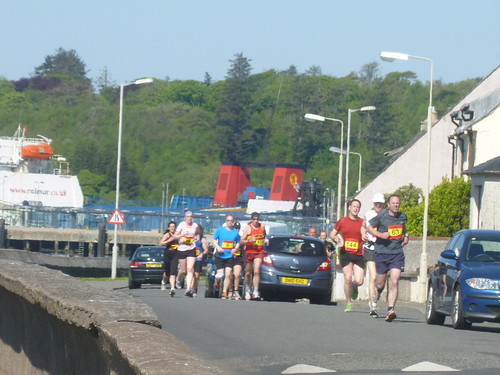
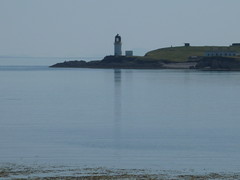
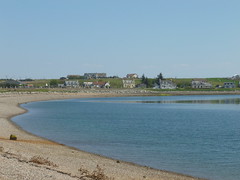
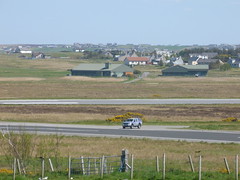
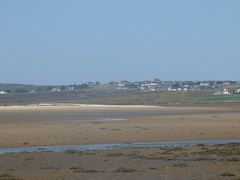
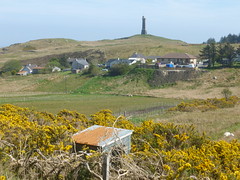
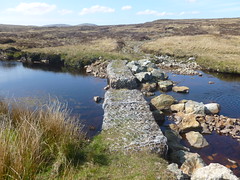
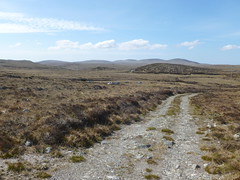
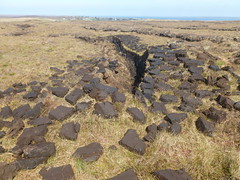
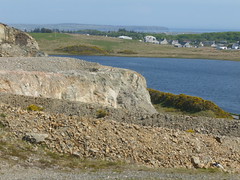
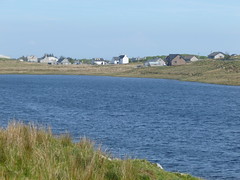
View across the Outer Harbour of Stornoway

Tuesday, 19 June 2012

Tuesday 19 June

A cool but bright day, with the mercury still stuck down at 12C and no further rain to speak of. The grand total for this month is 6 mm, a quarter of an inch. However, the forecast is for copious amounts of rain later in the week, which gives us a chance to make up for nearly 3 weeks of drought. It may seem like an exaggeration, but people are complaining of football pitches that bear a resemblance more to concrete than a grassy lawn; grassy lawns that have turned brown and yellow; and low water levels in rivers. I also found out that on Saturday evening, a few hours after I visited the fire-stricken area near the Creed River, fire once more flared up. I could not help but notice that it felt warm near the Creed Bridge - warmer than in the Castle Grounds or along the nearby Arnish Road.

I have gathered further information on 13 WW1 casualties from Lewis, my on-going project. The total is 258 to date; just over 1,000 left to do. Another project is the indexing of the Napier Report, which will take me quite a while. For the moment, this is an Excel file; I'll have to think of a way to put this on the WWW.

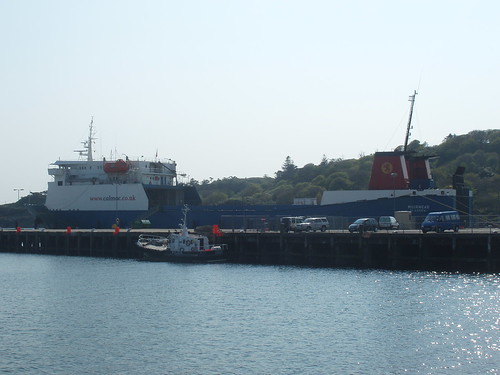
Locally, a Russian cargo-ship was halted off the north coast of Scotland, apparently near the Western Isles. The Alaed allegedly carried attack helicopters, bound for Syria. The company had had its insurance cancelled, meaning that the vessel could not proceed on its journey. The British Foreign Secretary has now announced that the Alaed is on its way back to Russia. The last recorded position of the Alaed was 40 miles north of the Butt of Lewis, at 1.37 am yesterday morning.


Image courtesy www.vesseltracker.com

Monday, 18 June 2012

Monday 18 June

Quite a nice day, with only the odd drop of rain. However, at this time of year, that brings out one spoiler: the dreaded midges. And they certainly had a nip at me when I was outside for a spell this afternoon <scratches>. I have today done a few more entries in the long saga of the Lewismen lost in WW1, continuing my researches into the men from Upper Bayble in Point. Tomorrow, I shall make a start on the onerous task of indexing the Napier Report. Remember, 46000 questions and answers - some answers being pages long? 

A few weeks ago, I passed through the village of Steinish, when I came across the dried remnant of a bunch of flowers, left at the roadside near where a teenager had been left dead last November. Liam Aitchison had come north out of South Uist to start a new life in Lewis, only to find death. Two suspects have been bailed pending further investigations. The residents of Steinish have now set up a fund to help vulnerable teenagers in the island.

Whilst typhoon Guchol begins to fade in the Pacific, another system is threatening to form in the open Atlantic Ocean, northeast of Bermuda. Although this is only a threat to shipping, tropical storm Chris could still put in an appearance there. On the other side of the American continent, the remnants of Carlotta appear to be reforming into a new cyclone, some 270 miles west of Manzanillo in Mexico. This system is moving east. Its attendant heavy rains continue to pose a threat to Mexico, with potentially life-threatening flash floods and mud slides.

Sunday, 17 June 2012

Columba's Island Paradise

Loriana Pauli, who resides in and blogs from North Uist, posted this excerpt of a poem, attributed to St Columba on her blog. I take the liberty of reposting.

Columba’s Island Paradise (12th century, translated from the Gaelic)
in THE TRIUMPH TREE, Scotland’s earliest poetry AD 550-1350

Delight I find in an island’s breast,
on a rock’s peak,
that there I might often gaze
at the sea’s calm.

That I might see its heavy waves
over the brilliant sea
as it sings music to the Father
on its constant way.

Might see its smooth bright-caped strand
(no dismal tryst);
might hear the strange bird’s calls,
a joyful strain.

Might hear the shallow waves’ crash
against the rocks;
might hear the cry beside the graves,
the ocean’s roar.

Might see its splendid birdflocks
over the teeming sea;
might see its whales,
greatest of all marvels.

Than I might see its ebb and flow
in their sequence………

The poem concludes with the lines 

That this might be my name, a secret I tell
'Back towards Ireland'

That help of heart might come to me
gazing on it
that I might lament all my wrongs
hard to mention


St Columba, who died in the year 597 AD, was an abbot and a prince who had fled his native Ireland after standing up against one of that islands warrior kings. Upon fleeing, he decided to go to the west coast of Scotland. However, as he felt that seeing the Irish coast on the horizon would be an irresistible temptation to return, Columba (or Colum Cille) vowed that he would settle on the first island where he could not see Ireland on a clear day. That first island was Iona, off the west coast of Mull. Nonetheless, the yearning for his native land would be pulling his heart strings for good.

Sunday 17 June

A change in the weather today, with occasional showers - for the first time in weeks. The rainfall totals for today in Point (east of Stornoway) are between 1 and 2 mm, less than 0.1 inches. Nonetheless, a welcome dampening for our parched and tinderbox dry island. At least a recurrence of last week's wildfires now seems less likely.

The Greek elections appear to favour parties that want to retain the Euro, although forming a government is not going to be easy. Should a government be formed that does not want to abide by the restrictions, then Greece may be forced to leave the Euro, a move that will have serious consequences for Europe. Let's hope it does not come to that. However, the effects of the austerity measures have been shown in graphic details in recent news bulletins, with overt poverty and deprivation in abundance across Greece.

I could not get over the scenes at a tennis match, where one of the players kicked an advertising board, which injured a match official. The player, who was in a final, was promptly disqualified for unsportsmanlike conduct.

Saturday, 16 June 2012

Saturday 16 June

A fairly bright day today, with some more northeasterlies but also some rain around 7pm. Like earlier in the week, it was not warm, with the mercury only in the low teens, mid 50s F. Nonetheless, I'd like to think that on balance, we had the best weather in the country.

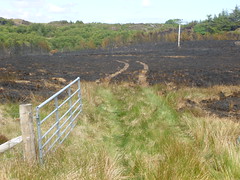
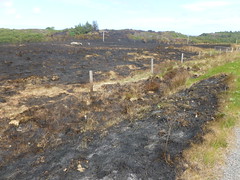
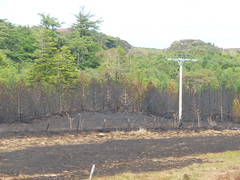
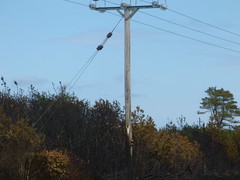
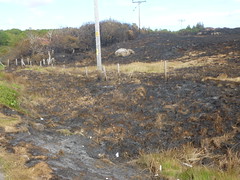
In the afternoon, I went out to the location of Thursday's wildfires. Two miles from the town centre, I came across a broad swathe of scorched earth, with blackened and scorched powerpoles. The fire had even threatened an electricity sub station after jumping across the main road to Tarbert. Local news reports mention that pumping water out of the adjacent Creed River left it waterless at the time. I shall post a handful of pics of the devastation I found. Was it me, or did it still feel hot in the vicinity?

Friday, 15 June 2012

Friday 15 June

Still a steady northeasterly breeze, but not feeling as cold as of late. And would you believe: we even had a little rain this evening. We're going to need a lot more if we want to stamp out the threat of more wildfires. Yesterday's fire is reported to have caused extensive damage, and came close to burning down electricity poles and an electrical substation.

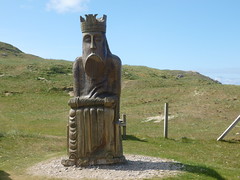
It is reported that 6 of the 91 Lewis Chessmen will come 'home' once the new museum opens in Lews Castle in 2014. The six Chessmen, figurines carved out of walrus ivory, could be alternating pieces. At present the collection is held at the National Museum of Scotland in Edinburgh and at the British Museum in London. Last year, several Chessmen were taken to Stornoway to be exhibited at the Western Isles Museum on Francis Street, and six pieces were taken to Uig Museum, a mile from the supposed location of their find in 1831.

I was bemused about the furore surrounding the school dinner blog, written by a 9-year old girl from Lochgilphead, Argyll. It's a pity that it was all sparked off by a newspaper, calling on the dinnerladies at the school to be fired, after the young lass voted down some of her dinners. However, she was just commenting on the food, not on those serving it. I wonder when someone in a hospital will do the same about their food - hospital food has this unfortunate reputation for being awful.

Thursday, 14 June 2012

Thursday 14 June

Another bright and sunny day, with a stiff breeze and low temperatures. So far this month, we have had all of 3 mm (0.12 inches) of rainfall, and the results were plain to see this afternoon. A huge brown and white cloud billowing behind the Castle Grounds, signalling that last Friday's fire had flared up again. Fire crews battled for several hours to bring the blaze under control. The fire had reached the main road south from Stornoway, prompting its closure. The diversionary Pentland Road, a single track road leading out to Achmore, Breasclete and Carloway, was very soon gridlocked, prompting police to divert southbound traffic north through Barvas. That is a diversion of 40+ miles. At rush hour, Stornoway was gridlocked, with cars clogging up the main thoroughfares - by all accounts. I did not go out to watch, but my Twitter and Facebook contacts kept me posted. The road closures were lifted after 7 pm. The below image shows the smoke from the fire at 2.30pm, twenty minutes after it was reported. The picture is taken near the ferry terminal in Stornoway.

Hurricane update - 14 June

Tropical storm Carlotta has formed in the Eastern Pacific and is expected to strengthen into a hurricane within 36 hours. The storm poses a threat for southern Mexico, specifically around the Gulf of Tehuantepec. This is to the east of Acapulco. Carlotta will make landfall at 70 knots (a category I hurricane), weaken overland and reemerge over water near Acapulco, then hang around near there as a tropical storm.

NHC have 6-hourly updates, always refer to those for the latest information.

Wednesday, 13 June 2012

Wednesday 13 June

Not warm at all today, with the mercury barely above 10C and that continuing northeasterly wind. At 9.30 this morning, I accompanied my father to the airport where he took a flight to Inverness and onward to Amsterdam. He reported to have reached home at 5 o'clock (UK time), in good order in other words. I walked back from the airport to Stornoway, a distance of about 3 miles. A shear line passed over me, with showers in evidence over the Harris and Uig hills, as visible from Sandwick. No rain fell in Stornoway, worthy of the mention. Returned to town at 11.30, an hour after leaving the airport. Spent the day attempting to upload several hundred photographs, which I took over the past week whilst out and about. The process is on-going as I type, as Flickr.com is singularly slow. An upload rate of 40 kb/second is antediluvial.
Tomorrow, I shall post entries on here with pictures of the expeditions I undertook with my father.

Tuesday, 12 June 2012

Tuesday 12 June

A cool day, but with good spells of sunshine. Went across to Uig on the postbus, and was driven through a considerable rainshower on the way. Reached Timsgarry at 1.30, after dropping off mail at people's houses along the B8011 (M). Walked over to the Community Centre at Erista for a bowl of leek & potato soup, then continued down to Baile na Cille for a walk to Uig Sands. Came off at Ardroil; had wanted to proceed further west towards Carnish, but the tide was in and covering a large area of the strand. Returned to Timsgarry in time for the (pre-booked) bus back to town. It was a case of "Home James and don't spare the horses".

Uig is an area of stunning natural beauty, but only sparsely populated. The schoolbus at 4.45pm only dropped off 4 kids from the Nicolson Institute in Stornoway; and my father and I were the only ones going back to town at 5.10pm.

Today was the last day of my week of showing my dad around Lewis. He is flying back to Holland tomorrow.

Monday, 11 June 2012

Monday 11 June

A cold day with a chilly northeast breeze. The day started early for some in Stornoway, as the Olympic Torch passed through between 6.30 and 7.30 am. I was still asleep at that time. At 10.10, I took the bus west to Great Bernera, an island just off the west coast of Lewis. Visited the Norse Mill east of Breacleit, then returned to that village for a cup of soup in the community centre. Proceeded to go on a walk to Valasay, Tobson and Bosta. It was there that the sun came out, making it a pleasant 15 minutes on the beach there. On the way back, we were kindly given a lift from Croir to Breacleit. We settled down for a cuppa and some cakes, chatting to the staff who were very friendly and welcoming. A coach party also turned up from one of the two cruiseliners in today, the Minerva and the Expedition. It was on their behalf that the lady who usually guides people round the Iron Age House at Bosta had to stay on an hour or so longer than usual. Nonetheless, the cruise ships provide quite a bit of business in this island.

Sunday, 10 June 2012

Sunday 10 June

Fairly sunny, but that northeasterly wind did keep it cool. As I type this, the sun has set (at 10.30pm) and the cloud has covered the sky. Today is Sunday, so no public transport. I took my father for a walk round the Castle Grounds, and found one of the places that was ravaged by fire on Friday evening. It would appear to me that someone built a fire, it went out of control and burned half the island at the mouth of the Creed River, after which the sparks were blown onto the moor behind. When moorland catches fire, you've got a devil of a job to put it out. The fire may continue to smoulder in the peatland underfoot for days if not weeks, particularly in the continuing dry conditions. Tomorrow, some showers are forecast, but we could really do with a good dousing.

Saturday, 9 June 2012

Saturday 9 June

An overcast day with a continuing northeasterly breeze, making it feel quite chilly. Stornoway temperatures were pegged back to 12C, but I was in North Harris where the sun came out, courtesy the Clisham. Took the 9.35 bus to Bowglass [translates as Grey Cow], on the Lewis border. An 11 mile path leads through Glen Langadale to Loch Bhoisimid and Meavaig nam Beann on the coast. We only went as far as Glen Langadale, which is my no 1 favourite place in this island. It is surrounded by some magnificent mountain scenery, with names like Stulabhal, Rapaire, Tealasbhal and Mullach an Langa. Those who have followed by blogging from the start, specifically from February 2005, will remember those names. The track gradually rises to 600 feet above sealevel, then to drop down to 160 feet in Glen Langadale. A wooden bridge has been provided for crossing the river, where before you had to jump from rock to rock or wade the waters. We ascended the path under the frowning crags of Stulabhal as high as 600 feet (the summit is at 1100 feet), then retraced our steps back to Bowglass over several hours. Encountered several other walkers, two cyclists and one runner. By 3pm, the sun came out, making it feel warm again.

Friday, 8 June 2012

Friday 8 June

I don't think I should moan about the weather, when it has been mainly dry and I even spotted the sun for a few minutes this afternoon. But that strong northeasterly wind, blowing at a steady 25 mph, made it feel quite cold when we jumped off the bus at Lower Shader to visit the Steinacleit homestead. Didn't hang about for long, but doubled back to the village and walked through to the shore. Headed southwest along the shinglebank, crossed the Shader River and ended up at Ballantrushal. Why they don't get rid of all the scrap cars and trucks in that village is beyond me. Visited the Trushal Stone, where a friend of mine broke an ankle last September. Could see the stones that brought them to grief. Proceeded to the moor beyond and headed due west to a fenceline. Had to walk for nearly half a mile to find a stile to cross the barbed wire, then continued southwest, broadly parallel to the coastline. Initially quite high up, about 150 feet above the pounding waves, then gently descending towards the strand off Barvas. Walked the curve of the beach as far as the outflow of Loch Mor Bharabhas. Was amazed to find an array of machair flowers already out in bloom, something that reaches its peak in July. Once at the outflow, an old green bus had been parked, and we had to turn round to regain the paved road at Loch Street, going straight into the teeth of the wind. Had to wait for a bit to catch the 4.20pm bus back to town.

I shall post pics in a separate post in a few days' time.

Thursday, 7 June 2012

Thursday 7 June

Yesterday, my father arrived by plane and for the next 6 days I'll be showing him places in the island. This morning at 10.10, the bus took us to Callanish where we saw three of the stone circles, including the main one. There are 20 stone circles within a 3 mile radius of Callanish. Came across a chap who was holding a Harris hawk. Pics to follow. After having a bite to eat outside the visitor centre, another bus took us to Carloway, with a minibus connection to Gearrannan, where the Blackhouse Village sits. From there, we walked the two miles (and a bit) to Dalmore, but it is rather up and down along stunning clifftop scenery. The highest point we reached was not far off 100 metres / 330 feet. Dalmore beach was reached at 4pm, and another 20 minutes of tedium brought us to the main road. The final bus took us back into town at 5.45pm.

It was warm (15C) in the bright sunshine we had today, although a screen of cloud is moving up from the southeast. Weather elsewhere in the UK is rather autumnal, with heavy rain and strong winds. May it stay well away from here - and apparently, it will.

Wednesday, 6 June 2012

16 years ago


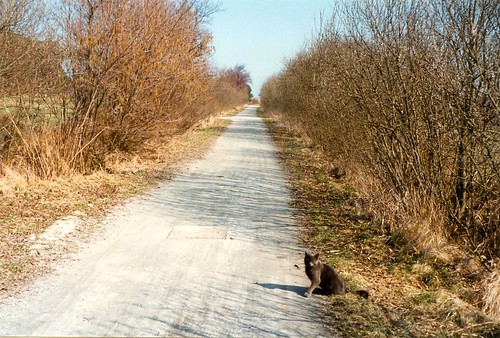
A simple image, which some of my regular readers (you know who you are) will recognise. The track, paved with ground-up seashells, the leafless trees, although in bud, and the pale-blue sky of early spring. Nothing out of the ordinary, but what prompted the post was the wee cat in the roadside. The picture was taken on the Dutch island of Vlieland in April 1996. I have images of the same location from much more recent years, but the wee cat will no longer be in it - or around. Things change.

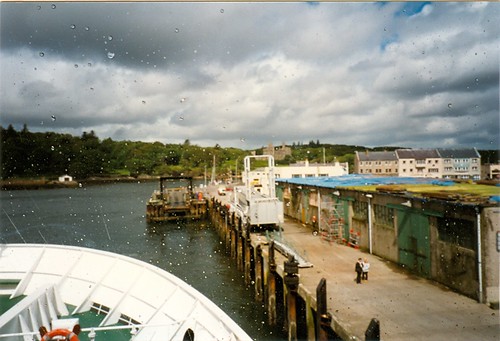
The same applies to this old pic from Stornoway, taken on 31 July 1996.

Only the Caledonian Hotel and adjacent buildings are still standing. The Maritime Building was demolished in October 2007, and the sheds on the quayside were removed well before I came to Lewis in 2004.

The below image, from April last year, shows a side-on view of the same area, pier no 1.

68 years ago today

Today in 1944, an armada of ships brought an invasion force to the beaches of Normandy, spelling the beginning of the end for Nazi Germany. After some hard fighting, the march through France, Belgium and Holland did not falter until they reached the Rhine bridge at Arnhem in September that year.

A list of those from the Isle of Lewis who fell at Normandy and the month following the invasion.

Seaman NORMAN MACDONALD
Last address in Lewis: 30 Knock, Carloway
Service unit: Royal Navy HMMM 7
Date of death: 07/06/1944 at the age of 34
Killed in action in D-day Invasion of Normandy

Chief Petty Officer ALEXANDER MORRISON
Last address in Lewis: 8 North Tolsta
Service unit: Naval Auxiliary Personnel (Merchant Navy) HMRT Sesame
Date of death: 11/06/1944 at the age of 41
Lost off Normandy

Private KENNETH JOHN MACDONALD
Last address in Lewis: 2/4 Kershader
Service unit: 7th Seaforth Highlanders
Date of death: 28/06/1944 at the age of 24
Killed in action at Caen, France

Fusilier ALEXANDER ROBB
Last address in Lewis: 15 Cross Street Coulregrein
Service unit: 6th Royal Scots Fusiliers
Date of death: 29/06/1944 at the age of 30
Lost in German counter attack at Manvieu

Leading Seaman DONALD MUNRO
Last address in Lewis: 6 Knock, Point
Service unit: Royal Naval Reserve HMMM 1019
Date of death: 02/07/1944 at the age of 37
Lost off Cherbourg

Hurricane update - 6 June

A tropical cyclone has formed in the Southern Hemisphere, more than a month after the season ended. Tropical storm Kuena is 600 miles east of Madagascar and will strengthen gradually as it moves over Agalega, an outlying island under the jurisdiction of Mauritius. The system is expected to veer northwest, passing through the archipelago of the Seychelles. Kuena will be weakening at that point, and is not expected to survive to the coastline of mainland Africa.


Tuesday, 5 June 2012

Tuesday 5 June

Quite a nice day, in spite of the lowish temperatures of 11-13C. Not much wind, so it felt reasonably nice. At the moment, we are having springtides, with high tide peaking at 5.0 m and the low tide at 0.6 m. That's a tidal difference of nearly 15 feet. It is odd to see the mudflats in the basin at low tide at 2.30pm, and come back 6 hours later to realise they are under 14 feet of water. Where on earth (literally) did all that water come from - and where does it go to??

The Jubilee celebrations have come to a close, and I managed to miss today's excitement. I came across this image, showing the Queen sitting on the throne - a hollow one. Next instalment of Britishness (or should I have omitted the capitalisation?): the Euro 2012 football championships in Poland and Ukraine. I think they start in about 10 days' time. And on July 27th, the London Olympics commence. Mind you, over in Holland they are even crazier about the football, with half the country turning orange (orange being the national colour in the Netherlands).

Tomorrow morning at 4.23, the sun will rise and it will be obscured by the planet Venus. Well, 0.1% of it. The forecast is not favourable, and I'd have to walk miles out of town to have a clear view of the northeast. I think I'll stay in bed.

Over the next few days, you'll see less of me than normal as my father is coming to visit. Where are my waterproofs?

Monday 4 June

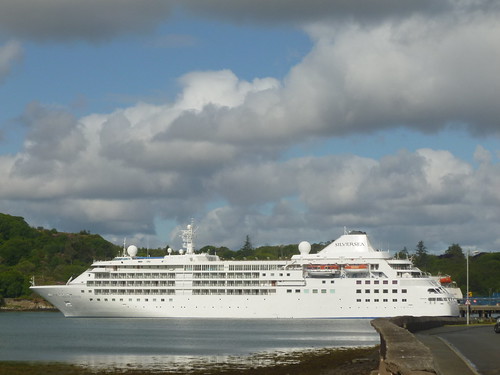
A change in the weather, with mainly overcast skies and still cool. The day started with a large cruiseship docked alongside the ferry pier. The Silver Cloud left just after 3 o'clock, headed for Douglas, the main town in the Isle of Man.


During the afternoon, I continued my project of looking up further details about the WW1 casualties from the Isle of Lewis. This information is admittedly limited, such as a date of birth and family details from the censuses. I completed the village of Lower Bayble, which lost quite a few names. Next one will be Upper Bayble, next-door.

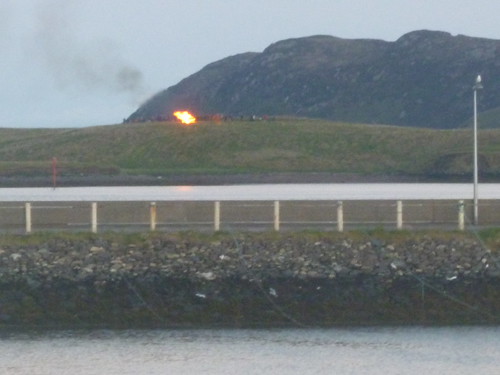
At sunset, at 10.15pm, the beacons were lit in the Western Isles (and beyond) to celebrate the Diamond Jubilee. One was across from my position at Arnish Point; others were at Ness and on the top of the Clisham. I walked out to Oliver's Brae to check whether I could see fire on the Clisham, but the distance (30 miles) and the fact that the Arnish beacon was already out by that time meant there was not a spark to be seen.

The below image was taken just after 11pm on Oliver's Brae between Stornoway and Sandwick.

Monday, 4 June 2012

Sunday, 3 June 2012

Sunday 3 June

A bright and sunny day, although feeling cold in the easterly breeze. We once more managed 11C / 52F. However, I think I prefer our weather to the pouring rain that is coming down on the Jubilee Pageant. It is currently coming to a close. A spectacular cavalcade of boats, large and small, sailing down the 7½ miles to Tower Bridge. Many thousands are lining the riverbank, in spite of the weather.

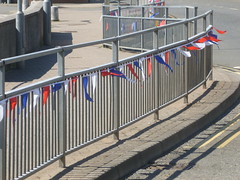
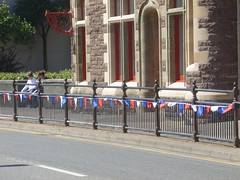
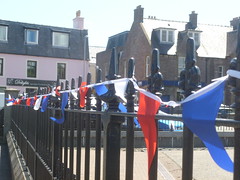
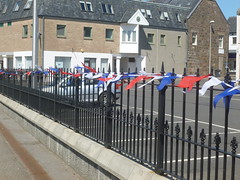
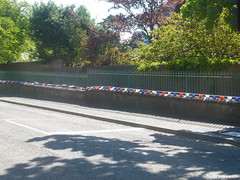
Here in Stornoway, Sunday means quiet, and on a half-hour walk through the town, there was only the odd car and the odd pedestrian. Streamers of bunting are out on the railings along James Street, South Beach, the railings along the quayside of Cromwell Street, Matheson Road from Church Street down to James Street. Next Monday, June 11th, the Olympic Flame will be carried along many of those streets between 6.30 and 7.30 in the morning. I gather that someone got a visit from CID for saying something rude about the Olympic Flame passing through another Scottish town. Must have been very nasty prompt such a visit.

Saturday, 2 June 2012

Saturday 2 June

Ooh, we had two drops of rain early this morning. Otherwise, another bright and sunny day, with a biting northeasterly wind keeping the temperature around 11C all day. Bit warmer darn sarf [down south], where HM the Q attended the Epsom Derby horse race as a start to her Diamond Jubilee weekend. There was a streetparty here in Lewis (at least one I know of) in Laxdale, with another one planned for next Wednesday in the town area of Stornoway. On Monday, we'll be watching the lighting of beacons.

I was pleased to hear that former president Mubarak of Egypt was sentenced to life in jail for complicity in the killings of people 16 months ago in Cairo, when his regime was overthrown. He could have been executed, but that would have made him a martyr. Isn't it odd though, how certain figures crash from favourite to outcasts in a matter of weeks. Mubarak and Gadaffi are certainly good examples. As a classical music afficionado, I am only too familiar with Carl Orff's rendition of Carmina Burana, and the first excerpt of that piece:
The wheel of Fortune turns;
I go down, demeaned;
another is carried to the height;
far too high up
sits the king at the summit -
let him beware ruin!
for under the axis we read:
Queen Hecuba.


Friday, 1 June 2012

View of an island

I found this posting from my old Northern Trip blog among my files in Google Drive. It summarises what kept me in Lewis, after arriving there in November 2004. This revised text dates back to late December 2005. Before you ask, the same reasons still apply. 

I was amazed at the colours at sunset these past days. And at sunrise as well. Normally, I expect light to start to fail 25 minutes after sunset, but at this latitude this is extended to 40 minutes. I am not a native of the islands, but one of the reasons I have come here is the natural beauty. Whether it is in the images shown above, at a time of good weather - or in bad weather, as I showed in a much earlier posting about the November 11th [2005] hurricane.

Being caught up in a thunder, hail, snow, sleet (and kitchensink) shower back in January, whilst going down the Lochs Road at Leurbost, with the bus driver being forced to reduce speed to a crawl. No snow or ice at the next village, Keose.

The many rainbows in the spring.

The joy at seeing the first green shoots, in April.

Hearing the first bleating of lambs in a pasture at Breascleit late in March. Walking the island in the bitter winds of February, and seeing the sad remains of the sheep that did not make it through the winter. Or the sheep that was knocked down at the Marybank cattlegrid in April, and was slowly decomposing in peace in the ditch that it was dumped in over a period of 6 months.

Seeing the days lengthen to an incredible extent, sunset at 22.30, with the light lingering to the nadir of the night at 01.30, then returning fully at 03.30. But also shortening of the days, with the present daylight hours of 09.15 to 15.35.

The howling of the gales, 4 in one week in November. Clattering of hail and thumping of the wind against the window at night - waking up in the middle of the night because there is no noise.

Watching the breathtaking coastal scenery at Filiscleitir, or the stunning mountain scenery from Rapaire, Teileasbhal, Mullach an Langa. Or beautiful Glen Langadale, where I'm forever fording that river under the frowning face of Stulabhal. The little mouse on the slopes of that mountain, the one that allowed me to stroke it. The yellow grasses on the moors of South Lochs, finding your way in amongst a myriad of lochs, streams and bogs. Loch nan Eilean, south of Garyvard.

Place seems to have gotten under my skin.

Friday 1 June

Another day of the bright and sunny variety, with some cloud out and about. The northeasterly wind continues to make it feel cold outside, although in the lee and in the sun it does feel quite pleasant.

The news is dominated by the Jubilee Weekend. Here in Stornoway, bunting has been strung along the railings along South Beach, the main street on the seafront. I'm not aware of anything major being organised here (I stand to be corrected), although a streetparty has been organised in Laxdale. On Monday, beacons will be lit on the Arnish Point peninsula as well as in Ness and on the Clisham, our highest hill. Her nibs is having a do, it would seem. Unfortunately, the temperature in London looks set to take a nosedive, with rain and 10C forecast for Sunday. Think I'll watch it all on the box.

Although I did not attend, this week saw the Local Mod. As you may recall from my blog postings in October of last year, the Mod is a showcase for Gaelic culture in this part of the world, and I found a large group of small children outside the Town Hall, where they had been performing. The performances include singing, dancing, declamation and instrumental performances, e.g. the melodeon, clarsach and others. Five years ago, I attended some of the prelims and recorded the results. You can hear some of those recordings from this page. I never cease to be amazed by the gusto and confidence with which the tiniest tots (as young as 5) strut their stuff on the stage, in front of an audience of more than 100 at times.


Hurricane season 2012

Today, June 1st, is the start of the North Atlantic hurricane season. However, we have already seen two named tropical storms. Beryl dissipated two days ago; Chris is the next one on the list. As regular readers of Atlantic Lines know, I take an active interest in the subject of hurricanes and blog summaries warnings and advisories on a separate blog, Tropical Cyclones. 

Hurricanes, typhoons and tropical cyclones are all one and the same thing. It is a phenomenon which, on a planetary scale, serves as a safety valve to vent excess heat from the tropics to temperate latitudes (above 30 degrees north or south). Simply put, the processes of evaporating and condensating water transfer energy from the ocean to the atmosphere. When the circumstances are right, this can give rise to an area of low pressure, accompanied by intense thunderstorms which reach up to 10 miles up into the atmosphere. A tropical cyclone needs water temperatures of at least 26C / 80F to form, and uniform windspeeds and wind direction throughout the atmosphere. The rotation of the earth spins the system and also propels it to higher latitudes. Wind speeds near its centre can go as high as 150 knots (170 mph), with gusts to 180 knots or 200 mph. Both path and central windspeed are not easy to forecast.

For reference, storms are named once their windspeeds reaches or exceeds galeforce, 35 knots or 39 mph. Names of storms that have been particularly devastating are usually retired, never to be used again. Katrina is an example of a retired name.

Around the world, several specialised meteorological centres have been set up to monitor tropical cyclones. The main ones are at Miami (North Atlantic and East Pacific Oceans), Honolulu (Central Pacific), Tokyo (Northwestern Pacific), three in Australia, La Reunion (Southwestern Indian Ocean), New Delhi (Northern Indian Ocean) and Nadi, Fiji (Southwestern Pacific Ocean). The Joint Typhoon Warning Center in Honolulu monitors the Northwestern, Southern and Southwestern Pacific Ocean as well as the whole of the Indian Ocean basin. Tropical cyclones rarely form in the southern Atlantic or southeastern Pacific Ocean.

Personally, I frown at descriptions of hurricanes as "killers" or "monsters". The effects of these natural phenomena are certainly devastating, and sometimes claim many lives. However, the advent of the above mentioned monitoring centres has served to increase warning times to those that live in the paths of hurricanes, preventing more damage and loss of life than in the past.

Stay safe.

Thursday, 31 May 2012

Thursday 31 May

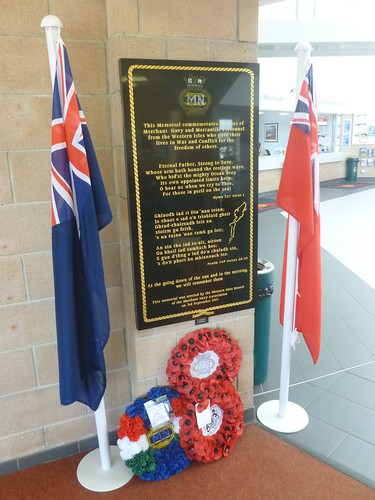
A cloudier day than of late, but still with good spells of sunshine. Went to town for a few bits and pieces at 3pm, and was surprised to find the ferry still tied up. She normally leaves for Ullapool at 1.50pm, but in the end the MV Isle of Lewis did not go until 3.50pm. As a result, the boat did not come back in until 10pm, still 2 hours late. Called into the ferry terminal to look for bus timetables (none to be found) for mainland buslinks, but instead found the below memorial to merchant seamen from the Western Isles who were lost in both world wars. The memorial is new, having only been erected last September.


Transcription of the text:

This Memorial commemorates the loss of
Merchant Navy and Mercantile Personnel
from the Western Isles who gave their
lives in War and Conflict for the
freedom of others.

Eternal Father, Strong to Save,
Whose arm hath bound the restless wave,
Who bid'st the mighty Ocean deep
Its own appointed limits keep;
O hear us when we cry to Thee,
For those in peril on the sea!

Hymn 527 verse 1

Chlaodh iad ri Dia'nan teinn;
Is shaor e iad o'n trioblaid gheir
Ghrad-chuireadh leis an
stoirm gu feith,
's na tuinn 'nan tamh gu leir;

An sin tha iad ro-ait, airson
Gu bheil iad samhach beo:
S gun d'thug e iad do'n chaladh sin,
's do'n phort bu mhiannach leo

Psalm 107 verses 28-30
Then they cried out to the Lord in their trouble, and he brought them out of their distress.
He stilled the storm to a whisper; the waves of the sea were hushed.
They were glad when it grew calm, and he guided them to their desired haven.


At the going down of the sun and in the morning
we will remember them

This memorial was erected by the Western Isles Branch
of the Merchant Navy Association
on 3rd September 2011

Wednesday, 30 May 2012

Another bloody water

I'm not apologising for the swear word in the title of this post. It is in fact the name of a brand of bottled water in Australia. I'll let the label, forwarded to me by an acquaintance in Queensland, speak for itself.


Wednesday 30 May

More sunny weather, but with a persistent northeasterly wind which once more keeps us cold. The mercury only reached 13C / 57F this afternoon. In the sun it's nice; but not so in the shade.

Next Monday, beacons will be lit across the United Kingdom in celebration of the Diamond Jubilee, Queen Elizabeth's 60th anniversary on the throne. No fewer than five will be lit on the Long Island. One at the Butt of Lewis, one at Cross-Skigersta Road nearby, two on the Arnish Peninsula across from my position and one on the summit of the Clisham. I hope the weather will be clement, as the Clisham is 799 metres or 2,621 feet high. The beacons will be lit between 22.00 and 22.30 hours. Oddly enough, no beacons are planned in the Isle of Skye, 50 miles south of here. The nearest beacon to that island will be at Ardnamurchan Point, 30 miles to its south.

The recent good weather has even made it to the local news headlines, as it has enticed people out to cut their peats. Last week's heatwave (26C / 80F in Harris) made it very uncomfortable at the peats, which is a strenuous physical exercise. You cut slabs of peat out of a peatbank with a peat iron (or tairsgeir), and leave them to dry for a couple of weeks, weather permitting.

Tuesday, 29 May 2012

Tuesday 29 May

A beautifully sunny day, but that strong cold northeasterly wind took the warmth out of it all. We did not manage more than 12C / 54F, but the wind made it feel even lower. Rather warmer, I gather, were the people in the US, where late May temperature records have tumbled. I gather that some places got as high as 36C, not far off 100F. I think I'll stick to the Hebrides; I find 12C easier to cope with than the mid-30s.

A few weeks ago, six children were killed in a house fire in the town of Derby. The fire was started deliberately, by pouring petrol through the letterbox and setting this alight. The parents, of whom the father had 18 children, have now been arrested on suspicion of their murder. The investigation in Derby is still on-going.

Italy has suffered another earthquake, measuring 5.8 on the Richter scale. Sixteen people are reported to have lost their lives. Seismologists expect the quakes to continue. Footage of a refugee camp at the time of today's quake showed people running away, out of their tents.

Monday, 28 May 2012

Monday 28 May

That was a startling contrast. From 23C yesterday right down to 13C today. The day started overcast, but by lunchtime we had the sun back. However, that did little to help the mercury, as there was this penetrating northeasterly wind blowing at force 6. And we are not likely to get any warmer anytime soon, as there will be a nationwide downturn in the warmth. Nonetheless, here in the Hebrides we are not really used to these large jumps in temperature - even if they take us back where we should be at this time in the year.

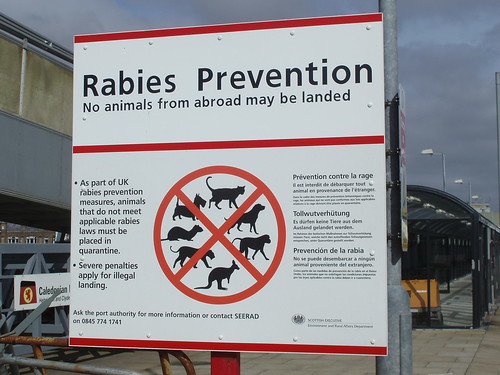
The woman who had contracted rabies after being bitten by a rabid dog in southern Asia has sadly died at a hospital in London. Only a few cases of imported rabies occur in the UK each year, but the survival rate of the disease is poor. Once symptoms become evident, the outlook is grim. Stringent controls on the import of mammals into Great Britain have eradicated rabies from the indigenous wildlife.

Sunday, 27 May 2012

Sunday 27 May

Another warm day, with the mercury cresting at 22C. It has become rather more humid. By evening, a northeasterly wind has picked up, heralding quite a change for tomorrow, when we should have no more than 14C on the thermometer. This transition will prompt thunderstorms on the mainland. We normally only get thunderstorms in winter. I spent the day outside, sitting in the sun - yes, I did apply sunblock and was in t-shirt and trousers.

The first tropical storm to threaten the US mainland this season is headed for the border between Georgia and Florida. Beryl is a storm, carrying winds of force 10 to 11 on the Beaufort scale, and will be even stronger upon landfall, later this evening. After making landfall, Beryl will make an about turn and head northeast. I don't think the up to 12 inches of rainfall are unwelcome, as there have been drought conditions for many months in that part of the States.

Saturday, 26 May 2012

Saturday 26 May

Beautiful spring day, with the mercury reaching summer-like values of 22C / 73F by 10am. Although it did cool down with the seabreeze later in the afternoon, it remained very pleasantly warm.

At 10 am, the runners in the Stornoway Half Marathon passed through the town and outlying areas. There were about 100 of them, I think. Click on the picture to see more images of the run.

In the afternoon, I went for a 5 mile walk out to Sandwick and Steinish, taking in the fringes of the Cockle Ebb. This is an area of tidal mudflats as well as quicksands. During specific times, it is possible to cross to Tong, a village that is 4 miles away by road - but far less than that directly.

Friday, 25 May 2012

Friday 25 May

Today in 1962, St Michael's Cathedral in Coventry was rededicated by Queen Elizabeth II. The cathedral had been wrecked during a Nazi German bombing raid on 14 November 1940, which caused extensive damage to the city. The ruins of the old cathedral were retained and are standing outside the new edifice, as a reminder of the destructiveness of war.

In Stornoway, it was a sunny day, but with a fair amount of haze about, and haar rolling ashore in Point, 5 miles east of the town. The cruiseliner Marco Polo came in during the early hours, and still lies anchored off Arnish Point. She is due to leave for Ullapool later tonight. Marco Polo is the second cruiseship to visit us this season; the Ocean Nova paid us three visits over the past fortnight or so.

I am making my way through The Healing Threads by Mary Beith, who died on 13th May. I have read half the book, which is a thoroughly researched appraisal of traditional medicine in Scotland. The second half is a rundown of what is termed Materia Medica, various healing practices in other words. I may conduct my own research into the subject.

Thursday, 24 May 2012

Thursday 24 May

A brilliant day, if a tad cooler than yesterday. That's not the way it felt, but the official readings said 16C. Went out for a walk of 12 km, 7½ miles, through the Castle Grounds to Bennadrove, Loch Airigh na Lice and Horgaraid. From the latter remote corner, I went back through Newvalley, Guershader and Laxdale. Took me 2 hours and 45 minutes. I did this walk in my walking days, early in 2005, when it was a good deal colder. For this afternoon's walk, I did not take a coat or indeed a jumper.

A woman with rabies presented to A&E at her local hospital in northwest Kent twice before being transferred to a specialist hospital. The UK is rabies free and stringent controls are in place to prevent infected animals crossing the border. Those cases of rabies that do occur here result from bites from infected animals (e.g. dogs) abroad.


Wednesday, 23 May 2012

Wednesday 23 May

A very nice spring day, with the mercury topping out at 21C / 70F this afternoon at 2 o'clock. It was wall-to-wall, blue-sky sunshine, as there was a lot of high-level cloud about. However, that did not spoil the fun at all, and these high temps are quite unusual for this part of the world. The highest maximums I've seen here are 25C / 77F, and we just might get there in the next couple of days.

The Jubilympics are serving to push the news on the Euro off our screens, but I am learning from Dutch news media that governments in the EU are beginning to draw up contingencies to reinstate their own currencies, should the Euro fail. Once Germany withdraws from the Euro, that will be the end of the currency. Greece is on the point of withdrawing, and when that starts, others will follow.

I received a free CD today from the Gaelic college in Skye, containing Voices from Scottish Islands, as recorded by the School of Scottish Studies. If you're interested, you can request a free copy (if in the UK) by emailing dualchas [at] smo.uhi.ac.uk, mentioning your name and address and subject Guthan Eileanan na h-Alba/Voices of Scotland's Islands CD.