A harrowing tale of evictions from the island of Raasay, as I continue to copy, paste and clean up the findings of the Napier Commission, now sitting at Torran in Raasay. Raasay is the longish island off the east coast of Skye. Donald Mcleod, a 78-year old former fisherman from Rona, just north of Raasay, tells of the evictions of fourteen townships. Chairman Lord Napier is asking about this.
7837. We want to find out if you know about the evictions in former times. The first one began in the time of M'Leod himself about forty years ago. Do you recollect that?
—I don't remember the first removing, but I remember Mr Rainy about thirty years ago clearing fourteen townships, and he made them into a sheep farm which he had in his own hands.
7838. What became of the people?
—They went to other kingdoms—some to America, some to Australia, and other places that they could think of. Mr Rainy enacted a rule that no one should marry in the island. There was one man there who married in spite of him, and because he did so, he put him out of his father's house, and that man went to a bothy—to a sheep cot. Mr Rainy then came and demolished the sheep cot upon him, and extinguished his fire, and neither friend nor any one else dared give him a night's shelter. He was not allowed entrance into any house.
7839. What was his name?
—John MLeod.
7840. What is the name of the town were his father was?
—Arnish.
7841. Will you give us a rough estimate of the population of the fourteen townships?
—I cannot; there were a great number of people.
7842. Were they hundreds?
—Yes, hundreds, young and old. I am sure there were about one hundred in each of two townships.
7843. Will you name the towns?
—Castle, Screpidale, two Hallaigs, Ceancnock, Leachd, two Fearns, Eyre, Suisinish, Doirredomhain, Mainish.
[...]
7858. Did the people out of these fourteen townships that Rainy cleared go of their own accord?
—No, not at all. The people were very sorry to leave at that time. They were weeping and wailing and lamenting. They were taking handfuls of grass that was growing over the graves of their families in the churchyard, as remembrances of their kindred.
7859. Mr Cameron.
—Might that not occur even though the people left of their own free-will, if they were much attached to their kindred?
—No, they were sent away against their will, in spite of them.
Tuesday, 7 September 2010


Tuesday 7 September
Although the day started fairly bright, cloud increased through the afternoon and bits and pieces of rain started to bother us. The wind remained fairly strong through the day, leading to a slight delay on the ferry service to Ullapool. As my previous post indicated, I have been transcribing more evidence from the 1883 Napier Commission of Inquiry into the Condition of the Crofters and Cottars in the Highlands and Islands. The submissions at Glendale were a touch worse than from elsewhere in Skye, but I have yet to do Raasay and Portree.
 Today saw the 70th anniversary of the start of the London Blitz, and the beginning of the end of Hitler's bid to invade Great Britain. It has been suggested that if he had kept up his attacks on RAF airfields and aircraft, the RAF would have been on its knees in a week or so. The Blitz, which was sustained for weeks and months, claimed thousands of lives, and not just in London. In 1941, a bombing raid on the Glasgow suburb of Clydebank was devastating, and the raid on Coventry in 1940 infamous. After bombing with aircraft, the Nazis switched to bombing with flying bombs (the V1) and rockets (V2) in 1944 and 1945. Again, it is suggested that Hitler's Germany was within weeks or months of developing a jet-propelled aeroplane, which would easily have outflown the propellor-driven planes that the Allies were using.
Napier Commission in Skye - Attitude
I am currently working my way through the Napier Commission's Report for the Isle of Skye. The landowner at the time (1883) in the northwest of the island was Dr Nicol Martin. His attitude towards his tenantry is eloquently portrayed in reply to:
7570. You think they could not pay the rent?
—I know they could not do it, and they would not do it. They are getting indolent and lazy besides. Look at this winter; they did nothing but go about with fires on every hill, and playing sentinels to watch for fear of sheriff's officers coming with warnings to take their cattle for rent. They went about with pitch-forks and scythes and poles pointed with iron or steel, and it was a mercy no one would serve the processes upon them, or they would have murdered him sure enough. You cannot get a sheriffs officer now to serve a process on any tenant in Skye.
Monday 6 September
Quite a nice day, but very breezy out here. I took delivery of an external harddrive with a terabyte (1 million megabytes) storage capacity. So I spent the afternoon transferring pictures and files onto it, including my collection of videos that I've shot with my photocamera. Cleaned up the laptop's harddisk at any rate, and I now have all my pictures (more than 26,000 at this time) in one place. I also have all the tags that people have sent me over the year in one place. I have everything backed up on CD-ROMs, but the disadvantage of those is that you cannot (normally) add to them. The external harddrive works just like a normal computer HDD.
I have also continued to transcribe the reports from the Napier Commission in the Isle of Skye, and you can follow progress on the link provided.
A reminder, as if I need to remind, that the 9th anniversary of 9/11 will be this coming Saturday. As per usual, there will be only one post from me - possibly two, if I get that other tribute sorted out before then.
Monday, 6 September 2010
Hurricane update - 6 September
Tropical storm Hermine has formed in the Bay of Campeche, west of the Yucatan Peninsula. The system is moving north and strengthening steadily. At the moment, the NHC has warnings out for 45 knots of wind, equivalent to force 9-10 on the Beaufort scale, although there is a possibility that Hermine could intensify to a hurricane.
A Hurricane watch has been declared from Rio San Fernando (MX) to Baffin Bay (TX)
A Tropical storm warning is in force from La Cruz (MX) to Port Oconnor (TX)
NWS Brownville is issuing Hurricane Local Statements.
A Hurricane watch has been declared from Rio San Fernando (MX) to Baffin Bay (TX)
A Tropical storm warning is in force from La Cruz (MX) to Port Oconnor (TX)
NWS Brownville is issuing Hurricane Local Statements.
Sunday, 5 September 2010
Sunday 5 September
After days of having up to half a dozen tropical cyclones to monitor, we're now back down to 1. Tropical storm Malou, which is churning its way up the Yellow Sea towards the Korean peninsula. Hurricane Earl is no more, just an early autumn depression east of Labrador. The remains of Gaston could turn back into a tropical depression in a day or so, to worry the Lesser Antilles; and something might brew up in the Bay of Campeche, in southern Mexico.

Here in Stornoway, it was Sunday, i.e. very quiet. Once more a sunny day, but with a breeze going, so not incentivised to sit outside. Instead I revamped my website http://www.adb422006.com, and renamed it "Across Two Seas", reflecting the fact that these days I undertake infrequent forays back and forth across the Minch and the North Sea. I have updated several pages, found a number of dead links that needed weeding out, and may add to the Walks page. The History page is still the heaviest part of the website, as that has and still is my main activity in Lewis.
Here in Stornoway, it was Sunday, i.e. very quiet. Once more a sunny day, but with a breeze going, so not incentivised to sit outside. Instead I revamped my website http://www.adb422006.com, and renamed it "Across Two Seas", reflecting the fact that these days I undertake infrequent forays back and forth across the Minch and the North Sea. I have updated several pages, found a number of dead links that needed weeding out, and may add to the Walks page. The History page is still the heaviest part of the website, as that has and still is my main activity in Lewis.
Saturday 4 September
A brilliantly sunny and warm day, with the mercury reaching at least 21C. Spent much of the afternoon outside, until high clouds came over and obscured the sun. Not much of a breeze, until an approaching band of rain brought some wind as well. Two large cruiseliners in today, the Silver Cloud and the Princess Daphne. The former was tied up alongside the ferry pier, standing out a mile against the dark green of the trees in the Castle Grounds. The Princess Daphne is a very old lady of the seas, launched in 1955 as the Port Sydney. She lay at anchor off Sandwick, ferrying its passengers ashore using tenders. I walked over to the Battery area of Stornoway to take pictures of the Princess and came across several cats, sunning themselves under trees and on top of an outside gasmeter.


Silver Cloud


Princess Daphne


Cats in the sun
Silver Cloud
Princess Daphne
Cats in the sun
Friday, 3 September 2010

Thursday, 2 September 2010
Thursday 2 September
A beautiful, sunny day, with not a cloud in the sky. The high-level clouds hardly registered. We reached 20C / 68F this afternoon, a respectable temperature for this part of the country. In other words, time for sitting out in the sun. The midges were present - out of the sun. Got my new box of pencils out, but nothing to show for it yet. In the past, I used to draw a fair bit, but not of late. I find drawing using a computer-mouse way too cumbersome. The box was cheap, £3 for 36 pencils, at B1 hardness. They feel harder than that. Once I've completed a drawing of sorts, I'll scan it in and post it on the blog.
Hurricane Earl is now approaching the US East Coast, so please call round at the National Hurricane Center's website for advice.
Typhoon Kompasu has wreaked havoc in South Korea, and three people have died in Seoul. Tropical storm Lionrock, having made landfall in China, has added to that country's woes with flooding this summer. More info on this BBC article.
John Macaulay, 7 Islivig
A tribute and account of the fate of Leading Deckhand John Macaulay.

John Macaulay was lost when SS Kenmare was torpedoed in the Irish Sea on 2 March 1918. He came from the village of Islivig in the district of Uig in Lewis. His remains turned up on the east coast of Ireland, north of Dublin, and lie buried in a grave in Balrothery. His grave is marked by a Commonwealth War¬graves Commission headstone.
This tribute is dedicated to his memory, and endeavours to tell the story of SS Kenmare, the German submarine U-104 which fired the fatal torpedo and John Macaulay’s final resting place.
John’s family history
John was the son of fisherman Donald Macaulay of Islivig and domestic servant Margaret Macaulay who were married at Miavaig on 4 April 1878. Both were aged 26 at the time. It is worth pointing out that in the Gaelic community, the name Margaret is sometimes converted to Peggy. They continued to live in Islivig after their marriage. Donald and Peggy were blessed with the birth of a son, John, on 7 December 1881. It has not been part of my investigations to find out whether they had any more children.
Thirty-six years later, on 16 January 1917, John (now living at 7 Islivig) was married to Catherine Ann Macaulay, a 29-year old nurse from 19 Brenish. She is the daughter of boat-builder John Macaulay and Isabella Matheson. The marriage was conducted at Seaforth House on Scotland Street in Stornoway.
By that time, John’s mother Peggy had died, and Donald, by that time aged 62, was a crofter. His son, John, was a seaman in the Merchant Service, but (1917 being a war year) also marked as being in the Royal Naval Reserve, as so many islanders were.
S.S. Kenmare
[A picture of the ship previously published at this location turned out to be that of a different vessel by the same name]
The Kenmare was launched on 16 February 1895 at Wigham, Richardson and Co. of Newcastle upon Tyne. She was powered by a triple-expansion steam engine, generating 437 hp. She was completed for the City of Cork Steam Packet Co. Ltd. Her dimensions were 264.5 x 36.5 x 16.9 feet, measuring 1,346 gross tons.
During the First World War, she found herself under attack by German submarines (U-boats) on four occasions. On 27 June 1915, SS Kenmare was attacked by gunfire off Youghall, but outran her attacker with minimal damage. Two years later, on 21 October 1917, Kenmare was off Holyhead, bound from Liverpool to Cork, when a torpedo passed only a few feet from her stern. A few weeks later, the Kenmare had to fire at a submarine that was chasing her. However, the last attack, on 2 March 1918, proved fatal.
That day, SS Kenmare was sailing from Liverpool to Cork with a general cargo at position 53°40’095”N 5°06’099”W. This is 60 km (approximately 35 nautical miles) northeast of Skerries, Co Dublin. At around 7pm, U-104 fired a torpedo without warning. It inflicted severe damage, and Kenmare sank by the stern within two minutes. Only one lifeboat was serviceable, and the three who had managed to get into it tried to find other crew members. Three more were saved. In spite of shouting being heard, the occupants of the lifeboat did not manage to locate these unfortunates as it was dark by that time and the sea covered in wreckage. Twenty-nine members of crew perished, 24 of whom were in a boat which overturned – the weather being poor and the sea rough at the time. The First Mate, four crewmen and one gunner (RNR man Joseph Broughman, aged 20) survived the torpedoing of the ship. This was remarkable, bearing in mind that the ship sank in just two minutes. Two other gunners, A. E. Aston and John Macaulay, did not survive. Apparently, the ship’s gun had been thrown from its mountings by the force of the explosion. The survivors were picked up by the steamer Glenside the next morning, and taken to Dublin.
Postscript
U-boat 104 had been in service for only five months at the time of the attack on the Kenmare. U-104 sank a total of eight ships, which accounted for a third of the number of ships (25) sunk by its commander, 32-year old Kapitän-Leutnant zur See Kurt Bernis, until he was killed in the sinking of his U-boat on 25 April 1918.
On 23 April 1918, U-104 was attacked by USS Cushing using depth charges. These damaged the submarine. Two days later, HMS Jessamine came across the submarine on the surface in St George’s Channel as its crew were attempting to repair the damage, caused by the depth charges. KLt Bernis dived his submarine, but depth charges from HMS Jessamine forced him to surface. The U-boat was finally sunk, taking 31 to the bottom with her. Ten sailors were left in the water, after their vessel went down, of whom only one was picked up by the warship. The other nine were left to drown in the sea.
Found in Ireland
John Macaulay was not saved from the sinking of the Kenmare. Although the one working lifeboat remained on the scene as long as possible, the shouting of the floundering seamen ceased after some 10 minutes. It is a matter of conjecture what happened during the next fourteen days.

 Coast Watchman John Doherty and Constable Masterson found the body of John Macaulay on a beach at King’s Point (shown left) on 16th March. Two other bodies turned up on nearby beaches at Skerries and Gormanston, but only John Macaulay’s body could be identified. He carried a letter which is said to have identified him as George [sic] Mcauley of Stornaway. He is described as a fine young sailor of about 25 – however, at the time of his death, John Macaulay was actually aged thirty-five. All three were dressed in semi-naval uniform.
Inquests into the deaths of the three naval were held by Coroners Friery and Corry, and the evidence disclosed nothing further than that two of the men carried beads and scapulars, while a disc showed that McAuley was a Presbyterian. The bodies, which were only a few days in the water, bore no sign of violence, and the medical testimony was that death was due to drowning. A verdict of “found drowned” was duly returned by the Jury under foreman Mr George Mongey.
News found its way to John’s native Isle of Lewis, and was relayed by local weekly newspaper Stornoway Gazette, on 15 March 1918.
“It is with deep regret we have to record the death by drowning of Seaman John Macaulay (Iain Dhomhnaill an Taillear) [John the son of Donald the Tailor] Islivig on Saturday 2nd inst. His boat the “Kenmore” [sic] was torpedoed, and only six out of a crew of thirty-five were saved. John was one of the finest young men that could be met in a day’s march. To his young and sorrowing widow, and to his other near relatives and friends, the heartfelt sympathy of the whole community is extended in their very sad and sore bereavement.”
John’s mother had endeavoured to have the body transferred home, but the authorities would not sanction this. An account of the funeral was forwarded to his parents by the Acting Divisional Officer of Coastguard at Rush, and the Stornoway Gazette copies this; I insert additional information as supplied by the Drogheda Independent and Drogheda Advertiser in their editions of March 23rd, 1918.

 The funeral started from the Coastguard Station, Balbriggan (shown left, about 1920). The military supplied four horses and the coffin was place on the timber, and we marched through the town of Balbriggan. The military firing party, with a piper at its head, led the procession; a military funeral party and a body of police followed behind the coffin with as many of the Coastguard as could be obtained; and a large crowd of the inhabitants followed to the churchyard. the piper played a lament and other Scottish airs suitable for the occasion. (Pipers’ Band of the Royal Engineers playing the Dead March) The military also took photographs of the funeral and if they turn out successful you will be sent copies. Your son is buried at Balrothery Churchyard, and the funeral service was carried out by the Protestant minister (Rev. H. B. Good, Rector, Rev. C. Benson L.L.D. and Rev. R. Scriven). Your son was given the grandest funeral that was ever seen in Balbriggan and I think it is particularly gratifying to know that full honours were paid to his remains. Three volleys were fired over the grave and the piper played between each volley.”
Postscript
It would stand to reason that such a grand occasion would be remembered for many years to come in a small town like Balbriggan. Not in this instance. British armed forces burned and looted the centre of the town on 9 September 1920 in reprisal for an assault in a pub on one of their members. This would have eclipsed if not erased the burial in the collective and popular memory of the inhabitants of the town.
In the 1930s, the Commonwealth War Graves Commission commissioned the erection of a grave-stone over John Macaulay’s grave at Balrothery, a gravestone which faces east. His was one of many such gravestones in Ireland that were put up by the Office of Public Works, a branch of the Irish Government. In the 1920s, the family ordered the installation of iron railings around the grave site. The spelling of John Macaulay’s name on the gravestone (Macauley) is noted, but the information on the stone confirms the identity of the casualty.
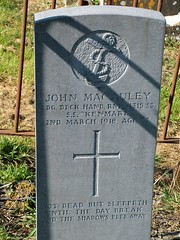
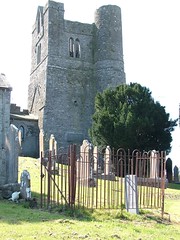
Catherine Ann, John’s wife, died in Stornoway on 17 April 1961, aged 73. From the limited resources available to me, I have not been able to find out if she remarried and / or had children.
John’s father, Donald Macaulay, passed away in the district of Uig in 1933, aged 80.
John Macaulay is remembered on the commemorative panel in Grangegorman Military Cemetery, Blackhorse Avenue, Dublin.

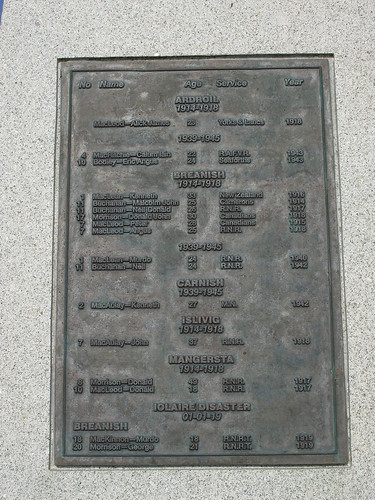
He is also mentioned on the West Uig division of the Lewis War Memorial at Stornoway

and on the Uig War Memorial at Timsgarry
Sources
• David J. Grundy, Skerries, Dublin
• Scotland’s People
• The Drogheda Historical Society, from the archives of The Drogheda Independent and The Drogheda Advertiser, Mellmount Museum, Drogheda, Co Louth, Ireland
• Stornoway Gazette, 15th March 1918 and 12th April 1918, from transcript of original copies, held on microfiche at Stornoway Library
• Comann Eachdraidh Uig, Uig Museum, Timsgarry, Isle of Lewis
• Commonwealth War Graves Commission
• Cork Examiner archives (now Irish Examiner), courtesy Brendan Mooney
• From book: The Irish Boats (Cork & Waterford), courtesy Brendan Mooney
• Uboat.net
• Portrait photograph: Loyal Lewis Roll of Honour 1914-1918, Stornoway Gazette, 1921 (held at Stornoway Library)
John Macaulay was lost when SS Kenmare was torpedoed in the Irish Sea on 2 March 1918. He came from the village of Islivig in the district of Uig in Lewis. His remains turned up on the east coast of Ireland, north of Dublin, and lie buried in a grave in Balrothery. His grave is marked by a Commonwealth War¬graves Commission headstone.
This tribute is dedicated to his memory, and endeavours to tell the story of SS Kenmare, the German submarine U-104 which fired the fatal torpedo and John Macaulay’s final resting place.
John’s family history
John was the son of fisherman Donald Macaulay of Islivig and domestic servant Margaret Macaulay who were married at Miavaig on 4 April 1878. Both were aged 26 at the time. It is worth pointing out that in the Gaelic community, the name Margaret is sometimes converted to Peggy. They continued to live in Islivig after their marriage. Donald and Peggy were blessed with the birth of a son, John, on 7 December 1881. It has not been part of my investigations to find out whether they had any more children.
Thirty-six years later, on 16 January 1917, John (now living at 7 Islivig) was married to Catherine Ann Macaulay, a 29-year old nurse from 19 Brenish. She is the daughter of boat-builder John Macaulay and Isabella Matheson. The marriage was conducted at Seaforth House on Scotland Street in Stornoway.
By that time, John’s mother Peggy had died, and Donald, by that time aged 62, was a crofter. His son, John, was a seaman in the Merchant Service, but (1917 being a war year) also marked as being in the Royal Naval Reserve, as so many islanders were.
S.S. Kenmare
[A picture of the ship previously published at this location turned out to be that of a different vessel by the same name]
The Kenmare was launched on 16 February 1895 at Wigham, Richardson and Co. of Newcastle upon Tyne. She was powered by a triple-expansion steam engine, generating 437 hp. She was completed for the City of Cork Steam Packet Co. Ltd. Her dimensions were 264.5 x 36.5 x 16.9 feet, measuring 1,346 gross tons.
During the First World War, she found herself under attack by German submarines (U-boats) on four occasions. On 27 June 1915, SS Kenmare was attacked by gunfire off Youghall, but outran her attacker with minimal damage. Two years later, on 21 October 1917, Kenmare was off Holyhead, bound from Liverpool to Cork, when a torpedo passed only a few feet from her stern. A few weeks later, the Kenmare had to fire at a submarine that was chasing her. However, the last attack, on 2 March 1918, proved fatal.
That day, SS Kenmare was sailing from Liverpool to Cork with a general cargo at position 53°40’095”N 5°06’099”W. This is 60 km (approximately 35 nautical miles) northeast of Skerries, Co Dublin. At around 7pm, U-104 fired a torpedo without warning. It inflicted severe damage, and Kenmare sank by the stern within two minutes. Only one lifeboat was serviceable, and the three who had managed to get into it tried to find other crew members. Three more were saved. In spite of shouting being heard, the occupants of the lifeboat did not manage to locate these unfortunates as it was dark by that time and the sea covered in wreckage. Twenty-nine members of crew perished, 24 of whom were in a boat which overturned – the weather being poor and the sea rough at the time. The First Mate, four crewmen and one gunner (RNR man Joseph Broughman, aged 20) survived the torpedoing of the ship. This was remarkable, bearing in mind that the ship sank in just two minutes. Two other gunners, A. E. Aston and John Macaulay, did not survive. Apparently, the ship’s gun had been thrown from its mountings by the force of the explosion. The survivors were picked up by the steamer Glenside the next morning, and taken to Dublin.
Postscript
U-boat 104 had been in service for only five months at the time of the attack on the Kenmare. U-104 sank a total of eight ships, which accounted for a third of the number of ships (25) sunk by its commander, 32-year old Kapitän-Leutnant zur See Kurt Bernis, until he was killed in the sinking of his U-boat on 25 April 1918.
On 23 April 1918, U-104 was attacked by USS Cushing using depth charges. These damaged the submarine. Two days later, HMS Jessamine came across the submarine on the surface in St George’s Channel as its crew were attempting to repair the damage, caused by the depth charges. KLt Bernis dived his submarine, but depth charges from HMS Jessamine forced him to surface. The U-boat was finally sunk, taking 31 to the bottom with her. Ten sailors were left in the water, after their vessel went down, of whom only one was picked up by the warship. The other nine were left to drown in the sea.
Found in Ireland
John Macaulay was not saved from the sinking of the Kenmare. Although the one working lifeboat remained on the scene as long as possible, the shouting of the floundering seamen ceased after some 10 minutes. It is a matter of conjecture what happened during the next fourteen days.
Coast Watchman John Doherty and Constable Masterson found the body of John Macaulay on a beach at King’s Point (shown left) on 16th March. Two other bodies turned up on nearby beaches at Skerries and Gormanston, but only John Macaulay’s body could be identified. He carried a letter which is said to have identified him as George [sic] Mcauley of Stornaway. He is described as a fine young sailor of about 25 – however, at the time of his death, John Macaulay was actually aged thirty-five. All three were dressed in semi-naval uniform. Inquests into the deaths of the three naval were held by Coroners Friery and Corry, and the evidence disclosed nothing further than that two of the men carried beads and scapulars, while a disc showed that McAuley was a Presbyterian. The bodies, which were only a few days in the water, bore no sign of violence, and the medical testimony was that death was due to drowning. A verdict of “found drowned” was duly returned by the Jury under foreman Mr George Mongey.
News found its way to John’s native Isle of Lewis, and was relayed by local weekly newspaper Stornoway Gazette, on 15 March 1918.
“It is with deep regret we have to record the death by drowning of Seaman John Macaulay (Iain Dhomhnaill an Taillear) [John the son of Donald the Tailor] Islivig on Saturday 2nd inst. His boat the “Kenmore” [sic] was torpedoed, and only six out of a crew of thirty-five were saved. John was one of the finest young men that could be met in a day’s march. To his young and sorrowing widow, and to his other near relatives and friends, the heartfelt sympathy of the whole community is extended in their very sad and sore bereavement.”
John’s mother had endeavoured to have the body transferred home, but the authorities would not sanction this. An account of the funeral was forwarded to his parents by the Acting Divisional Officer of Coastguard at Rush, and the Stornoway Gazette copies this; I insert additional information as supplied by the Drogheda Independent and Drogheda Advertiser in their editions of March 23rd, 1918.


Postscript
It would stand to reason that such a grand occasion would be remembered for many years to come in a small town like Balbriggan. Not in this instance. British armed forces burned and looted the centre of the town on 9 September 1920 in reprisal for an assault in a pub on one of their members. This would have eclipsed if not erased the burial in the collective and popular memory of the inhabitants of the town.
In the 1930s, the Commonwealth War Graves Commission commissioned the erection of a grave-stone over John Macaulay’s grave at Balrothery, a gravestone which faces east. His was one of many such gravestones in Ireland that were put up by the Office of Public Works, a branch of the Irish Government. In the 1920s, the family ordered the installation of iron railings around the grave site. The spelling of John Macaulay’s name on the gravestone (Macauley) is noted, but the information on the stone confirms the identity of the casualty.
Catherine Ann, John’s wife, died in Stornoway on 17 April 1961, aged 73. From the limited resources available to me, I have not been able to find out if she remarried and / or had children.
John’s father, Donald Macaulay, passed away in the district of Uig in 1933, aged 80.
John Macaulay is remembered on the commemorative panel in Grangegorman Military Cemetery, Blackhorse Avenue, Dublin.

He is also mentioned on the West Uig division of the Lewis War Memorial at Stornoway
and on the Uig War Memorial at Timsgarry
Sources
• David J. Grundy, Skerries, Dublin
• Scotland’s People
• The Drogheda Historical Society, from the archives of The Drogheda Independent and The Drogheda Advertiser, Mellmount Museum, Drogheda, Co Louth, Ireland
• Stornoway Gazette, 15th March 1918 and 12th April 1918, from transcript of original copies, held on microfiche at Stornoway Library
• Comann Eachdraidh Uig, Uig Museum, Timsgarry, Isle of Lewis
• Commonwealth War Graves Commission
• Cork Examiner archives (now Irish Examiner), courtesy Brendan Mooney
• From book: The Irish Boats (Cork & Waterford), courtesy Brendan Mooney
• Uboat.net
• Portrait photograph: Loyal Lewis Roll of Honour 1914-1918, Stornoway Gazette, 1921 (held at Stornoway Library)
• Photographs of Balbriggan Coast Guard Station are the copyright of Mr. David Brangan and is reproduced with his kind permission.
Wednesday, 1 September 2010
Wednesday 1 September
The evenings are now drawing in, and it gets dark well before 9 pm. Only a few weeks away from the equinox, and all that. The hurricane season has come to live, and it takes me nearly half an hour to update the bulletins on my Tropical Cyclones blog. Hurricane Earl is bearing down on North Carolina and the US East Coast, while Typhoon Kompasu is making for Seoul.
Went for a walk around the town this afternoon, but ended up midge-fodder. Part of the Nicolson Institute has been knocked down, affording views in the area not seen since the 1930s. Got a few bits and pieces in the shops before escaping from the winged fiends.

Harris Tweed project, island primary schools

Cairn Dhu, Matheson Road

Nicolson Institute (with one building knocked down)
Went for a walk around the town this afternoon, but ended up midge-fodder. Part of the Nicolson Institute has been knocked down, affording views in the area not seen since the 1930s. Got a few bits and pieces in the shops before escaping from the winged fiends.
Harris Tweed project, island primary schools
Cairn Dhu, Matheson Road
Nicolson Institute (with one building knocked down)
Hurricane update - 1 September
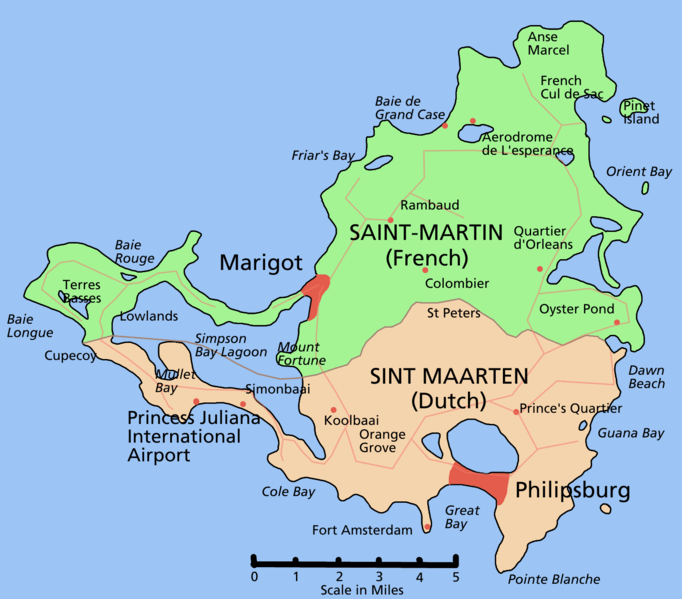
This is a map of the island of St Martin in the Caribbean. As the scale shows, it measures about 12 by 12 miles. It is part French and part Dutch - see this Wikipedia article for more details.The reason I'm flagging it up is that the two governments are not talking to each other with regards the approach of tropical storm Fiona. This tropical cyclone is not as strong as Earl, at the beginning of the week, but could still pack a nasty punch in the shape of rain. The bemusing fact is that according to the National Hurricane Center, the French part of the island is under a tropical storm warning, meaning that winds above galeforce could arrive within 24 hours; and the Dutch part is under a tropical storm watch - like the other islands in the vicinity, minus French St Barthelemy which, like St Martin, is also under warning. I have emailed the weather services for both halves of the island asking them to have a look at this situation.
Hurricane Earl meanwhile is on its way to the US East Coast, which it will graze. The Canadian Maritime provinces will see a lot more of Earl than they'd like - most likely a category I hurricane by that time.
In the Pacific, typhoon Kompasu is making a beeline for Korea, which can look forward to a typhoon strike with winds of 95 knots, that's 110 mph, near the South Korean capital, Seoul. North Korea is expected to experience the worst of Kompasu. After passing over the Korean peninsula, the storm will veer east and pass within reach of Vladivostok in Russia.
Tuesday, 31 August 2010
Tuesday 31 August
It is 13 years ago today that Princess Diana died as a result of injuries, sustained in a car crash in Paris. Just after midnight on 31 August 1997, the Princess was rushed from the Paris Ritz Hotel in order to evade waiting celebrity journalists, paparazzi. Her driver, Henri Paul, was called up at the last moment, although he had been drinking that evening. The third person in the car was Diana's lover, Dodi al-Fayed, son of Mohamed al-Fayed, the Egyptian businessman who was the owner of the Harrods store in London. Just before 1 am, the Princess' car entered an underpass along the Seine River at high speed, and careered out of control into a pillar. The vehicle deflected off the pillar and came to a halt in the middle of the underpass. Dodi al-Fayed and Henri Paul were killed on the spot, but Princess Diana was still alive. She was transferred to hospital in Paris, but died at 5 am.
I have never seen such an outpouring of public grief, including by radio and television presenters. Ordinary people congregated outside Buckingham Palace and Kensington Palace and left banks of flowers. The Royal Family nearly tripped up over the issue, with Queen Elizabeth II taking days to properly assess the situation and make a public statement. Princess Diana was a royal who appealed to average British people.
Fast forward to the year 2010. As I type this, the month of August is quietly coming to a close. I've spent the day compiling a tribute to a Lewis sailor who drowned off the Irish coast in 1918 after his ship was torpedoed. The U-boat involved was sunk a few weeks later, with 9 of its crew left to drown in the sea; 31 others went down with the sub. Only one crewmen was saved by HMS Jessamine. An understandable action - U-boat crews were responsible for some pretty atrocious acts after torpedoing ships in the First World War.The tribute will be published on this blog in the next few days.
Hurricane update - 31 August
Five tropical cyclones to watch today. Danielle is no longer a tropical cyclone, just a very deep area of low pressure southeast of Newfoundland.
Hurricane Earl is a category IV hurricane, now moving away from Puerto Rico. This system will approach the American East Coast, anywhere north from Cape Hatteras to Nova Scotia. The inherent uncertainty surrounding hurricanes is very visible, as Earl has the potential to directly affect any part of the aforementioned coastline. The hurricane is now carrying maximum sustained winds of 135 mph.
Tropical storm Fiona is approaching the Leeward Islands, which will have to suspend mopping up after Earl. This is a relatively weak affair, with winds at galeforce (force 8 to 9 on the Beaufort scale).
In the Pacific, Lionrock, Kompasu and Namtheun are doing a menage-a-trois, but the first two should be watched. Kompasu will make landfall near Seoul with winds of 90 knots, that's a trifling 105 mph near the centre. Lionrock will make landfall in eastern China at tropical storm strength, bringing deluges of rain.
Monday, 30 August 2010
Monday 30 August
A nice day, quite a decent temperature (for this neck of the woods), 16C. No coat required for walk to shop this afternoon. The pretty yacht that was in on Sunday has disappeared; AIS tells me it left after 10pm last night, destination "Home".

This is the Eleonora E, which is a replica of the 1910-built schooner Windward.
Here in Lewis, the battle for the Pairc Estate has hotted up and the gloves are off. Under Scottish law, the community can purchase the estate they reside on, whether the landlord wants to cooperate or not. Barry Lomas, owner of the Pairc Estate, most definitely does not want to part with his land - even less so now that a windfarm could be built on it, meaning its value would skyrocket. According to the Pairc Trust, which are spearheading the community buy-out bid since 2004, his family have ratcheted up an 85-year record of neglect.

Gravir, Pairc
This is the Eleonora E, which is a replica of the 1910-built schooner Windward.
Here in Lewis, the battle for the Pairc Estate has hotted up and the gloves are off. Under Scottish law, the community can purchase the estate they reside on, whether the landlord wants to cooperate or not. Barry Lomas, owner of the Pairc Estate, most definitely does not want to part with his land - even less so now that a windfarm could be built on it, meaning its value would skyrocket. According to the Pairc Trust, which are spearheading the community buy-out bid since 2004, his family have ratcheted up an 85-year record of neglect.
Gravir, Pairc
Hurricane update - 30 August
No fewer than five tropical cyclones to watch at present, with one possibly about to form, and another about to cease being a tropical cyclone.
Danielle is turning into a non-tropical storm depression south of Newfoundland, and will head towards Greenland.
Earl is a category III hurricane, which is presently giving the northern Leeward Islands, Virgin Islands and Puerto Rico hurricane-force winds. Its future path should give concern to the US east coast, although it is more likely that Nova Scotia gets a category II hurricane knocking on its door later this week.
Lionrock is a tropical storm in the western Pacific, bound into an unholy threesome with nearby storms Kompasu and Namtheun, in the vicinity of Taiwan. Kompasu is a 75 knots typhoon, Namtheun is a minor tropical storm, which will be gobbled up by Lionrock as that storm strengthens into a typhoon.
97L is a tropical disturbance which is trying to catch up with Earl - this gives the forecasters a headache as it introduces all sorts of uncertainties.
In summary: watch Earl if you're in the Caribbean or the US East Coast / Canadian Maritimes.
Sunday, 29 August 2010
Stranded

The cruiseliner Clipper Adventurer (shown above during a visit to Stornoway in September 2007) has run aground on an uncharted rock in the Northwest Passage in the Arctic, southwest of Victoria Island. This according to MSNBC. Attempts to get free from the obstacle have failed, which have left the liner aground and listing slightly. The icebreaker Amundsen has been despatched to take the passengers to safety. Nobody is reported hurt.
Post Katrina

Found in an abandoned house in New Orleans after Katrina, books stuck together - suspended as shown in picture. Image posted under Creative Commons License, courtesy Incognita Nom de Plume. Please click on picture for more information in the comments section.
Today 80 years ago
Sixty miles southwest of Lewis, the villagers of St Kilda were packing up their belongings, before leaving the island of their birth forever. Some left a bowl of grain on the table, with the Bible open at the chapter of Exodus. A community, a culture, a way of life was coming to a close after thousands of years. Life on their outpost in the Atlantic had become untenable, to their minds, and the Hiorteachs had requested their own removal. The steamer Harebell took them to the village of Lochaline, on the mainland and on to Glasgow.
A lot has been written about St Kilda, with insights changing as the years and researches progress. Someone has recently mooted the idea to repopulate the islands with permanent inhabitants - an idea that is as fanciful as it is unrealistic. Even today, with modern, powerful boats, it is not always possible to cross the sea to the islands. In the past, there would be no communication with St Kilda for 8 months of the year, due to the severity of the weather and the ocean. That has not changed.
Work is in progress to establish a St Kilda Centre at Mangersta in Lewis, where culture and history of St Kilda will be remembered. For it is no longer alive.
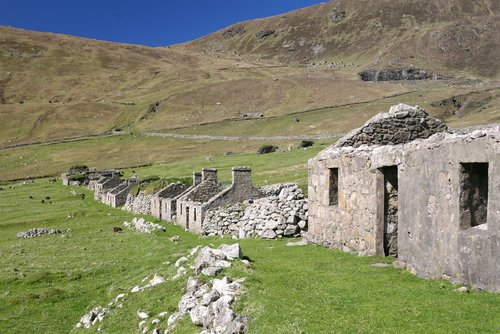
Image courtesy planetware.com
A lot has been written about St Kilda, with insights changing as the years and researches progress. Someone has recently mooted the idea to repopulate the islands with permanent inhabitants - an idea that is as fanciful as it is unrealistic. Even today, with modern, powerful boats, it is not always possible to cross the sea to the islands. In the past, there would be no communication with St Kilda for 8 months of the year, due to the severity of the weather and the ocean. That has not changed.
Work is in progress to establish a St Kilda Centre at Mangersta in Lewis, where culture and history of St Kilda will be remembered. For it is no longer alive.
Image courtesy planetware.com
Today 5 years ago
The hurricane in focus on 29 August 2005 was of course Katrina, one of the most devastating tropical cyclones to affect the US mainland in modern times. Although it had weakened prior to landfall in New Orleans, its impact was devastating. I blogged about it a few days ago, so will just dedicate the entry to the memory of those lost in that disaster, in New Orleans and along the Gulf Coast.

Gulfport

Biloxi


Gulfport
Biloxi
Subscribe to:
Posts (Atom)