The hours of darkness were punctuated by high winds and heavy rain. These abated by about 5 am. As I glanced across the bay at that hour, I noticed a blur of light beside the lighthouse that is not normally there. On training the binoculars on it, it turned out to be a stationary ship. It appeared to be in a position to the north of the Arnish Peninsula, i.e. a bit too close in to shore for good comfort. However, its lights were on and nobody was rushing out to help, so I concluded that all was well. When daylight came, just after 7, the ship in question was on the other side of the peninsula, to the south, and its superstructure peeped above the low land by the lighthouse. I have often found the perspective to be deceiving here, particularly in the dark. The lighthouse, for instance, is exactly 1 mile from my position (across the water), but appears to be much closer. It is not until you step out on the causeway that you realise the distance.
I have completed the transcription of all the war memorials here in Lewis, with the addition of the 23 panels from the Lewis War Memorial. This contains the names of 1,600 people who were lost in WW1 and WW2. I am now continuing my search for the 400 cemeteries and memorials across the world which are the final resting place or the location of remembrance for all from the island who were lost in foreign fields, or on the seas of the world. This link shows the first 100.
Sunday, 13 February 2011


13 February
Today, 319 years ago, 38 members of the Clan Macdonald were killed in Glen Coe, when their guests, members of the Clan Campbell, turned on them. Glencoe, a spectacular mountain valley about 80 miles north of Glasgow, is now synonymous with this crime. the details of which are outlined on this Wikipedia article.
The involvement of King William III renders this a black mark on the conscience of the Dutch - he assumed the English throne when he came across from Holland as William of Orange. In the Netherlands, he is referred to as the Father of the Fatherland - translating directly. 23 years ago, there were extensive celebrations on the 300th anniversary of William's marriage to Queen Mary II of England. This lasted for 6 years, until Mary's death in 1694.
William III has another black mark on his record, commonly referred to as the Battle of the Boyne. This battle, which took place on Irish soil in 1689, has been used as a pretext by extremist sections of the Protestant and Catholic communities in (Northern) Ireland for acts of violence in the 20th century.
Mind you, if you think that is bad, it is worth bearing in mind that the war in the Balkans in the 1990s was justified by Serbia's president Slobodan Milosevic on account of the Battle of Kosovo in 1390.
The involvement of King William III renders this a black mark on the conscience of the Dutch - he assumed the English throne when he came across from Holland as William of Orange. In the Netherlands, he is referred to as the Father of the Fatherland - translating directly. 23 years ago, there were extensive celebrations on the 300th anniversary of William's marriage to Queen Mary II of England. This lasted for 6 years, until Mary's death in 1694.
William III has another black mark on his record, commonly referred to as the Battle of the Boyne. This battle, which took place on Irish soil in 1689, has been used as a pretext by extremist sections of the Protestant and Catholic communities in (Northern) Ireland for acts of violence in the 20th century.
Mind you, if you think that is bad, it is worth bearing in mind that the war in the Balkans in the 1990s was justified by Serbia's president Slobodan Milosevic on account of the Battle of Kosovo in 1390.
Saturday, 12 February 2011
Saturday 12 February
Quite a nice and sunny day, but as the afternoon came to a close, the wind was picking up. We are on warning for winds up to galeforce overnight, and tomorrow will be as wet as Friday. It's a see-saw weather pattern we're in - your average Hebridean winter in other words.
Not so nice is the weather in the Indian Ocean, where tropical cyclone Bingiza is blowing up to a category III hurricane by the time it reaches eastern Madagascar on Monday. We're talking winds of 105 knots, 120 mph. The winds are bad enough, but the main threat for Madagascar tends to be flooding. Hurricane Ivan wreaked havoc in the north of the island in 2008; and hardly anyone knew about it.
I am completing the transcript of the war memorials here in Lewis, all 15 of them. The Lewis War Memorial, at the northern end of Stornoway, is proving a challenge, due to the poor legibility of the panels on my photographs. I'll get there yet.
Not so nice is the weather in the Indian Ocean, where tropical cyclone Bingiza is blowing up to a category III hurricane by the time it reaches eastern Madagascar on Monday. We're talking winds of 105 knots, 120 mph. The winds are bad enough, but the main threat for Madagascar tends to be flooding. Hurricane Ivan wreaked havoc in the north of the island in 2008; and hardly anyone knew about it.
I am completing the transcript of the war memorials here in Lewis, all 15 of them. The Lewis War Memorial, at the northern end of Stornoway, is proving a challenge, due to the poor legibility of the panels on my photographs. I'll get there yet.
Friday, 11 February 2011
Friday 11 February
Egypt's president Hosni Mubarak has stood down and has left Cairo for Sharm el-Sheikh, a resort on the Red Sea coast. His departure follows 18 days of protests in the centre of the capital, broadly condoned by the army. Several attempts by Mubarak to placate his opponents by promising to resign later in the year did nothing to assuage his critics. And today, he left office.
It is a victory for the ordinary man and woman of Egypt, all 85 million of them. Nobody from outside was involved, and outside issues did not feature in the protests. It was an impopular and despotic ruler that was the object of protests. The advent of the Internet has made it possible, it has shown Egyptians what is possible. Tunisia, but other places too, has shed its despots. Who will be next? Gadaffi, Assad, the Arabian leaders?
What will happen next is anyone's guess. But it will be a series of decisions that are up to the Egyptians to make. If free and fair elections, promised by the armed forces, result in an Islamic party coming to power, so be it. The peace treaty between Egypt and Israel, signed by the late president Sadat and late premier Begin in the 1970s, does not appear to be in jeopardy. Tearing it up is in nobody's interest.
Our wet weather pales into insignificance compared to the momentous events in Cairo today.
It is a victory for the ordinary man and woman of Egypt, all 85 million of them. Nobody from outside was involved, and outside issues did not feature in the protests. It was an impopular and despotic ruler that was the object of protests. The advent of the Internet has made it possible, it has shown Egyptians what is possible. Tunisia, but other places too, has shed its despots. Who will be next? Gadaffi, Assad, the Arabian leaders?
What will happen next is anyone's guess. But it will be a series of decisions that are up to the Egyptians to make. If free and fair elections, promised by the armed forces, result in an Islamic party coming to power, so be it. The peace treaty between Egypt and Israel, signed by the late president Sadat and late premier Begin in the 1970s, does not appear to be in jeopardy. Tearing it up is in nobody's interest.
Our wet weather pales into insignificance compared to the momentous events in Cairo today.
Thursday 10 February
A bright and sunny day, which makes a change from the dreich and grey conditions of late.
I kept myself busy compiling a map showing the positions of cemeteries and memorials across the world, where casualties from this island lie buried or are remembered, who fell in WW1 and 2. Unfortunately, Google Maps is not the ideal tool for that, and my internet connection ground to a halt after 6pm.
Having watched a programme about the natural wonders of Madagascar, the tropical cyclone centre in La Reunion promptly issued a warning that cyclone Bingiza will hit the island in a couple of days from now. As the forecast stands, maximum sustained winds will be at 85 knots, 90 mph.
The saga surrounding the downgrading of coastguard services around the UK coast took another twist, when the CEO of the MCA admitted that local knowledge would be lost if the current plans were to go ahead. Ever more unacceptable.
I kept myself busy compiling a map showing the positions of cemeteries and memorials across the world, where casualties from this island lie buried or are remembered, who fell in WW1 and 2. Unfortunately, Google Maps is not the ideal tool for that, and my internet connection ground to a halt after 6pm.
Having watched a programme about the natural wonders of Madagascar, the tropical cyclone centre in La Reunion promptly issued a warning that cyclone Bingiza will hit the island in a couple of days from now. As the forecast stands, maximum sustained winds will be at 85 knots, 90 mph.
The saga surrounding the downgrading of coastguard services around the UK coast took another twist, when the CEO of the MCA admitted that local knowledge would be lost if the current plans were to go ahead. Ever more unacceptable.
Wednesday, 9 February 2011
Wednesday 9 February
It's a grey day in Stornoway, with occasional light rain. At least it's not really cold, with the mercury up a few points to 9C / 48F. The weather will continue to fluctuate, as a battle is being fought between cold air over Scandinavia and milder air over the Atlantic. The mild air looks set to win at this stage. However, it's still only February and three weeks left in that month.
Yesterday, I was thinking that the southern Indian Ocean had been quiet so far, in terms of tropical cyclone formation. Promptly, up pops this disturbance (94S), which is rumbling away some 450 miles north of La Reunion, which looks set to turn into a nasty piece of work. At the moment, it may well intensify to a category II hurricane as it passes just west of La Reunion over the weekend. I should get a flood of visits to my Tropical Cyclones blog - when cyclone Gamede passed by the Mascaregnes in 2007, the record for the number of daily visits was around 3,000.
If you want to read a long and verbose account of speeches to a departing president of the Gaelic Society of London, look no further than my local history blog Pentland Road. Roderick Macleod lost a son in WW1 (hence my interest), and left the presidency of the GSL in 1927. His farewell do attracted about 200 dignitaries.
Yesterday, I was thinking that the southern Indian Ocean had been quiet so far, in terms of tropical cyclone formation. Promptly, up pops this disturbance (94S), which is rumbling away some 450 miles north of La Reunion, which looks set to turn into a nasty piece of work. At the moment, it may well intensify to a category II hurricane as it passes just west of La Reunion over the weekend. I should get a flood of visits to my Tropical Cyclones blog - when cyclone Gamede passed by the Mascaregnes in 2007, the record for the number of daily visits was around 3,000.
If you want to read a long and verbose account of speeches to a departing president of the Gaelic Society of London, look no further than my local history blog Pentland Road. Roderick Macleod lost a son in WW1 (hence my interest), and left the presidency of the GSL in 1927. His farewell do attracted about 200 dignitaries.
Tuesday, 8 February 2011
Tuesday 8 February
Not a very inspiring day, weatherwise, with a cold wind blowing and increasing amounts of cloud. Processed information on a Lewis-related item (see Pentland Road blog). I have more, but that will involve copying nearly a dozen pages of small print.
The Coastguard revamp continues to hog the news headlines for us in the Western Isles, because the CEO for the Maritime and Coastguard Agency insists that his staff broadly support the plans for downgrading the service, and it's just the members of the public that cry blue murder - because they are unfamiliar with the workings of the Coastguard service. The only problem with that problem, Sir Alan Massey, is that a lot of criticism of your plans actually come from Coastguard staff. Furthermore, you have only been in office for 7 months, and I think your staff know rather more about their agency than you do.
There was this journalist who thought that everything she wrote on Twitter was only intended for her 700-odd followers. She is obviously not aware that anybody can see your Twitter feed (except if you make it private). Still on the subject of social media, many people have an account on Twitter as well as Facebook, with different contacts on either service. And cross-posting may not always be a good idea!
The Coastguard revamp continues to hog the news headlines for us in the Western Isles, because the CEO for the Maritime and Coastguard Agency insists that his staff broadly support the plans for downgrading the service, and it's just the members of the public that cry blue murder - because they are unfamiliar with the workings of the Coastguard service. The only problem with that problem, Sir Alan Massey, is that a lot of criticism of your plans actually come from Coastguard staff. Furthermore, you have only been in office for 7 months, and I think your staff know rather more about their agency than you do.
There was this journalist who thought that everything she wrote on Twitter was only intended for her 700-odd followers. She is obviously not aware that anybody can see your Twitter feed (except if you make it private). Still on the subject of social media, many people have an account on Twitter as well as Facebook, with different contacts on either service. And cross-posting may not always be a good idea!
Monday, 7 February 2011
Monday 7 February
A day of sunshine and showers, and the most fantastic gallery of cloudscapes that graces the southern horizon. Who needs paintings, television, internet when you can just look out of the window and see an ever changing tableau in the sky? Worth more than anything I can think of.
On a related topic, I have been told that my submissions to Blipfoto could feature on the website of the Scottish Government. Nice accolade.
As I have been posting on Twitter and Facebook, I have today reduced the number of Facebook apps from 187 to 44. The excellent social media website mashable.com featured an article on Facebook privacy which I strongly recommend to everyone who uses Facebook. I have heard too many instances where people got caught out by the stuff they innocently put on their Facebook page; only to get into serious trouble over them. Varying from losing a job to family strife or marital breakdowns.
The reduction also showed how my use of Facebook has changed since I started on the site in October 2008. I used to authorise all sorts of apps (hence that high number), but nowadays I can't be bothered to reply to the requests - sorry.
I am presently compiling a website listing the fifteen or so war memorials in the Isle of Lewis. It's a work in progress at the moment, but you can preview on this link.
On a related topic, I have been told that my submissions to Blipfoto could feature on the website of the Scottish Government. Nice accolade.
As I have been posting on Twitter and Facebook, I have today reduced the number of Facebook apps from 187 to 44. The excellent social media website mashable.com featured an article on Facebook privacy which I strongly recommend to everyone who uses Facebook. I have heard too many instances where people got caught out by the stuff they innocently put on their Facebook page; only to get into serious trouble over them. Varying from losing a job to family strife or marital breakdowns.
The reduction also showed how my use of Facebook has changed since I started on the site in October 2008. I used to authorise all sorts of apps (hence that high number), but nowadays I can't be bothered to reply to the requests - sorry.
I am presently compiling a website listing the fifteen or so war memorials in the Isle of Lewis. It's a work in progress at the moment, but you can preview on this link.
Sunday, 6 February 2011
Sunday 6 February
A sunny day, but with varying amounts of cloud and one or two showers passing us to the south.
I could not believe my eyes when local broadcaster STV reported that Molly Campbell had returned to the UK. Molly made headlines in the summer of 2006, when she vanished from the Nicolson Institute here in Stornoway to be with her father in Lahore, Pakistan. Her mother, Louise, reported her missing, but the daughter later turned up in Pakistan. Molly (now called Misbah) voluntarily went east. She has now returned of her own free will again, and is living with her sister in England. Their mother has travelled south of the border to be with her daughters. Misbah's return is said to be permanent.
The Prime Minister, David Cameron, has enunciated that the multicultural society has failed, and we should return to a sense of national pride. That, to my mind, opens the door to negative discrimination of ethnic minorities and the victimisation of those who adhere to the Muslim faith. It is perfectly possible to be proud of your nationality, and you can take even more pride by being welcoming to those who want to join you from overseas. Mr Cameron's remarks are more redolent of the extreme-right BNP party than of a party in national government.
I could not believe my eyes when local broadcaster STV reported that Molly Campbell had returned to the UK. Molly made headlines in the summer of 2006, when she vanished from the Nicolson Institute here in Stornoway to be with her father in Lahore, Pakistan. Her mother, Louise, reported her missing, but the daughter later turned up in Pakistan. Molly (now called Misbah) voluntarily went east. She has now returned of her own free will again, and is living with her sister in England. Their mother has travelled south of the border to be with her daughters. Misbah's return is said to be permanent.
The Prime Minister, David Cameron, has enunciated that the multicultural society has failed, and we should return to a sense of national pride. That, to my mind, opens the door to negative discrimination of ethnic minorities and the victimisation of those who adhere to the Muslim faith. It is perfectly possible to be proud of your nationality, and you can take even more pride by being welcoming to those who want to join you from overseas. Mr Cameron's remarks are more redolent of the extreme-right BNP party than of a party in national government.
Saturday 5 February
Was treated to the unusual sight of MV Muirneag hoving into view this morning. Our freight ferry has not put to sea at all this week, and last night was the first time she ventured out. The Muirneag is more than 30 years old, and is not good at manoeuvering in adverse conditions. Long term readers of my blog may remember an episode in 2005, when she was caught in stormforce winds which forced her 60 miles off course, well on the way to the Faroe Islands (250 miles north of here).
I have completed another big chunk of transcriptions from the reports from the Napier Commission (1883), which is a crucial document in the history of the Highlands and Islands. The county of Sutherland was the scene of the some of the worst abuses of crofters. Bear in mind that there was more to the clearances than people being shunted off to Canada or Australia. The session at Bonar Bridge e.g. revealed how the rent of some crofters was bumped up from 1s to £6 - an increase of 1200% [£1 = 20s] over a few years. It is a long read, but if you take the time, you'd be horrified.
The next batch of transcriptions will cover Ross-shire; for Scottish readers, this is strictly speaking Wester Ross, from Ullapool south to the Applecross peninsula; as well as a session at the county town, Dingwall.
I have completed another big chunk of transcriptions from the reports from the Napier Commission (1883), which is a crucial document in the history of the Highlands and Islands. The county of Sutherland was the scene of the some of the worst abuses of crofters. Bear in mind that there was more to the clearances than people being shunted off to Canada or Australia. The session at Bonar Bridge e.g. revealed how the rent of some crofters was bumped up from 1s to £6 - an increase of 1200% [£1 = 20s] over a few years. It is a long read, but if you take the time, you'd be horrified.
The next batch of transcriptions will cover Ross-shire; for Scottish readers, this is strictly speaking Wester Ross, from Ullapool south to the Applecross peninsula; as well as a session at the county town, Dingwall.
Friday, 4 February 2011
The Politician
The SS Politician was a merchant ship, which was sailing from Liverpool to Jamaica in December 1941. On February 5th, she ran aground on the island of Calvay, between the larger islands of Eriskay and South Uist. She later broke up and sank. Her cargo included tens of thousands of bottles of whisky - which inspired Compton Mackenzie to write his famous book Whisky Galore, the word Galore being one of the few Gaelic words that are in common usage in English today. Gu Leor means plenty.
The whisky was salvaged by the islanders. Although a near-endless supply of whisky may seem like heaven on earth, it did cause serious health problems in the longer run. Alcoholism and all its attendant problems, for instance.
The Politician did not just carry whisky. She also had a consignment of Jamaican banknotes, a grand piano, bathroom fittings and bicycles. The fittings were put to good use outside one islander's home, and were still being used decades later - in an outhouse beside a stream.
Even here in Lewis, there are stories around, if you know where to listen. Of the odd case being 'smuggled on request', and the skipper of the ferry distracting the 'polis' whilst the runner makes his get-away.
The whisky was salvaged by the islanders. Although a near-endless supply of whisky may seem like heaven on earth, it did cause serious health problems in the longer run. Alcoholism and all its attendant problems, for instance.
The Politician did not just carry whisky. She also had a consignment of Jamaican banknotes, a grand piano, bathroom fittings and bicycles. The fittings were put to good use outside one islander's home, and were still being used decades later - in an outhouse beside a stream.
Even here in Lewis, there are stories around, if you know where to listen. Of the odd case being 'smuggled on request', and the skipper of the ferry distracting the 'polis' whilst the runner makes his get-away.
Friday 4 February
Yesterday's storm finally abated after midnight, but not before blasting the north of Lewis and Shetland with gusts of 104 mph. A fishing vessel broke free from its moorings in Scalloway, Shetland, and had to be tied up again - in 90 mph winds. There appear to have been no casualties. The weather continues inclement in central Scotland, but is not too bad here in the islands. There was a thin drizzle this afternoon.
Events in Egypt continue to develop unpredictably. Liberation Square remains the focal point for the movement which seeks to oust president Mubarak, whose followers tried to remove the protesters with violence yesterday - unsuccessfully. It would appear that this is an issue for the Egyptians themselves to resolve, and there is no way to predict how it will end.
The fishing vessel Jack Abry II which ran aground on the Isle of Rum earlier this week is still stuck fast. There appears to be an oil leak within the vessel, but no oil is leaking out. Dutch salvage equipment is on its way to the island, but the winter weather may delay the recovery of the boat.
This image courtesy hebrides-news.com.

Events in Egypt continue to develop unpredictably. Liberation Square remains the focal point for the movement which seeks to oust president Mubarak, whose followers tried to remove the protesters with violence yesterday - unsuccessfully. It would appear that this is an issue for the Egyptians themselves to resolve, and there is no way to predict how it will end.
The fishing vessel Jack Abry II which ran aground on the Isle of Rum earlier this week is still stuck fast. There appears to be an oil leak within the vessel, but no oil is leaking out. Dutch salvage equipment is on its way to the island, but the winter weather may delay the recovery of the boat.
This image courtesy hebrides-news.com.
Thursday, 3 February 2011
Thursday 3 February
It was windy in the night, and a fall of snow brought the airport to a halt first thing. That was nothing. At 1pm, the weather turned increasingly savage, and at the moment the anemometer is spinning to 86 mph at the Butt of Lewis, 25 miles north of here. Curtains of spindrift are blown across the harbour, in front of my position, and angry white riders adorn the wave crests. Almost all ferry services in the west of Scotland have been withdrawn, in the face of hurricane force winds. Flights are still operating normally. The wind is from the south; as the runway at the airport is north/south orientated, planes can still take off. It will be a very bumpy ride though. There will be a springtide at 7pm tonight, clocking in at 4.8 metres / 16 feet, which coincides with the height of the storm - sandbags at the ready in the flood-prone areas of Stornoway. As I type, I can see huge curtains of spindrift crossing the basin in front of me, indicating that we're heading for force 11. Two poor collar doves were blown around so hard that they had to land in a tree (which doves don't like doing) before finally taking off for their roost in one of the buildings nearby.
Wednesday, 2 February 2011
Wednesday 2 February
Tropical cyclone Yasi has roared ashore in Queensland, with winds well in excess of 200 km/h (125 mph). The impact is as yet unknown, but as day breaks, this should become clearer.
Events in Egypt have taken a turn for the worse, with clashes between supporters and opponents of president Mubarak. Although the president pledged not to stand in the elections later in the year, this has not served to placate his opponents, and quite ugly scenes ensued in the square which has been the focal point of the popular uprising over the past week or so.
Here in the Hebrides, we can expect a fully-fledged storm, with winds up to force 12 in the next 24 to 48 hours. Gusts are anticipated to be in the range of 80 to 90 mph. Nowhere near as bad as in Queensland, but sufficient to cause damage. We'll be battening down the hatches.
Events in Egypt have taken a turn for the worse, with clashes between supporters and opponents of president Mubarak. Although the president pledged not to stand in the elections later in the year, this has not served to placate his opponents, and quite ugly scenes ensued in the square which has been the focal point of the popular uprising over the past week or so.
Here in the Hebrides, we can expect a fully-fledged storm, with winds up to force 12 in the next 24 to 48 hours. Gusts are anticipated to be in the range of 80 to 90 mph. Nowhere near as bad as in Queensland, but sufficient to cause damage. We'll be battening down the hatches.
Tuesday, 1 February 2011
Tuesday 1 February
A bright day with good sunshine - and equally good, heavy, showers. The wind turns squally in the showers, but otherwise it's not too bad. We are on warning for severe gales on Thursday and Friday.
Queensland is on warning for tropical cyclone Yasi, which will strike near the northern city of Cairns during Wednesday local time. At present, maximum sustained winds near the centre are at 135 mph, gusting to a puny 160 mph. This is likely to increase further, and the cyclone could carry winds of 150 mph at landfall, gusting to 180 mph. For the hurricane savvy among you, this is equivalent to a top-end category IV system. I don't think I'd like to be in Queensland just now. Because a category IV hurricane does this:
There is a very high risk of injury or death to people, livestock, and pets due to flying and falling debris. Poorly constructed homes can sustain complete collapse of all walls as well as the loss of the roof structure. Well-built homes also can sustain severe damage with loss of most of the roof structure and/or some exterior walls. Extensive damage to roof coverings, windows, and doors will occur. Large amounts of windborne debris will be lofted into the air. Windborne debris damage will break most unprotected windows and penetrate some protected windows. There will be a high percentage of structural damage to the top floors of apartment buildings. Steel frames in older industrial buildings can collapse. There will be a high percentage of collapse to older unreinforced masonry buildings. Most windows will be blown out of high-rise buildings resulting in falling glass, which will pose a threat for days to weeks after the storm. Nearly all commercial signage, fences, and canopies will be destroyed. Most trees will be snapped or uprooted and power poles downed. Fallen trees and power poles will isolate residential areas. Power outages will last for weeks to possibly months. Long-term water shortages will increase human suffering. Most of the area will be uninhabitable for weeks or months.
Still on weather-related topics, the Chief Coastguard, Sir Alan Massey, made some breathtaking remarks on Scottish TV last night. He said that local knowledge should be pooled onto Google Earth. Well, that's bonny. There is such a thing as the Gaelic language in these parts; and anyone who has ever done a search on Google generally knows what a pile of results can crop up. Secondly, he said that coastguard stations are often overmanned in relation to the amount of work. Accidents and emergencies do not occur on schedule, and do not wait for daylight, when the proposed satellite Coastguard Stations may be manned. Sir Alan also admitted that the cutbacks in service were purely money-related, and if the demand for savings had not come down from upon high, nothing would have changed.
Queensland is on warning for tropical cyclone Yasi, which will strike near the northern city of Cairns during Wednesday local time. At present, maximum sustained winds near the centre are at 135 mph, gusting to a puny 160 mph. This is likely to increase further, and the cyclone could carry winds of 150 mph at landfall, gusting to 180 mph. For the hurricane savvy among you, this is equivalent to a top-end category IV system. I don't think I'd like to be in Queensland just now. Because a category IV hurricane does this:
There is a very high risk of injury or death to people, livestock, and pets due to flying and falling debris. Poorly constructed homes can sustain complete collapse of all walls as well as the loss of the roof structure. Well-built homes also can sustain severe damage with loss of most of the roof structure and/or some exterior walls. Extensive damage to roof coverings, windows, and doors will occur. Large amounts of windborne debris will be lofted into the air. Windborne debris damage will break most unprotected windows and penetrate some protected windows. There will be a high percentage of structural damage to the top floors of apartment buildings. Steel frames in older industrial buildings can collapse. There will be a high percentage of collapse to older unreinforced masonry buildings. Most windows will be blown out of high-rise buildings resulting in falling glass, which will pose a threat for days to weeks after the storm. Nearly all commercial signage, fences, and canopies will be destroyed. Most trees will be snapped or uprooted and power poles downed. Fallen trees and power poles will isolate residential areas. Power outages will last for weeks to possibly months. Long-term water shortages will increase human suffering. Most of the area will be uninhabitable for weeks or months.
Still on weather-related topics, the Chief Coastguard, Sir Alan Massey, made some breathtaking remarks on Scottish TV last night. He said that local knowledge should be pooled onto Google Earth. Well, that's bonny. There is such a thing as the Gaelic language in these parts; and anyone who has ever done a search on Google generally knows what a pile of results can crop up. Secondly, he said that coastguard stations are often overmanned in relation to the amount of work. Accidents and emergencies do not occur on schedule, and do not wait for daylight, when the proposed satellite Coastguard Stations may be manned. Sir Alan also admitted that the cutbacks in service were purely money-related, and if the demand for savings had not come down from upon high, nothing would have changed.
Monday, 31 January 2011
Monday 31 January
Atrocious weather today, with strong winds (up to galeforce) and persistent rain. I nonetheless ventured out at lunchtime for a rally at the Coastguard Station to join a protest against the proposed closure of the station. They held a short march in front of the station, with banners and placards protesting against the closure. A handful of people held speeches, some very powerful, and with the chant "Save Our Station", the rally was closed at 1.30pm.
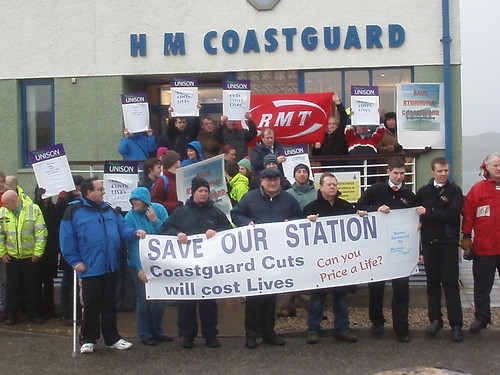

Trades union banners
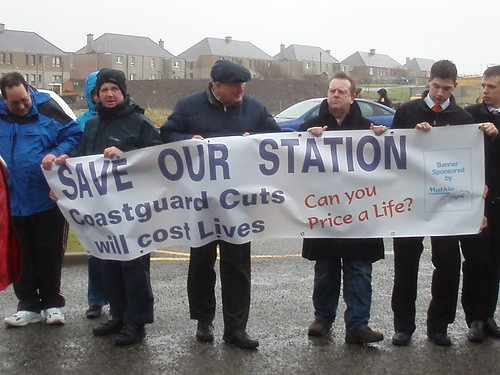
Save Our Station
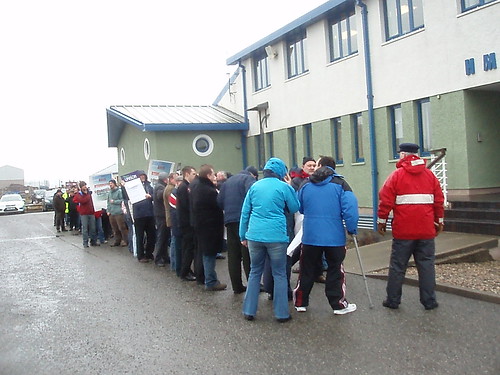
The march
Trades union banners
Save Our Station
The march
Sunday, 30 January 2011
Sunday 30 January
After a spell of heavy rain and high winds, the sun has come out to grace us with its presence for the last hour of daylight. There was a cloud of seagulls over the harbour outside my window, and when I went down to find out what attracted 400 gulls it turned out to be BIRDSEED. Lewis Crofters stock birdseed and other stuff, and as we have not had any heavy rain for a while, a lot of it got washed down the stormdrain and ended up in the harbour.
A moutain walker in the Highlands is the luckiest man alive, after he fell down 1,000 feet off a mountain top, east of Ben Nevis. He was spotted by the crew of a helicopter, who had been sent to his rescue. They did not believe he was the casualty, as he was standing up and reading his map. However, when the chopper crew saw the trail of debris, leading from the summit to the point where the man was standing, it did become clear he was the casualty.
Not so lucky were the passengers on a train in the German state of Sachsen-Anhalt, when it collided head-on with a goods train near Magdeburg. Ten of them died, and 33 were injured. The cause of the crash, which headed on a single-track line, is not clear. German railways (DB) have a good safety record.
I have completed the website for the casualties from the Uists and Barra from WW1 and WW2, replacing two separate webpages. I do not have as much information on the Uists as I had for Lewis, so hope it does serve some purpose.
And today brought more sadness to J-land, when I was told that Angie Marshall (Can you all hear me at the back?) had passed away unexpectedly. I was not a regular reader of her blog, but the expressions of grief over the past few hours have shown she was well loved in the community, and will be sorely missed.
A moutain walker in the Highlands is the luckiest man alive, after he fell down 1,000 feet off a mountain top, east of Ben Nevis. He was spotted by the crew of a helicopter, who had been sent to his rescue. They did not believe he was the casualty, as he was standing up and reading his map. However, when the chopper crew saw the trail of debris, leading from the summit to the point where the man was standing, it did become clear he was the casualty.
Not so lucky were the passengers on a train in the German state of Sachsen-Anhalt, when it collided head-on with a goods train near Magdeburg. Ten of them died, and 33 were injured. The cause of the crash, which headed on a single-track line, is not clear. German railways (DB) have a good safety record.
I have completed the website for the casualties from the Uists and Barra from WW1 and WW2, replacing two separate webpages. I do not have as much information on the Uists as I had for Lewis, so hope it does serve some purpose.
And today brought more sadness to J-land, when I was told that Angie Marshall (Can you all hear me at the back?) had passed away unexpectedly. I was not a regular reader of her blog, but the expressions of grief over the past few hours have shown she was well loved in the community, and will be sorely missed.
Saturday 29 January
A bright day, but the high cloud does not bode too well for the near future. Went outside Stornoway for the first time this year, to Bosta Beach in Great Bernera. That's about 30 miles by road. Bosta is one of my favourites in the island; I also wanted to go there to see the Time and Tide Bell that was installed there last July. It was not working, as the clapper appeared to be missing. In the evening, we gave the restaurant in the An Lanntair [Lantern] arts centre another try, and this time everything was good. Prompt service, good food and a decent price. I'll spare you the disasters that have befallen me there over the past five years.
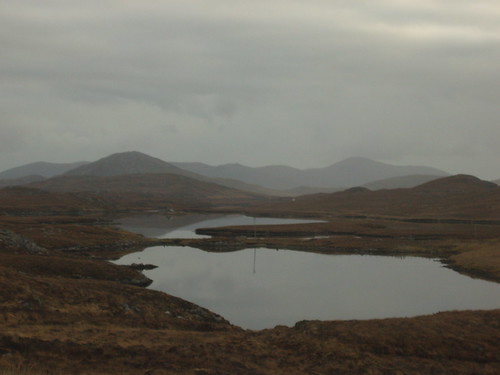
Looking towards Roineabhal from the Bernera road
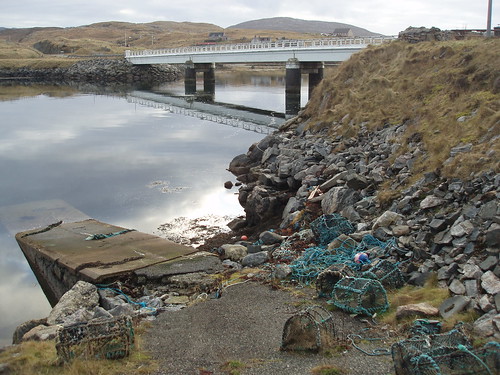
Old and new: the slipway for the pre-1950s ferry to Great Bernera, and the bridge
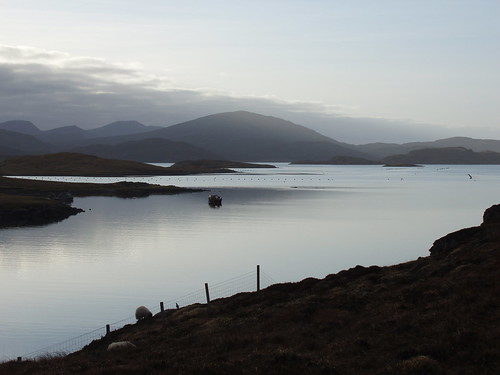
Loch Barraglom, near the Bernera Bridge
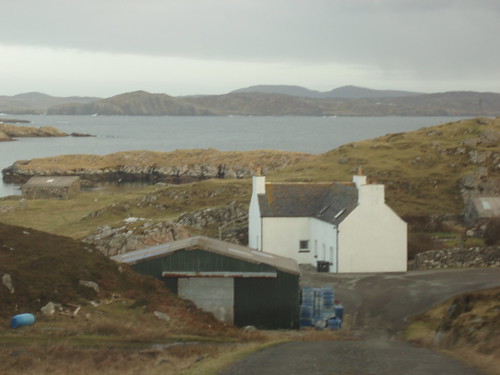
Croir
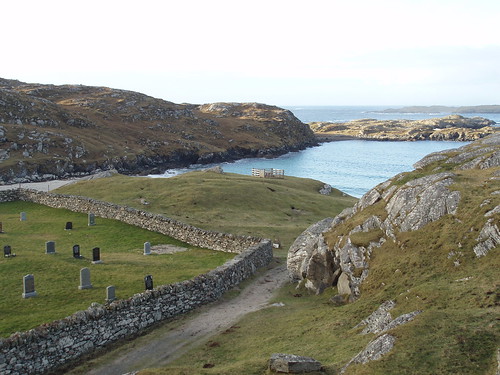
Bosta cemetery
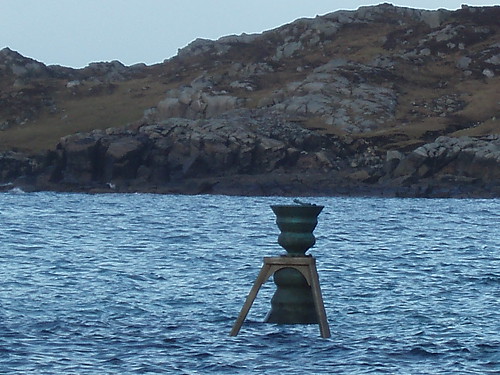
Tide and Time Bell
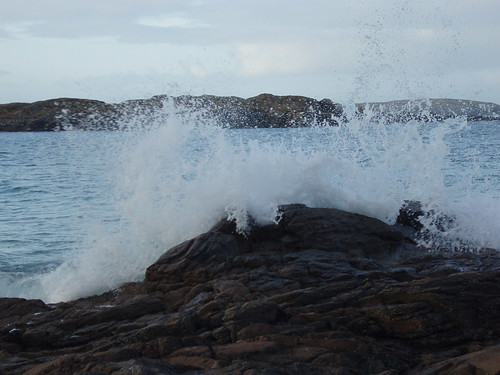
At Bosta Beach
Looking towards Roineabhal from the Bernera road
Old and new: the slipway for the pre-1950s ferry to Great Bernera, and the bridge
Loch Barraglom, near the Bernera Bridge
Croir
Bosta cemetery
Tide and Time Bell
At Bosta Beach
Hurricane update - 30 January
The Australian state of Queensland will take delivery of two tropical cyclones this week. Anthony is headed for landfall near the town of Ayr later today or early tomorrow. Its highest winds are at 45 knots, that's 50 mph or equivalent to force 10 on the Beaufort scale. The Australian weather service is issuing warnings.
I am far more worried about tropical cyclone Yasi, which has formed between Vanuatu and the Solomon Islands, 1500 miles east northeast of Queensland. The Joint Typhoon Warning Center is forecasting that this storm will blow up to an upper-end category III hurricane, striking the Queensland coast near Cairns with winds of 110 knots, 120 mph, on Friday of this week.
I am far more worried about tropical cyclone Yasi, which has formed between Vanuatu and the Solomon Islands, 1500 miles east northeast of Queensland. The Joint Typhoon Warning Center is forecasting that this storm will blow up to an upper-end category III hurricane, striking the Queensland coast near Cairns with winds of 110 knots, 120 mph, on Friday of this week.
Friday, 28 January 2011
Friday 28 January
The day started fairly bright, but cloud increased and when the sun went down, just after 4.30pm, there was some rain. We'll get more of the wet stuff through the night. Did I mention we had the saltboat and the coalboat in at the same time on Wednesday? Well, the coalboat usually leaves the town painted black, with lumps of coal scattered along the streets.
I spent a few hours in the library, to look up the croft histories for South Uist. I am not very familiar with that island, and I had to check the Gaelic names of the townships there against the English ones I have on file. I shall now incorporate those on my Berneray to Vatersay tribute site.
I spent a few hours in the library, to look up the croft histories for South Uist. I am not very familiar with that island, and I had to check the Gaelic names of the townships there against the English ones I have on file. I shall now incorporate those on my Berneray to Vatersay tribute site.
Subscribe to:
Posts (Atom)