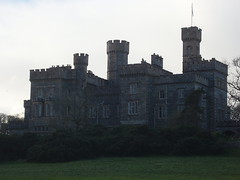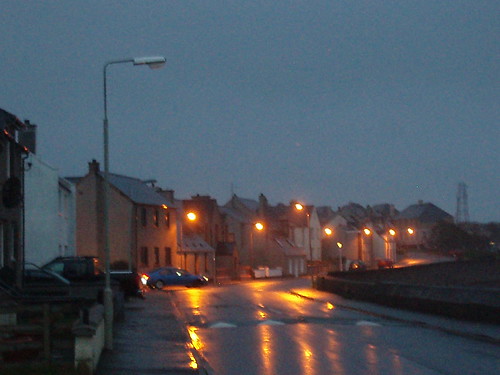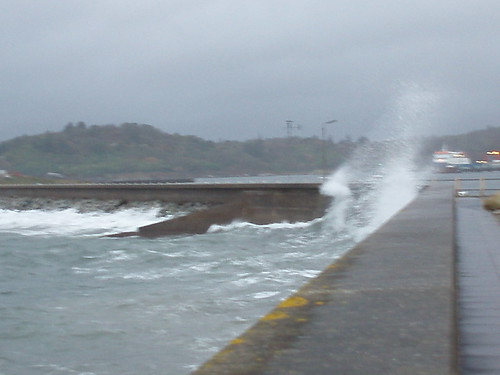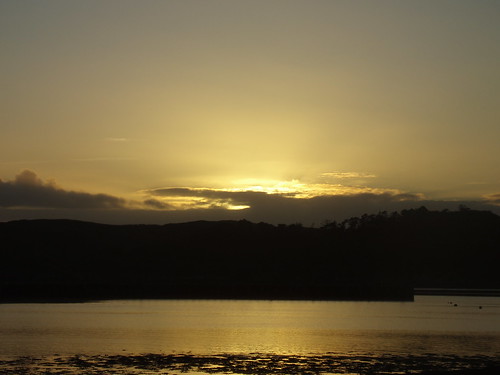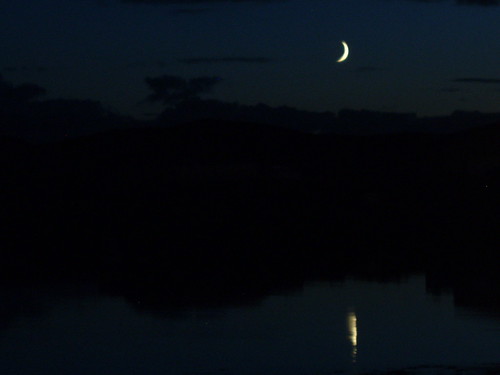
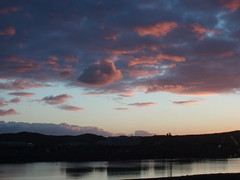
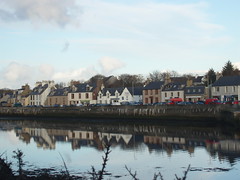
View across the Outer Harbour of Stornoway

Tuesday, 9 November 2010

Tuesday 9 November

A beautifully sunny but cold day, with the mercury barely on 8C. Fortunately, there was not much wind. After lunch, I went down to Sandwick Cemetery to (unsuccessfully) look for the grave of a Norwegian sailor who died after falling from the mast of a barque in 1917. Many of the older gravestones are covered in lichen, making them difficult to decipher. The shortest route to the cemetery takes me along the shores of Sandwick Bay, which are lined with shingle. Last Sunday's storm has washed tons of shingle and seaweed onto the shorepath, making it difficult to negotiate.


New moon at 5.23pm


Sunset colours
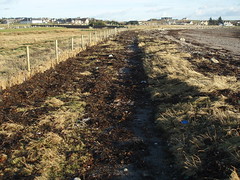
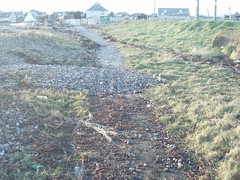
Walking to Sandwick


The bread shelves in Tesco, the day after the storms. Erm, the ferry did not sail, so no bread. Capiche?

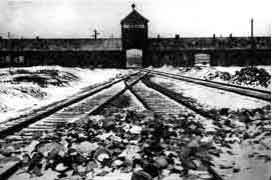
Waterboarding

That is a euphemism for a torture technique, employed by American forces in Iraq, to extract information from prisoners regarding possible terrorist attacks. President George W. Bush, writing in his memoirs, feels that the use of this technique is fully justified, as it prevented more terrorist outrages in the aftermath of 9/11.

Torture, Mr Bush, is never acceptable. You, as the former leader of the Land of the Free, should be the very last to condone such barbarity. The fact that the likes of Al Qa'eda see fit to descend to the depths of depravity in their acts does not justify you doing the same. Torture, Mr Bush, also elicits the responses the torturer wants to hear, which is not necessarily the truth. And your use of torture just lends power to the arguments of your political and military adversaries who say you are a barbarian, and gives them the justification for their actions.

Mr Bush was so blinkered by the fact that his daddy did not finish off Saddam Hussein in 1991 that he had, come hell or high water, finish it for him. Saddam Hussein was a clever dictator, who, seeing he was militarily hamstrung, got rid of his weapons of mass destruction, which he did possess. But they turned into a Weapon of Mass Delusion for George W. Bush. Everybody else joined in, including former British prime minister Tony Blair. Yes, they got rid of a monster, but they got landed with a Medusa instead, in the shape of Al Qa'eda. Not necessarily in Iraq, where they got booted out. But elsewhere, they certainly got plenty of followers on account of George Bush and his boundless stupidity.

Putting his age on

Many a youngster would tell a white lie when trying to enlist in the armed forces, early in the 20th century. It is referred to as "putting your age on", in other words, saying you're older than you are.

I found a good example in a Lewis soldier, James Macleod, who was born in Callanish as an illegitimate child. In February 1912, he enlisted with the Argyll & Sutherland Highlanders, and told the recruiting officer he was 17 years and 2 months. As James was born on 24 January 1897, he was in fact not much older than 15 years and 2 weeks. His height was 5 feet 3½ inches and only weighed 120 lbs, 54 kg.

Six years after joining the Argylls, James was killed in action near Ypres on 8 May 1918. His body was never recovered, but his name is inscribed on the Tyne Cot memorial at Zonnebeke, 6 miles northeast of Ypres. A few days ago, I saw aerial footage from 1919 of the battlefields around Ypres, and of the village of Passchendaele, which was all but obliterated. After the Germans were pushed back from Ypres in 1917, they tried to regain their lost territory in 1918, but finally failed in September of that year.

This week, the Ancestry.co.uk website is offering free access to British army service records, which is how I managed to fill the gaps for James Macleod. His mother, Isabella, had moved to Stornoway by the time of the death of her son. When she gave birth, her occupation was marked as Domestic Servant. A few months after James had fallen, she wrote to the (Army) Records Office in Perth. I reproduce the text of the letter. Part of it is illegible due to a hole in the paper, as shown in the scan.

"Mrs Bella McLeod
8 Mackenzie Street
Stornoway
16/8/1918

To Records Officer, Office Perth

Dear Sir,

Would you [...] me (his mother) of the late (killed in action (L/Cpl James Mcleod) 2 Bn Arg + Suth Hghns [Argyll & Sutherland Highlanders] Regt No S/43023 has any of his belongings come to hand. As far as I know, he had a wrist watch, Signet Ring, Pocket Folding mirror, Pocket Book or Wallet containing photos etc also a pocket knive [sic]. It would greatly oblige me if you could let me know at the earliest & how to  claim same.

I remain

Yours V. Truly
Mrs B. Mcleod"

The records do not relate whether the items, if any, were returned to Bella. She received a claims form, which was sent back to Perth, but that is were the records for James Macleod end.

9 November

9 November 1938 - an organised mob of Nazi forces and sympathisers go on the rampage in towns and cities across Germany, smashing and destroying Jewish-owned property and businesses. It was to be a marker, to what was to come during World War II - the extermination of anyone deemed sub-human by the warped mind of Adolf Hitler and his henchmen. Jews topped their league of the unfit, closely followed by gypsies, the mentally ill and many many others. The Reichskristallnacht was a night of infamy, and not just to Germany.
For Hitler was allowed to get away with literally murder for several years beforehand. In 1936, he occupied the Rhineland which had been ceded to France at the end of the First World War. The League of Nations, a toothless talkingshop, cried wolf but had no bite. In March 1938, Nazi forces marched into Austria to join that country to Germany, an event referred to as the Anschluss. Neville Chamberlain flew to Munich to meet with Adolf Hitler on 30 September 1938, returning with the infamous phrase: "Peace for our time". Six weeks later, the Reichskristallnacht took place, a sign of ill omen. Only a few months later, Germany invaded the Sudetenland area of Czecho-Slovakia, and again, nobody moved a finger to stop. In September 1939, Hitler thought he could get away with the invasion of Poland. But instead, it prompted the outbreak of the Second World War.

The lights have gone out in Europe, it was said at the time. The lights in Europe were extinguished in 1914, and had not been relit, not even at the end of the First World War. The Versailles Peace Treaty of June 1919 contained all the ingredients for another war, which duly materialised.

Monday, 8 November 2010

Autumn bareness

Just as well I went into the Castle Grounds for a walk on Friday. The tree behind the house here still had leaves on it on Sunday morning. Twenty-four hours later, all the remaining leaves had gone. In six months' time, they'll be back again.


2 November

Monday 8 November

Last night's storm was bad, by all accounts. Sustained winds peaked at 60 mph, gusting up to 80 mph at the Butt of Lewis. Other than major disruption on the regional ferry network, the storm did not have any significant impact. Watching from an upstairs window, I could just about see the curtains of seaspray blowing in on the winds, which rattled doors and shook windows. By daybreak, the winds had subsided to force 6 or 7, still very breezy, and have dropped to force 5 only in the last hour. Another storm looks on the cards for Thursday.

I went to the library this afternoon to look for more WW1 tributes from the Stornoway Gazette from 1917, which yielded about a dozen articles.

Regionally, the collapse of major building firm Rok, based at Inverness, has had extensive repercussions in Lewis. A four-year contract to revamp the Arnish Fabrication Yard in Stornoway and contracts to build new homes in the town are all up in the air now that the company has gone into administration. Highlands and Islands Enterprise had sunk £32m into the company, in spite of its cashflow problems.

Sunday, 7 November 2010

Sunday evening

The wind has picked up and is now blowing at 46 mph, force 9, gusting to 60 mph. Up at Eoropie, the windiest place in the country, the wind is gusting to 80 mph. Extensive cancellations across the ferry network in western Scotland, as no ferry will venture out in winds above force 8. The forecast, as I relayed earlier, is for a violent storm, force 11.

The Work and Pensions Secretary in the UK government has suggested that people who have been out of work for a long time could be made to do unpaid community work (like convicted delinquents) to get them used to the concept of regular work again. Mr Duncan-Smith, that is an insult.

A week or so ago, a pod of 35 whales were milling around in Loch Carnan, South Uist, but successfully made their way out again. It is reported from the north of the Irish Republic (not Northern Ireland) that the same inviduals have now beached and died. A very sad outcome to what appeared to be a story of hope.

Gamekeeper's son - WW1

Duncan Macdonald was 19 when he was killed to the east of Arras, in April 1917. It took a while for his death to be confirmed; it was not until British forces captured the territory where he was lost that they found his remains. Taking his personal effects with them, the British buried him near Fampoux.

Duncan was on my list, but only knowing that he was with the Seaforth Highlanders did not help matters much; nor the fact that his entry on the War Graves register only gives an initial "D", rather than his full name. The soldier was the son of a gamekeeper, and the article in the Stornoway Gazette that pointed me in his direction mentions the fact that his parents lived at Scaliscro, the shooting lodge some 25 miles west of Stornoway. Duncan's birth, which occurred on 5 March 1896, took place at Ath Linne, a hamlet on the Lewis Harris border some 20 miles south of Stornoway. The entry on the War Graves register refers to his parents living at Gress Lodge, 9 miles north of the town.

The chaplain wrote the message to Murdo and Helen Macdonald that their son Duncan had been lost:
[...] He must have been killed on 11th April. The ground where he fell has recently been won from the enemy. His body has been found and buried. We do not yet know which troops have found and buried our dead, nor do we know exactly where their graves are, but it must be somewhere just to the front of Fampoux, to the east of Arras.

Sunday 7 November

A bright and cold start to the day, with the mercury right down to -2C at sunrise. There was a frost on the grass, obviously. As I type this, at 11 am, the wind is beginning to pick up ahead of a violent storm which will hit us later today. I copy the inshore wind forecast for the Minch, which I overlook:
Southerly, backing southeasterly later, 5 to 7, increasing gale 8 to storm 10, perhaps violent storm 11 for a time, decreasing 6 to gale 8 later.
 This has already led to cancellations of ferry services later today, and some are on warning for disruption tomorrow as well. Never a dull moment up here.
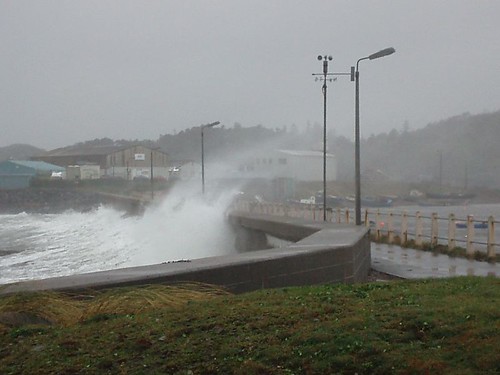
I shall have another update later today, when it will probably look like this:


30 November 2006

Saturday, 6 November 2010

Saturday 6 November

The calm before the storm today. It was not warm, only 6 degrees C once more. Went for a few errands around town before lunchtime, then spent the afternoon on more transcriptions of the Napier Report, as shown in previous entry. Tomorrow afternoon, we shall see rising winds as the first proper autumn storm strikes the United Kingdom. Winds could reach 55 mph during the evening and night.

Yesterday, a freak accident saw a cement-mixer running off a bridge in southern England and land on top of a moving train. Several people on the train were injured, as was the driver. Investigations are continuing into the cause of this strange accident.

And in football, the high scoring continues. Celtic beat Aberdeen 9-0, which led to much shedding of tears in the Granite City, whilst Celtic fans were complaining that their side could have scored 22 goals. Some people are never pleased. Did I say it was a slow news day my end? Maybe I should leave you with a link to this video of a nest of kittens playfighting. Better than that awful vid of the poor kittens that kept collapsing due to "fainting goat syndrome".

Clearances: Assynt

I copy part of the evidence given to the Napier Commission at Lochinver, on the west coast of northern Scotland, in July 1883. Assynt, the area surrounding Lochinver, was owned by the Duke of Sutherland, and his name continues to be cursed by many. I am not in a position to give a balanced view of the issue - but the actions perpetrated in his name do not do the Duchy of Sutherland any favours whatsoever.

John Mackenzie, Clashmore, was accused of being a ring-leader in a case of preventing what was regarded as an encroachment of the rights of the neighbourhood by Mr David Humphrey, and in face of every evidence to his innocence, he was sentenced to lose his croft, and he is now a pauper invalid and a burden to his neighbours. Donald Macleod, Clashmore, came in for the vengeance of the same power in connection remotely with the resistance offered to Mr Humphrey, when cutting off part of the Baffin pasture, when some boys went to obstruct the work. On this, Mr M'Iver ran to catch two boys assumed to have been obstructing the work, reaching a house, the boys got out of Mr M'Iver's sight, and he rushed into the house, supposing they had entered. There was a very sick woman who had been taken out of bed and placed on a shake-down at the fireside, Mr M' Iver went on, however, searching for the boys, and tossing things about, and so frightened the woman that her death shortly afterwards took place. The boys not being there, were not found, and Mr M'Iver, as soon as he came out, dashed at two small boys at play. The boys who were about nine years of age, and knowing of no offence, did not think of running from the factor, remained to be caught. Mr M'Iver, seized one of them by the throat, and kneeling down held his captive to the ground, insisting that he should tell the names of the persons engaged in the obstruction. Hugh Macleod, the boy's brother, seeing this, remonstrated with the factor, who now persisted, demanding the father's name. Hugh took hold of the factor's hand and told him to let go, but as Mr M'Iver held on, and the boy being in great danger, Hugh now took hold of the hand that was throttling the boy. On this, the factor's two sons and Mackay came. The factor said Hugh had struck him, but so little evidence was there for this, that an attempt was made to get Hugh to criminate himself. After this one of them came with a paper for Hugh to sign, which paper proved to be a declaration that he was guilty of striking the factor. He was told if he would sign this declaration, the factor would be his friend, and he would get anything he wanted ever after. But Hugh refused, saying he would have the factor prosecuted. The result was, that the father Donald had to emigrate with all his family, excepting Hugh, who had a little shop in which he carried on some business. The avenger did not rest satisfied with what he had done to the father. Hugh was about as offensive to him as Mordecai was to Haman. Taking advantage of Hugh's absence, his shop and his groceries, which he left carefully in boxes, were attacked by order of the factor, and when he returned he found the house broken into, and the boxes of goods smashed and damaged to a ruinous degree, and the house, which was built at the family's expense, except the roofing, was levelled to the ground shortly afterwards, and the timber handed to another man. John Mackenzie, son of Donald, an old, respectable man of 70, equally without foundation accused of the same offence, and deprived of his croft, which had come down to him from his forefathers. He went all the way to Lairg, then to Dunrobin, and not finding the Duke there, he went to Tarbert; but after travelling in all 160 miles, his efforts were in vain. The belief was, that the persistent hostility on the part of some of the officials was at the root of this. Humphrey said to John one day
—"You are bending to the grave,"
—"Yes," said John, "but see you are not bending with the weight of the evil you are doing to the widow and orphan."

Friday, 5 November 2010

Friday 5 November

Beautiful Friday sunshine - with a few treacherous little showers that annoy more than make you wet. Went for an 80-minute amble in the Castle Grounds to look for autumn colours. There is a severe gale in the forecast for Sunday and Monday, so I thought better to make the most of it. Plenty of colours around, and the low sun made for some very autumnal pictures.

Hurricane Tomas is lashing Haiti with rain, another disaster that that nation can do without. After the quake, the disease there is now flooding. Do not be surprised to hear similar tales of woe from India, which is bracing itself for the arrival of Jal, which will be at a similar strength as Tomas is at present when it makes landfall near Chennai on Sunday.

Journalists at the BBC are on strike, depriving us of Radio Scotland for two days. I am not bothering with the output from 5Live which is put on in its stead. Neither am I too enamoured with the output from Sky News, which has this tendency to be a tad sensationalist. Talking of news, I am sick to the back teeth of the saga that has been doing the rounds in Scotland over the past 3 weeks. Former Scottish Socialist Party leader Tommy Sheridan had sued the News of the World newspaper for defamation, after the rag alleged that he had visited a sex-club in Manchester. After being awarded damages, Mr Sheridan is now on trial for alleged perjury at the defamation trial. Well, we have been subjected to lengthy explanations who has been having sex with who, heads being popped round doors before going upstairs, into secluded rooms and what not. Please, just give us the outcome and spare us the details.

Hurricane update - 5 November

INDIA
Tropical cyclone Jal is approaching from the Bay of Bengal and will intensify to hurricane strength, with winds near 90 mph. I copy the advice from the India Met Department.

Winds
Squally winds speed reaching 55-65 kmph gusting to 75 kmph would commence along and off North Tamil Nadu, Puducherry and south Andhra Pradesh coast from morning of 6th November 2010. It may increase upto 120-130 kmph gusting to 140 kmph at the time of landfall. Sea conditions will be very rough to high, along and off these coasts becoming phenomenal at the time of landfall.

Damage expected:
Extensive damage to thatched roofs and huts. Minor damage to power and communication lines due to uprooting of large avenue trees. Flooding of escape routes.

Action suggested:
Total suspension of fishing operations. Fishermen are advised not to venture into the sea. Coastal hutment dwellers to be moved to safer places. People in affected areas to remain indoors.

CARIBBEAN
Hurricane Tomas is passing between Haiti and Cuba, bringing heavy rainfall to both nations. Predicted totals are 5 to 10 inches, locally up to 15 inches, with the danger of mudslides and flashfloods. Beyond that, the southeastern Bahamas and the Turks and Caicos Islands will also see hurricane-force winds and torrential rain.  

Thursday, 4 November 2010

Donald Maciver, another WW1 casualty not listed as such

Private DONALD MACIVER
Last address in Lewis: 17 Knock, Point
Son of Murdo and Mary Mciver, of 17 Knock, Point
Service unit: 179th Canadian Infantry
Service number: 859994
Date of death: 24 May 1920 at the age of 28
Was gassed; quoted as severely wounded
Interred: Winnipeg (Brookside) Military Cemetery, grave Mil. 246

He does not feature on the local war memorial in Garrabost, and is not listed as deceased in the Roll of Honour, presumably because he died 18 months after the end of the First World War. However, Donald still qualifies for inclusion as he passed away before 1922 (the CWGC cut-off point) and he was born in Lewis.

Hurricane update - 4 November

Tropical storm Tomas is approaching Haiti, and although its attendant winds are not particularly high (equivalent to force 9 or 10 on the Beaufort scale), the rainfall from this system could prove devastating. Maximum amounts range from 5 to 10 inches, up to 15 inches in mountainous terrain.

Tropical cyclone 05B has formed in the Bay of Bengal and is headed west towards the coasts of the states of Tamil Nadu and Andhra Pradesh in India. The storm will be at hurricane force by the time it makes landfall late on Sunday.

Daniel Mciver, Coll

Daniel was a sergeant-major in the 5th battalion Canadian Infantry (Saskatchewan Regiment), the Fighting Fifth, when he was killed in action on 28 April 1917, aged 41. His link to the Isle of Lewis did not become clear to me until I was going through tributes in the Stornoway Gazette for 1917. The article, which sourced its information from a Canadian newspaper, the Yorkton Enterprise (Saskatchewan), gave quite a bit of information, but there was no reference to him from local files.

Let me quote the article first.
From the "Yorkton Enterpise" (Sask, Canada) to hand we cull the following:-
"Word was received by Mr Maciver, Saltcoats, on 19th May, that his son, Sergt Major Dan Maciver, D.C.M. ofo the Fighting Fifth battalion, had been killed in action. Dan, who was well known and a prime favourite throughout the district, was born at Coll, Lewis, Scotland, and came to Canada with his parents in 1889, settling in the Lothian Colony. Whilst still in his teens, Dan, along with Malcolm Docherty (now Major Docherty, DSO) journeyed to Winnipeg and joined the Canadian Dragoons. When the South African War broke out, he was one of the first to volunteer for active service, taking part in no less than twenty-three campaigns. At the outbreak of the present conflict Dan again showed his military spirit by enlisting and went overseas with the first contingent. After reaching France, he gave a splendid account of himself, and was promoted on the field to the rank of Sergt.-Major, being also frequently mentioned in despatches for bravery and coolness in action. Some time he was offered the chance to return to Canada for promotion, but preferred to stay with the game. His death is the fourth that has occurred in the family within the last five years, and he is survived by his parents and two brothers and two sisters out of a family of twelve."
A year last Christmas, Sergt.-Major Maciver paid a visit to the haunts of his youth at Coll, and needless to say had a very cordial welcome.

An on-line study group into the Canadian Expeditionary Force was most helpful in eliciting the information I was after, and another on-line contact here in Scotland will hopefully ascertain the claim to the Distinguished Conduct Medal (DCM).

I have access to birth, death and marriage records in Scotland, but Daniel does not feature on them. This can easily be explained by a fire in Stornoway Town Hall in March 1918, which destroyed some of the island's civic records. However, the other documentation clearly states that he was born in Coll, Isle of Lewis, although the year of birth on his WW1 attestation paper is clearly wrong: if he was born in 1888, he would not have been aged 41 in 1917. It is more likely that Daniel was born in the late 1870s.

His parents emigrated to Canada in 1889, as the article says, and he joined up for the Boer War of 1899-1901. He gained the Queen's Medal with four clasps (Paardeberg, Driefontein, Cape Colony and Transvaal) before being discharged on Christmas Day 1900.

Fourteen years later, the spectre of war once more descended over Europe and Daniel immediately responded. He enlisted at the Valcartier barracks in Quebec on 17 September 1914, 6 weeks after the outbreak of war. On his attestation paper he was quoted as a Real-Estate Agent, with his father Kenneth Mcivor (sic) living in Saltcoats, SK, although elsewhere Mciver senior is listed at Barvas. This hamlet is located a dozen miles north of Saltcoats. On enlistment, Daniel is described as 5 ft 10 (1.77 m) tall, of fair complexion with brown eyes and brown hair. A mole was seen at the centre of his back. He professes to be of the Presbyterian faith.

During the First World War, Daniel is mentioned in despatches twice; being mentioned in despatches is a distinction in itself. However, Daniel was sadly lost in the aftermath of the battle for Vimy Ridge in April 1917 and is only mentioned on the Vimy Memorial; the location of his grave is unknown.

I have entered Daniel's details on Faces from the Lewis War Memorial under the heading of Coll.

Thursday 4 November

Not a terribly inspiring day, overcast, wet and cold. Only 5 or 6 degrees above freezing. Would you believe that 550 miles away at Heathrow Airport, the mercury reached 18.3C this afternoon?? Fortunately, there is justice in this world, and they will come crashing down to 9C by the time the weekend is over.

Once more, I have traced a soldier from the First World War who is not mentioned in any of my files, although he is recognised by the Commonwealth War Graves Commission. As soon as I have completed the research, I'll post the results on here.

The saga of the grounded sub, HMS Astute, took another twist when it became known that the craft collided with the tug that was pulling it off its shinglebank. This prang damaged a starboard foreplane on the submarine, but it was able to proceed back to base without problems. The investigation into this incident is continuing, whilst the Western Isles MP, Angus Macneil, has now called for a parliamentary debate on the emergency tugs.

Wednesday, 3 November 2010

Wednesday 3 November

A very cold day, with the mercury at only 6C / 43F. Heathrow Airport, west of London, recorded 16C / 61F this afternoon, highlighting the large temperature differential across the country. Went into town to buy some storage 'solutions' (read: folders, box-file &c), then paid a visit to Sandwick Cemetery. It was there that I noticed how cold it got, and even more so later in the afternoon.


After 4pm, the Red Duchess hove into view, towed by the Anglian Prince. The Duchess had suffered engine failure yesterday, and it had taken 24 hours for the Prince to tow her the 100 miles from the Isle of Rum, where the breakdown had occurred. I was a bit annoyed that nightfall overtook me when the boats came in, meaning I could only see a few lights as they headed for what I took to be pier no 1. Once the Duchess's engine is fixed, her cargo of coal will be discharged.

Tuesday, 2 November 2010

Tuesday 2 November

Fairly bright day with strong winds and very heavy showers. It did allow for some nice cloudscapes, but it would not have been nice to be caught out in the downpours, which were accompanied by strong squalls.

Here in the Western Isles, a committee of the local council has voted to close 11 out of the islands' 24 primary schools, and abolish the rural secondaries (where pupils are taught for the first two years before going to a large secondary in Stornoway or Lionacleit (Uist)). The full council will debate the plans on Thursday, but I do not have high hopes of any of the small schools being reprieved. There are just not enough children to justify keeping some of the schools open - Stoneybridge in South Uist has no pupils in it at all at present.

America has gone to the polls today, and it would appear that President Obama could well lose control of both houses of Congress. I am not very well acquainted with the Teaparty movement and neither do I want that to change. If Obama does lose control of the American parliament, it is simply due to the fact that people do not see the benefit of the policies he has implemented - some of which may take up to 2014 to show up.

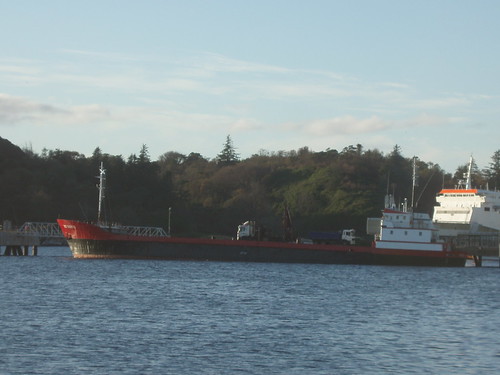
And finally, a cargo ship, the Red Duchess, which was bound for Stornoway with a cargo of coal got into difficulty this morning when it suffered engine failure. This happened southwest of the Isle of Rum, 70 miles south of Stornoway. High winds were threatening to blow the vessel into Harris Bay on Rum, but the Mallaig lifeboat managed to keep her safe. The Coastguard helicopter went across to check if anyone needed airlifting, and the Coastguard tug Anglian Prince has also sailed to Rum to tow the Red Duchess to safety. The ship is a regular visitor to Stornoway - shown here on a picture from last November.

Picture post - 1 November


Baking cookies


Dusk, 1 November


The last leaves clinging to the branches...


High winds


Sunset