On 23 June 2016, voters in the United Kingdom will go to the polls to decide whether the country should continue to be a member of the European Union. The UK joined the EEC in 1973, and appears to have been a reluctant convert to the cause. Memories of Margaret Thatcher handbagging the Europeans into special deals for Britain remain from the 1980s, and David Cameron has now done much the same. Another deal to make remaining in the EU as palatable as possible for the home front.
My perspective is not a usual one, as (a) I am Dutch and (b) I am blogging this from the Outer Hebrides in Scotland. The Dutch were one of the founding members of the European Economic Community back in 1957 (the others being France, Germany, Italy, Belgium and Luxembourg). The object was to create a free-trade association with open borders and as little impediment to movement of goods and people as was practicable. Criticism of the EU centres on its colossal bureaucracy (centred on three cities which are actually quite far apart, Brussels, Luxembourg and Strasbourg) and creation of at times ridiculous rules. However, the EU has also been beneficial to areas like the Scottish islands, providing funding for (e.g.) infrastructure projects and enterprise. Another criticism is its sheer size. There are now 28 memberstates and a large number of different languages in which all the paperwork has to be translated (I did say bureaucracy). Whether the introduction of the Euro currency was such a success I very much doubt. You only have to look at Greece, which is in a state of economic collapse. As a memberstate of the EU, it has to bow to directives from the European Central Bank as to how to stave off total disaster. And the complaints are that Germany (as the largest and economically most powerful memberstate) is calling the shots.
EU membership has been a major source of divisions within particularly the Conservative party for decades. It brought down the premiership of Margaret Thatcher in November 1990, and it has bedeviled David Cameron since he came into office in May 2010. A No vote will not spell economic disaster for the UK. But it will remove a lot of the perks that the country has enjoyed in its dealings with other European nations, and I very much doubt that the EU will be prepared to give Britain yet another special deal after any No vote. In that instance, the UK will probably find itself in a similar position to Norway, as a member of the EEA (also comprising Iceland and Liechtenstein). The argument that the EU erodes the sovereignty of the UK does not ring true, to my mind. It is in fact disingenuous. When you join a club, you play by its rules. If you don't like the rules, you work to change them. It is for that reasons too that I feel that the United Kingdom should stay in the EU. But, I'm not eligible to vote. I am eligible to express my opinion, though.




 Moon and Jupiter


 Jupiter (L) and the moon

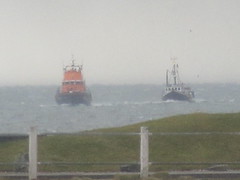 Lifeboat bringing a casualty