View across the Outer Harbour of Stornoway

Friday, 21 January 2011

Picture post - 21 January


Sunset colours, Balallan, 4.20pm


Pairc War Memorial, Kershader


Letterbox


Ram and ewe


Loch Erisort, looking east


In the Pairc Museum, Ravenspoint

Friday 21 January

Quite a nice day, with good spells of sunshine. And I cannot grumble about daytime temps of +8C, 46F, in spite of the breeze that was blowing. In the afternoon, I jumped on the bus to Lochs to visit the Ravenspoint Centre at Kershader, 22 miles (by road) from Stornoway. The journey takes about 40 minutes. Once at the Ravenspoint Centre, it took me the grand total of five minutes to realise that I would not find any of the information required about 18th and 19th century residents of Cromore, 8 miles east of Kershader. So, I had a little while to go on a short walk. The bus journey back was punctuated by primary school kids who all had to pile out of the people carrier in order to let me on. I was back in Stornoway at 5pm, and it was not yet fully dark. We are now one month from the shortest day, and the days are lengthening nicely.

I've taken about 40 pics, and will post those in a separate entry shortly.

Lost at sea

The fishing boat, belonging to a Shetland fisherman, reported missing last night, was found wrecked on rocks on the Isle of Bressay, just east of Lerwick. I'm awaiting further details.

A passenger has been reported missing from a ferry, which had sailed from Larne in Northern Ireland to Cairnryan in southwestern Scotland. The vessel, the European Highlander has been thoroughly searched, and air and sea searches are underway.

Jo Yeates

This lady was murdered on December 17th, after she had gone out to buy some food in the city of Bristol. On Christmas Day, her remains were recovered along a frozen country road near the city. She had been strangled. Initially, her landlord was arrested on suspicion of her murder,  but he was later released on bail. Yesterday, a Dutch architect, Vincent Tabak, was apprehended in Bristol. He was Jo's next-door neighbour. Vincent came to Bristol in 2007 and according to Dutch broadcaster NOS lived there with his girlfriend.

I was taken aback by ITV [a commercial broadcaster in the UK] which had cameras in Mr Tabak's hometown of Veghel, north of Eindhoven in Holland. I'm not surprised people there were reluctant to discuss the case. Under Dutch law, a suspect is not identified by his full name, only by first name and the first letter of the surname.

This morning, police were granted more time to interrogate Mr Tabak, and further investigations at addresses in Bristol continue.

Thursday 20 January

A cold January day, but at least it was dry. Went to the library, where even the librarian had to search high and low for the booklet I was wanting - only for me to discover it did not hold the information I required. So, a visit to the community centre in South Lochs is imminent. I also continued my searches on the Internet for another aspect of local history, the results of which are posted on my Pentland Road blog.

Still on aspects of local history, I discovered that WW1 and WW2 casualties from Lewis are buried and / or remembered in 400 different locations across the globe. I intend to compile a Google Map with them all, a nice little project. Oh, I made a very nice discovery in the library (no details), which (to my mind) has endorsed and vindicated my activities in the field of local history in Lewis.

Thursday, 20 January 2011

Zodiac shift

We all heard about the shifted zodiac signs? Well, you may be interested (or not) to hear that the Pole Star at the time of the Pyramids was called Kochab, a minor star in the constellation of Ursa Minor. And even longer ago, it was Vega, the primary star in Lyra.

What happens is that the Earth wobbles around its axis in a cycle of about 23,000 years. This means that the axis will veer round over that period of time to point at a different part of the sky. In other words, there will be a different North Star over the millennia, see image below.


Apart from this perhaps obscure aspect of astronomy, it has had the astrologers in a tizz in recent times. Since the signs of the Zodiac were defined, the above described phenomenon has moved the apparent star signs round by one position. And someone has also ordained that there is now a 13th star sign, Ophiuchus (the Snake Bearer), which can be found near Scorpio. The sun moves into each star sign a month later than in the distant past. Fortunately, someone else has ordained that nothing has changed, so you can stick to your original star sign in your horrorscope, and your future has not changed.

If you Google about "Zodiac shift" you'll find some articles written in atrocious English. 

Wednesday 19 January

Another acceptable January day in the Western Isles, with some sunshine about. It's not warm and there is a bit of a breeze blowing. But dress up well, and there is little to complain about. I spent a little while in the library, looking up some information on 19th century residents of the village of Leurbost, some 8 miles south of Stornoway. There is one more look-up pending, this time for 18th century residents of Cromore, which lies 12 miles south of Stornoway by sea but 30 miles by road.

Separate from that, I am going to compile a map of places where Lewis servicemen lie buried who gave their life in WW1 and WW2. I was pointed to a similar map of casualties from Portsmouth.

Last week, my father told me about a problem in his town by email. Last night, I received a text from him, suggesting that the problem had surfaced again. His puzzled response led me to the conclusion that the problem had only occurred once, and that his text message had taken FIVE DAYS to reach me.

Wednesday, 19 January 2011

Fuel prices

I have mentioned that fuel prices here in Lewis are at a ridiculous level. This has prompted at least one person of my acquaintance to relocate closer to their place of work, with the object of ditching the car. An average car would take about £60-£70 to fill up with fuel at the £1.49 / litre rates for diesel at the moment. The relocation is apparently a common occurrence at the moment. One thing that annoys me is the variation of fuel prices across the Highlands and Islands. A tanker leaves the refinery at Grangemouth, east of Edinburgh, and supplies fuel oil to the north of Scotland, places like Aberdeen, Inverness, Scrabster (on the north coast) and Stornoway. Why is it though that petrol costs less in Inverness than in Stornoway? There is no justification for this at all.

There is one positive slant - fewer cars around, and possibly people taking to their bikes or shanks' pony. Good for health, unless the pavements and roads are icy.

Tuesday, 18 January 2011

Tuesday 18 January

Quite a nice day, but not very warm. The sun set an hour ago, with some clouds over the horizon. It's been a calm and quiet day, as I process the results from my researches in the island croft histories. Tomorrow, I shall look at these books again, this time at the request of another researcher. I may also have to go out of town to check records that have not been published by an island genealogist, Bill Lawson. It is these books that I am currently using for reference, but the range, covering all of Lewis, is by no means complete.

Did I mention that fuel prices here in Stornoway are close to £1.50 a litre? That, for my American readers, equates to $9 per gallon. The fact that remote communities will not get a so-called fuel-derogation has led to an angry outburst by local MPs against the Treasury. Funnily enough, the UK government is going to introduce a minimum price for alcohol, a measure opposed by members of the Scottish Parliament in 2010. Oh well, just as well I don't drink much (alcohol), and that I don't own a car.

Monday, 17 January 2011

Without the Internet

Without the internet? I would not be able to do what I have been able to do over the past decade, and especially over the last 7 years or so. But who am I in the grand scheme of things. No, I am writing this post with several events in mind.

Without the Internet, Julian Assange would never have been able to globally publicise the documents that were leaked to his organisation from the American government. That in itself has only led to embarrassment to the US authorities, not just because of the leak, but also over the persecution of Mr Assange. Worse is yet to come. Today, it was revealed that a former Swiss banker has leaked data on 2,000 secret Swiss bank accounts to Wikileaks. These could implicate dozens of people in high office; any pertaining to UK residents could lead to investigation by the Serious Fraud Squad and prosecution. Without the Internet, this would never have happened.

Without the Internet, the people of Tunisia would never have been empowered to rise up against their autocratic leader, forcing him to flee the country. Without the Internet, the demonstrations in Iran against alleged fraud in the reelection of its president last year, would never have made it onto the world stage. They would have been brutally suppressed, and hardly a beep leaked to the outside world. And, on the subject of Iran, without the Internet, the Stuxnet worm would not have been conceived, or been able to disrupt the workings of Iranian uranium enrichment plants.

Without the Internet, seemingly impenetrable bastions of power are now vulnerable. Swiss banks, thought to be the safest in the world, are now shown to be as strong as their weakest links: the much feared disgruntled employee. And he can be prosecuted, fined, jailed, even put to death. But the information is out there; and even disrupting the website does not help, as the establishment of dozens if not hundreds of mirror-websites will render that defence futile.

The Internet has come of age, and the second decade of the twenty-first century is opening to a whole new, brave world, which operates to new rules. The old ones are becoming defunct.

This video shows the opening credits to the 1995 BBC series "People's Century". Which person, alive in 1900, would ever have been able to envisage what the world would be like 111 years later? And who, alive today, will be able to imagine the world in 2122? We won't be there to see it.

Monday 16 January

The flurry of tropical cyclone activity in the southern oceans has come to an end - for now. TC Zelia has turned into a storm depression which will lash New Zealand over the next day or so. Nothing else appears to be forming, but the southern hemisphere season is yet young - equivalent to July in the northern season.

Here in the far north of Scotland, it has turned perceptibly colder. After 10 degrees over the weekend, the 5C this afternoon felt quite cold. The hat and gloves came in handy as I made my way into town for a stint in the library. I went through the croft histories for several townships in order to glean more information on some of the WW1 casualties, for whom I only have scant information. I have already made amendments to more than half a dozen names, and more are to follow as I continue to process the information.

Sunday, 16 January 2011

Sunday 16 January

Quite a nice day, but breezy and feeling cold in the wind. There were a few showers out and about earlier, but it has turned dry through the afternoon.

The weather remains the main topic, as I continue to monitor the one tropical cyclone currently left in the southern hemisphere: Zelia is racing southeast across the Pacific at a breathtaking 24 knots (nearly 30 mph), with winds near its centre of 105 mph. The storm will cease to be a TC within about 48 hours, before it reaches New Zealand. As I type, Zelia is west of New Caledonia, which will experience strong winds and heavy rains in the north.

I intend to gather some more information on some of the WW1 casualties from Lewis, by taking a look at the croft histories for parts of the islands. These show the people that lived on each croft since it was established as such - usually in the late 18th century. There are about 80-90 names that I have too little information on, and I hope to get some clarity for about half of that number.

Saturday, 15 January 2011

Saturday 15 January

I am typing this blogpost whilst trying not to be annoyed over the murder being committed on a Chopin piano concerto on Classic FM. The interpretation is laboured, heavy and the pianist sounds as if he has his nose pressed against the score, wondering how he is going to reach the end of that lot of peasoup that Frederic jotted down a century and a half ago. Classic FM tells me that it comes from an album entitled "Bullets and Lullabys", compiled by James Rhodes. Well, how apt.

Saturday started decidedly wild, and it's been a while since we had a gale. The ferry crew wasn't sure they were going to do all the runs today first thing, but I saw the Isle of Lewis heading out at half past two, and no further indication on the Calmac website that there was going to be further disruption. After today's high, 10C, the highest for nearly two months, we are likely to see slightly colder weather with night frosts into the new week.

Here in Scotland, we are due elections to the Scottish Parliament, and the pary-political skermishing is already starting up as the main parties are selecting their candidates. Please don't ask me to explain the system of proportional representation they have in place in Scotland. In practice, you have constituency MSPs and regional MSPs. Yes, I know, it's easier to explain that the universe is based on the square root of minus one. For the next four months we're going to be subjected to all sorts of rubbish, not just from the candidates but also from everybody else who is a party faithful and thinks they know it all.

Friday, 14 January 2011

Friday 14 January

I am slowly getting rid of another bout of cold, which crept up on me through the week. Just as well I had this new box of hankies in, they've been going at a rate of knots. Nonetheless, I have not really got any reasons for complaint, if I see what nature is throwing at Queensland and Brazil.

Here in the Western Isles, it is a day of brightness and showers (I have not seen the sun as such today), and we are on warning for a gale tonight. The overnight freight ferry, MV Muirneag, has been cancelled.

There is a bit of a wrangle going on regarding the closure of local schools. Eleven had been earmarked for closure, but the junior secondary schools in Lionel (Ness) and Shawbost have been reprieved by the Scottish Government, as have the primary schools in Carloway and Seilebost (Harris). The council is displeased, because this puts a spanner in their works of revamping education in the isles. Local parents are pleased though, as it means that children can be taught closer to home.

Again on the subject of natural disasters, there are two tropical cyclones around that people should be wary of. TC Vania is currently traversing New Caledonia, an island some 1,000 miles east of Cairns, Australia. The storm carries winds of about force 10 on the Beaufort scale. More worrying is TC Zelda, which has blown up off the eastern tip of Papua New Guinea. This system will reach hurricane force within 24 hours as it marches southeast across the Pacific. New Caledonia could (again) get a swipe from it, and New Zealand will probably see the storm when it has ceased being a cyclone - but still a nasty storm depression.

Thursday, 13 January 2011

Thursday 13 January

Darkness has fallen on an indifferent day, very grey and lightless. Although the days are lengthening, it is still very much mid-winter.

I am not very pleased with my on-line travelagents, whom I contacted to submit a claim for compensation after my delayed journey to Holland last month. They got back to me today, telling me to send my claim to the wrong airline. Wonderful. I can see an insurance claim coming up.

Floods seems to be the order of the day. The flood at Brisbane, Queensland, Australia, has peaked at nearly 3 feet below the predicted level. The devastation remains huge, and I anticipate the loss of life to rise further. Two or three tropical cyclones surround Australia, although none will affect the landmass of that continent directly.

Wednesday, 12 January 2011

Wednesday 12 January

A much milder day in Lewis today, and not too bad in terms of weather. The ice has nearly all gone now, and for the first time since November 26th, I am seeing green grass again. That is seven weeks... I'm nonetheless not complaining about weather, certainly not after seeing the devastation wrought in Queensland. An area of about 300,000 sq miles is inundated there, after rainfalls of 11 inches within 24 hours in places. The death toll continues to rise slowly, but once this is all over, it will be much, much higher than the dozen or so currently on the list. This video shows the incredible power of the water as it rises in a flash flood, emptying a car park of cars and not in the conventional manner.


Meanwhile, two tropical cyclones are around Australia as well. Vince is headed for the west coast of Australia, but is not expected to affect mainland WA. Vania is expected to pass near or over New Caledonia by Friday. My tropical cyclones blog is taking its usual high number of readings, with nearly 700 today. The one-day record of 2,300, taken when cyclone Gamede threatened Mauritius in 2007, is yet to be bettered.

Tuesday, 11 January 2011

Hurricane update - 11 January

Not had a hurricane update post for more than two months, but we're now having the first tropical cyclone of 2011. It currently goes by the prosaic title of 05P, meaning it is in the Southwestern Pacific Ocean. The system is located in the archipelago of Vanuatu, where the southern provinces are on alert. 05P will move southwest and cross the Grand Ile of New Caledonia [Nouvelle Caledonie] on Thursday (Friday local time) at nearly hurricane force. I am posting updates on my Tropical Cyclones blog.

Australia's year of disasters

The floods in the Australian state of Queensland are getting worse and worse. It all started before Christmas with a tropical storm near Cairns, which was followed by a protracted period of rain. This led to extensive and deep flooding, with the situation around the town of Rockhampton, 700 miles further south, being particularly dire. This now appears to have been eclipsed by flooding around the state capital, Brisbane, where 6 inches of rain fell within 75 minutes last night. Walls of water, up to 20 feet (6 m) deep have come crashing down the river valley, sweeping away everything in its path. A dozen people have died in the floods, although the casualty toll may not be known accurately until the floods subside. Queensland's state government publishes emergency updates on this link.

Elsewhere in Australia:
Over the next few days, the state of Western Australia will have to look over its shoulder, as a tropical cyclone appears to be forming 900 km to the north of Exmouth. Once it has formed, it will double back on its present westerly course and could pose a threat to the Pilbara or Kimberley coasts.

A similar hazard exists some 700 miles east of Queensland, where a tropical cyclone could form in the island state of Vanuatu. Four provinces of Vanuatu are on Yellow or Blue Alert at present.

Tuesday 11 January

A bright and sunny day, although the sun has now disappeared behind a veil of high cloud that is moving in from the west. Rain and sleet are on the menu tonight, and a gradual thaw is forecast for tomorrow. Today's max was +5C just after midnight; five hours later, the mercury had dipped to -3C. We're just above freezing, but that has not done much for the perilous state of the pavements. Yesterday morning, the presenter on local radio station Isles FM broke her arm whilst walking along the road to the station. I copy the story from the station's website:

Isles FM presenter Kathleen MacIver was a casualty of the winter ice yesterday morning - but she didn't let it stop her presenting live radio for two and a half hours. Kathleen slipped and fell on icy pavements on Newton Street at 5.30am, breaking a bone in her elbow and bruising her leg badly. After crawling to a kerb and getting back on her feet, she limped in to the radio station and was on air at 7.30am. "I did the show with one arm and between gritted teeth," said Kathleen, who did not tell listeners of the pain she was in. Fellow presenter Lionel Sewell took over soon after 9am and Kathleen went to Western Isles Hospital, where a broken elbow was diagnosed. Managing director David Morrison said: "That she still went in to do the breakfast show with a broken arm says a great deal about Kathleen. Not many people would have done that." She's now on bedrest and forbidden to work until she has recovered completely! 

Six years ago today

11 January 2005 is one of those days that everybody who was in the Outer Hebrides at the time will not forget. A deep Atlantic depression moved past our islands, bringing with it winds of force 12 on the Beaufort scale, with gusts in excess of 130 mph. At the time, I was staying in Kershader, 12 miles south of Stornoway as the crow flies - more like 22 miles by road. At 6.22pm, the power went off, not to go back on again for 48 hours. The wind was already howling around the building. Blue flashing lights penetrated the darkness from across Loch Erisort - police cars were stopping traffic on the Stornoway to Tarbert road after a lorry driver reported a sheep flying past his windscreen. The driver of the South Lochs bus that night was mightily relieved to make it home in one piece, he told me later. Trees were downed, roofs taken off, vehicles crushed under trees - and hundreds of them toppled in the Castle Grounds in Stornoway. High tides lapped at the doors of people on Cromwell Street and Bayhead in the town. Boats were torn off their moorings and smashed into the ferry terminal. Slates became like missiles, and pedestrians blown off their feet. Some who sought refuge were denied entry; others were taken inside.

The next morning dawned breezy and bright. Everybody heaved a sigh of relief. That was a bad one, but it's only damage. By 9.20 am however, reports start to emerge from the Southern Isles. Five people are missing in South Uist, after they fled their home the previous evening at around 7pm. Rising tides had started to approach their home, and pebbles were hurled against walls and windows. They enter two cars and drive from their home at Eochdar towards the causeway, linking South Uist and Benbecula. A fatal decision. That road parallels the stretch of sea that separates the two islands. The southeasterly storm, combined with a springtide from the northwest pushed the waters of Loch Bi up; but on account of the floodtide they could not drain into the sea. The loch flooded a small causeway, sweeping the cars into the water. By morning, the five missing people are found dead. They include a mother and father with two young children and a grandfather.


This is a repost from an entry I made on 11 January 2010.

Monday, 10 January 2011

Monday 10 January

An overcast and chilly day, although the mercury is slowly creeping up. The pavements in this town are in a hazardous state, but as the thaw progresses, this should steadily improve. Whether the weather contributed to an accident involving a school bus at Galson is not known. Nobody was injured when the vehicle went into the ditch on its way to town.

I am very pleased to hear that the harsh rhetoric in American politics is finally being called to account. Since Barack Obama came into office, two years ago this month, I have been quite frankly disturbed by the highly charged tone of political debate in the States in that time. It is a good thing that there is an open debate, and that politicians are criticised, where criticism is due. But people like Glenn Beck and the Teaparty Movement should really examine their consciences as to whether the tone of their criticism could have contributed to pushing the murderer of the six at Tucson over the edge. Jared Loughner is accountable for his own actions - if his mental state is deemed to be such that he can stand trial. I hope we will see some change in tone from here on.

Sunday, 9 January 2011

Sunday 9 January

Kept a quiet day today, with lots of television (not all good). The weather was reasonable, with good spells of sunshine but low temperatures. Some freezing rain this evening, but it would seem that the mercury will rise during the week. At least we'll be rid of the ice-locked pavements. I've "enjoyed" that since late November, and the fun is wearing thin.

I was horrified to hear of the shooting of US congresswoman Gabrielle Giffords, who was shot in Tucson, Arizona, yesterday. The death of six bystanders was even more shocking. Whatever the reasons for the gunman, I am pleased he was captured alive to face justice. I am aware of a strident debate within the state of Arizona, which borders Mexico, on the subject of immigration. Whether that had any bearing on this incident is not known; some people appear to think the polarisation of that debate may have contributed to it. I can obviously not comment.

Saturday, 8 January 2011

Saturday 8 January

A nice sunny day, after yesterday's heavy snowfall. We are due more heavy snow showers tomorrow. Perversely, I am told by my family in Holland that the mercury there has leapt up to 11C / 52F. Not so here; the thermometer at the airport has not risen above freezing all day, and is currently plunging down: -4C a quarter of an hour ago. The snow on the pavement turned to ice overnight, making the walk into town a slip-sliding affair. Pavements are not cleared of snow or ice. The wintry conditions have also caused travel disruption in the air.

The American government has demanded that the Twitter.com website hand over all details of supporters of Wikileaks. This has been endorsed by a court order, which has prompted Twitter to describe the action as harassment. I am of the opinion that this court action is not so much upholding the law of the land as upholding the illusion that the emperor wears clothes, if you catch my meaning. Whilst releasing classified documents is an offence, it seems that thus far, the only casualties of the whole operation has been one diplomat's career and the good standing (what good standing) of the US government overseas. I am quite frankly appalled.

Friday, 7 January 2011

Switzerland, 1983

In July 1983, we went on a family holiday to Switzerland, at the resort of Blatten, marked on the below map. I am sharing a handful images from that time.


Sparrhorn mountain, 3,021 m [10,070 ft]


Belalp resort overview


Matterhorn mountain, Zermatt

Friday 7 January

The dominating theme of today is the snow, and I'll let the imagery do the talking. Suffice to say that the airport shut late in the afternoon, and there is a nice blanket of the stuff now that darkness has fallen.


Going like the clapper

I could not help but smirk when I read that the clapper for the main bell in Cologne Cathedral had fallen down. You may recall from my 23 December post on the Shell Gallery that I was less than impressed with the reception in the Cathedral. It is of course no laughing matter that an 800 kg metal object comes crashing down from a height of about 400 feet; but its fall was fortunately broken by a metal structure further down the tower. The main bell itself weighs 24 tons. "Fat Peter" is only rung on a few occasions, and the clapper broke into pieces on January 6th (yesterday) as the bell was rung for Epiphany. Nobody was hurt in the incident. The clapper is likely to be recast. [source: NOS.nl, in Dutch].

Thursday, 6 January 2011

Thursday 6 January

Epiphany today; some Orthodox Christian churches celebrate Christmas today. Pope Gregory put the calendar forward by 12 days in 1582, but Orthodox churches did not adopt this change.

It was a wintry day today, with frequent snow showers sweeping over Stornoway. The ferry is sailing normally, after being repaired following a breakdown on Hogmanay. The Muirneag, which carries our freight, is not going out tonight due to adverse weather conditions.

During my absence in Holland, I received a large amount of information on a former president of the London Gaelic Society, who originated from the Isle of Lewis. Roderick Mcleod was involved with the LGS for decades, between 1882 and 1930. I shall summarise his information on my local history blog Pentland Road.

Picture post - 5 January


Rising above a closed cloud cover over western Holland and the North Sea


Amassed snow at Gatwick - remember the snow disruption over Christmas?


Snow showers moving south over Lancashire, leaving snow visible on the ground


Snow over the Lammermuir hills south of Edinburgh


Edinburgh and the Forth Bridges


Last light over central Scotland, 5.31pm

Wednesday 5 January

The journey back to Stornoway went without a hitch, unlike the outward trip. The taxi came as booked around 5.45 am and took us to the railway station in Arnhem, 4 miles away. The direct train to Schiphol Airport departed at 6.16 am, and filled up with commuters for the cities of Utrecht and Amsterdam along the way. Arrived at the airport at 7.30 am, and breezed through check-in to gate D21. Plane was a tad late, but everybody got on fine and we left for London Gatwick at around 9.30. After a flight above clouds, the weather at Gatwick was clear and fine; big banks of snow a vestige of the all the snow bother from before Christmas. I am a bit annoyed that I had to go through the security rigmarole again; I could just as easily have gone through a side-door if I had known which gate. But I did not, so I kicked my heels in the departure lounge between 9.45 and 11.45. Bought an Independent and did all the Sudoku puzzles. Flight 8922 to Edinburgh was pretty full, but it got us there nicely on time at 1.45. Had some lunch at Edinburgh, but the Christmas jingles drove me up the wall. It's January 5th, for goodness' sake. I asked the Flybe desk to reprint my boarding pass (which was not possible before I left Holland), then spent two and a half hours watching planes come and go. Darkness fell after 4 o'clock, and my flight was finally called at 5 pm. Once they managed to lock the hold door, we took off for Stornoway at 5.30. Could still see some daylight on the southwestern horizon, but that soon faded. Showers greeted us across the Minch, and we landed at Stornoway at 6.30. A taxi took me back to town for the usual £6.

I'll post some pics in a separate entry.

Friday, 31 December 2010

Hogmanay 2010

Wishing all my readers a happy Hogmanay, and a healthy and prosperous 2011.

At the moment, my local history blog Pentland Road is paralleling the Iolaire Disaster of 1919, so keep checking there until 9.10 am (GMT) tomorrow morning.

I am continuing to post on the Shell Gallery.

Monday, 27 December 2010

Lunar eclipse

I had promised to post a picture of the lunar eclipse, which occurred on Tuesday 21 December (last week, in other words). Well, this was the sight around 8 am that morning.


As I've said before, I'll resume posting on here on Thursday 6 January 2011. 

Tuesday, 21 December 2010

21 December 1988

It is early evening when PanAm flight 103 takes off from London's Heathrow airport, bound for New York. Not an hour into the journey, a homemade bomb, built around a radio-cassette recorder, explodes in the hold of the aircraft. This blows a hole in the fuselage, and the shockwave of the explosion disrupts the integrity of the aircraft. At 37,000 feet up, the Boeing 747 disintegrates, and the wreckage rains down on the small town of Lockerbie. The cockpit lands in a field near the A74 (Carlisle to Glasgow) road, but a large segment of the aircraft crashes into a small housing estate on the outskirts of Lockerbie. Houses are destroyed or set on fire. All passengers and crew on flight 103 are killed, although some were thought to have been alive as fell to the ground. Eleven townspeople were killed as well. Later, the evening became increasingly unreal, as newscrews descended on Lockerbie, reporting events - with the townspeople watching the 9 o'clock news on television to learn what had happened to their small town.

It was later determined that a bomb had been placed on the aircraft by Libyan security agents, acting on behalf of Col Ghadaffi. More than a decade later, Libya yielded two security agents for trial under Scots law, but only agreed to do so if they were tried not on British soil. So, an impromptu court was set up at Camp Zeist in Holland. Abdelbaset Ali Al-Megrahi was convicted of the crime and sentenced to life in jail. He was released in August 2009 on humanitarian grounds as he was terminally ill and only had 3 months to live. Well, it's 16 months later and he's still alive. Not everybody was happy with that decision, as he had treated his victims with inhumanity.

This entry is dedicated to the memory of the 270 victims of Lockerbie
The BBC has a separate webpage "On this day"


Tuesday 21 December

Another post from me on Atlantic Lines, for the simple reason that my travel plans fell apart this morning. The plane to Glasgow I was to have taken at 8.30 am was cancelled, along with all other flights before midday. The reason was black ice on the runway. The later departure at 2.30pm would have left me with insufficient time to make my connection at Edinburgh. The two cities are only 45 miles apart, but transferring between the two airports requires two 30 minutes bus journeys, a 45 minute rail trip, and that with a decreased frequency of trains. Leaving to one side the joys of travelling on the M8 in Glasgow and the A8 in Edinburgh, and the weather conditions. So I returned to Stornoway, awaiting tomorrow morning's plane. If things go to pot again, I'm quite prepared to cancel the trip.

The one benefit of this morning's excursion was the lunar eclipse, pics of which I will post separately. Otherwise, the overnight frost combined with a fall of rain had turned roads and pavements into ice rinks.

Monday, 20 December 2010

Monday 20 December

Another quiet day, and as I type this, the sun is sinking towards the southwestern horizon, due to set at 3.34pm. It'll be the shortest day of the year tomorrow, and it'll start in a spectacular fashion: with a lunar eclipse just before sunrise in the UK. The lunar eclipse starts in earnest just after 6 am (UK time), with totality just after 8 am and ending at around 10 am. This means that the moon sets during the eclipse. Here in Stornoway, the moon will set just after 9 am, leaving me with a pretty good display.

There will be a partial solar eclipse at sunrise on 4 January 2011, visible from Europe.

I'll be admiring tomorrow's lunar eclipse from Stornoway Airport, as I'm flying across to Amsterdam. I'm so glad I've changed my booking, as British Airways appears to be in meltdown. Its website is going round in square circles and doesn't do what it's supposed to do. I am positively horrified at the scenes at Heathrow, where people are resigned to sit on the floor until Thursday.

Unless something else crops up, this will be my last posting for 2010 on Atlantic Lines. I expect to resume entries from Stornoway on Thursday 6 January 2011. During my stay in Holland I'll be blogging on the Shell Gallery; updates on my journey tomorrow will be made on Facebook and Twitter.

Sunday, 19 December 2010

Sunday 19 December

The disruption on the travel front is showing no signs of abating. Again hardly any flights leaving the main London airports, with thousands of people unable to go on their Christmas breaks. Personally, I am booked to travel to Holland on Tuesday, through Heathrow and Gatwick. That's proving to be a mistake. The situation is so dire, that I have rebooked my outward journey to go straight from Edinburgh to Amsterdam. I count myself lucky that there was still a seat, and I don't mind having to wait for a number of hours. The alternatives were growing thinner and thinner on the ground, with Eurostar no longer accepting new bookings before Christmas and the English rail network subject to delays and cancellations. I am planning to return to Stornoway on Wednesday 5 January 2011.

Saturday, 18 December 2010

Saturday 18 December

Complete and utter mayhem, that's what the traffic situation in England can safely be described as today. Up to 10 inches (25 cm) of snow have fallen in various parts of the country, and the major airports around London have ground to a halt. Here in Stornoway, we awoke to a good snow shower, but as day broke, it cleared to a nice sunny day - but a cold one. A lot of events have been called off, and people are advised against all non essential travel. Although the boat with roadsalt did dock, we're still a tad short on the stuff.

No, I'm not going to watch Strictly Come Dancing (which I dub: Strictly Come V*m*t*ng) or the X-factor (better described as X-rated, due to the awfulness of it all). I'm sorry if there is anyone out there that genuinely likes it, that's fine. I just go off this sort of programs to which entire newsitems are devoted on BBC etcetera. Who is Simon Cowell when he's at home? A loudmouth? Who is Bruce Forsyth? Thought he'd been put out to pasture long ago. Mind you, I wish they'd put Terry Wogan out to pasture long before now, he's been known to go on stage drunk or farting.

I am closing with images of two of the family cats, who have long since departed over the Rainbow Bridge. Have a look at the posting on Call for Support, and you'll see what prompted me.


Friday, 17 December 2010

Evening notes

Although the weather has improved, Friday ended early for many people in these islands. Most schools were shut all day, and shops in Stornoway town centre closed early, between 2 and 3pm. Buses to rural areas in the island had their last service between 6 and 8pm; on a Friday, the last service usually leaves at around 11pm, just after the pubs close. Not today. One driver had a bad day, as a lamppost outside the supermarket had been knocked over. There is a layer of snow, 10 cm / 4 inches thick, on the ground, and drifts rising to 40 cm / 16 inches. With the light winds having fallen light, the main problem will be frost. A ship with a supply of road salt is sheltering in the Sound of Mull and will head this way over the weekend. Although there is 1,000 tons of roadsalt left in Lewis and Harris, the supply in the Southern Isles is only 200 tons.

Outside, the mercury has already dipped to -5C.

Friday 17 December

A very wintry scene presented itself, even before daybreak. About 4 inches (10 cm) of snow on the ground, which had accumulated into drifts of more than a foot deep (up to 40 cm). This has caused extensive disruption in the whole of the north of Scotland. The A9 is closed from Brora to Thurso, that's 53 miles of road, including the A99 spur to Wick. Looking at the traffic cameras, the road is almost completely covered in snow. Most schools are shut in the Western Isles, and the situation on the mainland is similarly bad. Here in town, the weekly bin collection has been cancelled for the first time that I've been here - that tends to go ahead, even in stormy weather. There is also no ferry service to the mainland from Stornoway, due to a heavy northerly swell. The alternative route, between Harris and Skye, is running as scheduled, as it's sheltered from the north.

More later.

Thursday, 16 December 2010

Picture post - week 12-15 December


The low sun always provides for colourful images in December


We went to the Braighe on Sunday (12th), but the tide was in

Picture post - 16 December


Another wintry blast - at low tide


The birds are having a hard time


This fishing boat, the Buckie-registered Sustain, ran aground on the east coast of Harris, and was escorted to Stornoway for repairs after the Coastguard dropped pumps on board to keep her afloat.

Coast not guarded

The UK government is proposing to axe a number of coastguard stations along the coast of Scotland in order to save money. Under current thinking (if there has been any thinking involved with this plan at all), only the station at Aberdeen would operate 24/7, with either Lerwick or Stornoway kept as a part-time (daylight only) cover. The other stations, at Clyde and Forth, would be shut permanently.

I’ll go so far as to describe that as sheer lunacy. This is typical bureaucratic pen pushing, a scheme dreamt up by someone in an office in central London, who does not have an inkling what goes on north of the proverbial Watford Gap.

Two fifth of the UK coastline covered by only ONE station? The very stretch of coastline that can experience the severest weather in the country? Today has already seen the Coastguard in action off Harris, with the helicopter (also potentially up for sale) dropping off pumps on board a leaking fishing vessel, and the RNLI lifeboat escorting it into Stornoway. Without Coastguard facilities present, things might have been coordinated from Aberdeen, but with all respect to the Coastguards there, they are unfamiliar with the vagaries of the Outer Hebrides coastline. And without a helicopter, the crew of the fishing boat would have been in dire straits, if not in danger of their life.

Thursday 16 December

A sharp downturn in temperatures has seen a rapid succession of snow showers rattling through here all morning. The mercury is now around zero and the strong northerly wind makes it very unpleasant outside.

Down in Benbecula, a plane has overshot the runway on landing, but nobody was hurt. The Benbecula - Stornoway - Inverness service is quoted as delayed on the Stornoway Airport website.

Out at sea, a fishing boat had to call for help when she started taking on water, which her own pumps could not cope with. The Coastguard helicopter flew out to the waters off Stockinish, East Harris, and dropped off an extra pump. Meanwhile, the RNLI's lifeboat Tom Sandersen has set off for Harris to escort the vessel to Stornoway. I am monitoring the horizon for her reappearance, and expect the fishing boat to go up the Goat Island slipway for repairs.

A former government minister has said that all illicit drugs, e.g. cocaine and heroin, should be legalised in a bid to address the problems caused by illicit drug taking. I think that is short-sighted and populist. Substances like cocaine and heroin (diamorphine), as used by drug abusers, are harmful and potentially lethal. The same goes for the group of compounds that come under the amphetamine banner. The major problem for society is caused by the fact that the addicts have to fund their habit, and a sizeable proportion do so by resorting to crime. The illegal drug trade is an international problem, which should not be tackled in this way by one nation on its own.

Wednesday, 15 December 2010

Wednesday 15 December

We're awaiting another wintry onslaught, which should reach us overnight. As I type, the mercury is reaching the dizzying heights of +8C; within 24 hours, the plus sign will be replaced by a minus sign on the Scottish mainland.

Religion
In Scotland, a ferocious debate is raging in the Free Church over the admission of musical instruments and hymns in the Sabbath service. The Free Church split from the Established Church of Scotland in 1849 in order for the congregation to be able to elect its own preachers, hence the designation of it being "Free". Previously, the Church of Scotland would impose preachers upon the faithful. The Free Church, which has a strong following in the Isle of Lewis, is regarded as fairly strict.

I have not attended a Free Church service, but I am advised that only psalms are sung, and there are no musical instruments present. These are regarded as frolicsome and instruments of the devil, prompting people to behave in an inappropriate fashion. Instead, psalms are sung out one line at a time by a precenter (yes, spelled with a C, not an S), which the congregation follows at its own pitch, pace and volume. The result is an eerie sound, almost like a swell rolling ashore on a beach.

It was recently decided that the Free Church would adopt musical instruments. This is a highly controversial move, and is threatening to split the Free Church even more than it already is. Which brings me to the point of this blogpost. I am a Protestant, but rather a protesting protestant. At the age of 20, a friend invited me along to a meeting of Opus Dei, which was seeking to recruit me (and other students). The explanation of Roman Catholicism very neatly served to persuade me that it was not for me. I cannot accept the basic tenet of RC faith that His Holiness the Pope is infallible. He was born a man, as fallible as the next person. And I can similarly not accept that one interpretation of the Bible is correct and all others are wrong. I apologise for any offense my statement may cause.

As far as Protestantism is concerned, I find it degrading to behold the spectacle, described at the start of my discussion, of grown men and women rolling in the street, fighting over an interpretation of the Bible. Whether this be the use of musical instruments in religious service, the observance of the day of rest or whichever aspect of life: it is enough to put people off religion, and brings down ridicule upon the faithful. And Protestantism to me is almost synonymous with squabbles and strife.

It should be a source of joy that factions of the Christian church seek to reconcile, which was attempted between the Anglican Church and the Roman Catholic Church a year or so ago. I have also seen it happen between fractions of the Protestant Church - it should be encouraged, and people should look for common ground, rather than focus on what divides them. If all those church denominations were to do just that, it would make the world a much better place. However, I only have to glance 250 miles to my south (to Northern Ireland) to see what religious strife can descend into.

Dare I say that there is a lot in common between Christianity and Islam as well?
Don't go there, Guido, don't go there...

Tuesday, 14 December 2010

Tuesday 14 December

Quite a nice day, with a good amount of brightness about. Hardly any wind, although it was not warm. In the sun, the 6C was quite acceptable. Some light rain wafted by in the afternoon, but no complaints. That will change by Thursday, when a strong northerly wind will bring copious amounts of snow down from the North Pole.

At the moment, the House of Lords is voting on the vexed issue of tuition fees, and it looks as if the government will be having its way. Tuition fees for universities will vary from £6,000 to £9,000 per annum in England and Wales; I seem to remember that students in Scotland don't pay tuition fees. No public order problems are reported from Westminster. I wonder what will happen if they ever catch the hoodlum that poked the Duchess of Cornwall in her Rolls Royce on Thursday of last week.

Monday, 13 December 2010

Monday 13 December

Another quiet day on the weatherfront, after a cold night, with the mercury down to -3C. We have lost the mild weather of the weekend, with afternoon highs only just on 4C. And we'll be even lower before the weekend. Strong winds will blow in another cold spell by Thursday, with snow and freezings temperatures. It won't be very nice here, but the mainland will get worse.

I came across another bad weather event, going back 92 years. A Pacific storm raged along the west coast of Canada and the northwestern USA in October 1918, with winds up to 100 knots (110 mph), making it hurricane force. The hurricane kept going for a week, wrecking several ships. One of them was a Canadian naval vessel, the Galiano. She went down with all hands, after transmitting a final message: "Hold's full of water, for God's sake send help". Help could not come, and the 39 crew were lost. One of them originated from Leurbost, here in Lewis, hence my interest in the disaster.

Bad weather has brought about the demise of at least two communities in the Hebrides in the 20th century. I was following up a tribute to a man from Scarp, Donald Maclennan. He died of the Spanish flu in 1918 at the age of 43. His mother, Catherine, died in November 1896 after suffering a very serious accident. She suffered head injuries, which brought about her death after about 7 weeks. Her death was not certified by a medical practitioner. Scarp, lying just a mile offshore from the northwest coast of Harris, is singularly difficult to reach due to strong tidal currents in the channel separating it from Harris, particularly in bad weather. The community abandoned the island in 1971. Before then, it gained prominence for being the home to a mother of twins which were born in two different counties. One baby came into the world in Inverness-shire (the county that Scarp is in), the other in Ross-shire, the county for Stornoway (until 1974).
The other abandoned island? St Kilda. For 8 months of the year, it did not have a regular steamer service until it was evacuated in 1930.

Sunday, 12 December 2010

Sunday 12 December

A quiet day, with hardly a breath of wind. That's the benefit of sitting directly under the centre of an area of high pressure. It will shift west later this week, leaving us with another northerly blast, snow and ice. Astronomically, winter is still nine days away, but weatherwise, it started two weeks ago.

I have been busy this afternoon adding tributes to the WW1 tribute site, and by the end of today the total for today will be close to 30, and the overall total at 200. I have gone through copies of the Stornoway Gazette from January 1917 to November 1918, as far as the edition of 15 November '18, which announced without much ado that war was over. The paper, published weekly, was only 4 pages due to paper shortages, so could not really go to town on the Armistice. And, by then, close on 1000 islanders had lost their lives in the war. Unbeknown to contemporary readers in 1918, another 200 were to be lost as they returned home on board their transport Iolaire, which sank outside Stornoway Harbour on New Year's Day 1919.

You've heard of the Titanic. Unless you have followed my output over the past 4 or 5 years, you are unlikely to have heard of the Iolaire. And even less likely to have heard of the loss of the Norge, in 1904.

Saturday, 11 December 2010

Saturday 11 December

A brighter day than yesterday, with some sunny or at least bright intervals. However, it is mid December, so the sun sets not long after 3.30pm. I spent an hour and a half in the library, first half hour doing battle with a magnifying lens on a microfilm reader; when I got it to focus properly, I found nearly 20 tributes from the last couple of weeks from the First World War. I came out of the library at 4.30, meaning it was dark outside.

Former Scots Transport Secretary Stewart StevensonI returned home to the welcome news that the Scottish transport secretary, Stewart Stevenson, has finally bowed to the inevitable and resigned. Mr Stevenson had planned to throw in the towel on Thursday, but had been persuaded by the First Minister to hang on. I am pleased that the Transport Secretary has quit, as he was ultimately responsible for communication and coordinating the emergency response.
Friday, 10 December 2010

Friday 10 December

A grey, drizzly and mild day. The mercury is at 9C, on a par with most of northern Scotland.

The news is dominated by the events of yesterday, when the House of Commons approved a rise in tuition fees for university and college students in England to between £6000 and £9000 per year. Students demonstrated around Westminster, near the Houses of Parliament, and there were violent clashes with police all day. Several students were injured, one seriously; several police were injured, one seriously as well. A car, carrying Prince Charles and his wife Camilla were attacked in Regent Street as they were headed for an engagement at the Royal Palladium Theatre; a window in the car was smashed and a can of paint thrown over the vehicle.
Today, the violence was roundly condemned, and although Prince Charles nor Camilla were hurt, it is said that the armed police accompanying the vehicle exercised great restraint; if the couple had been in any real danger, they could have discharged their firearms.

Students are angry with the current Conservative / Liberal Democrat coalition government, because the Lib Dems promised not to raise tuition fees before the election. That promise has come back to haunt them. Coalitions are rare in British politics, and the concessions that parties need to make in order to form a viable government not readily understood. On the continent, coalitions are the rule of the day, and nobody would have faulted the Lib Dems in Germany or Holland for abandoning some of their manifesto pledges.

I can understand the students' anger, but I disapprove of violence in any form or under any pretext. If a route for the protest march was agreed, then divergence from that route is likely to result in police action. And seeing some of the damage done to property around Parliament Square on TV this morning, I do think the police were justified in taking the action they have taken.

Higher tuition fees are here to stay now, but other cutbacks, proposed by the coalition government, will result in more street protests. Which are equally likely to get hijacked by the rent-a-mob anarchist elements in society, who hijacked yesterday's protests. Some students felt that anything is justified to highlight their cause, but that's a sentiment I disagree with.

Thursday, 9 December 2010

Wikileaks

The Wikileaks saga is moving into new territory. Its founder, Julian Assange, presently in custody, awaiting a court appearance prior to possible extradition to Sweden. Charges have been made against him in relation to alleged sexual offences, which he is said to have committed in Stockholm four months ago. There is concern in certain circles that after any court appearance in Sweden, the USA could apply for his onward extradition; a totally different ballgame.

Objectively speaking, releasing government files marked "confidential" or "secret" is against the law, and certainly placing them on the Internet makes it pretty blatant. However, I do grant that having such poor security in place that allows the leaking of such material is a serious matter in itself. If the USA chooses to prepare a case against Julian Assange, I would imagine that it would have a pretty strong body of evidence. To an independant observer, Mr Assange (and his Wikileaks organisation) would stand on stronger ground if they also leaked government files from other countries. It was put to me over the past week that (e.g.) releasing Russian or Chinese "cables" would probably lead to the discovery of Mr Assange in a lifeless state. Rumours circulate that certain circles in the American government would like that to happen. Very much.

Several companies, e.g. Visa, Mastercard and Paypal, have withdrawn their financial services from Wikileaks. Webhosting companies have also ceased to host the website, and it is presently on a Swiss webserver. These companies have now been subject to a "distributed denial of service" (DDoS) attack, which floods the website with so much traffic that it becomes inaccessible. Malware is being distributed to people, who then become part of a network of computers which carry out the DDoS. DDoS is illegal in most countries. Furthermore, the very word Malware should be a warning to anyone who might be tempted to participate. It causes all sorts alarmbells and red flashing lights to go off with me - you are NOT in control of your own computer.

The whole Wikileaks saga is a shady affair, hovering on the boundary of what is legal and what is not. When the release of American diplomatic cables first began, I was inclined to laugh at a government that did not have its security in order. My favourable inclination towards Wikileaks is beginning to fade fast.
There is a parallel, you see.

Back in 2002, a Dutch politician, Pim Fortuyn, was shot dead outside a radio studio. He was popular for daring to raise the issue of immigrants, up to that time a taboo subject in Dutch society (reason: WW2). I was appalled at the murder, and decided to sign his on-line condolence register. However, when I read the rabid, extreme-rightwing claptrap on said register, I could not be seen to be associated with it. So I did not sign.
Same here. The illegal DDoS attacks, perpetrated on behalf of Wikileaks (even if not overtly condoned by the organisation) are putting me off. Big time.

Thursday 9 December

The cold spell has come to an end here in the Western Isles of Scotland, with the thermometer at the dizzying heights of 6C / 43F this afternoon. There was some drizzle earlier on, but it is now dry. The sun will be setting in the next 20 minutes (it's 3.20pm) and it's getting dark. The ice on the pavements is melting, fortunately, as it was rather a nuisance over the past 10 days. The cold weather will return by Sunday or Monday, but the Met Office is not specific as to what shape it will take.

The Met Office has come in for rather a lot of stick, as it is being given the blame for the travel disruption in central Scotland on Monday and Tuesday. The Scottish Government says the Met Office did not indicate that the amount of snow would fall that did come down; however, the fact that were was going to be a substantial fall of snow (up to 5-10 cm) was forecast on Sunday evening. However, the role of coordinating the response to the severe weather was not taken up adequately by the Scottish Government, which is deplorable. It says enough that the First Minister was more interested in presenting his Christmas Card rather than in dealing with the emergency; by 9pm on Monday, people had been stranded for up to 12 hours in their vehicles already.

Wednesday, 8 December 2010

Wednesday 8 December

Another winter's day, with a layer of just under an inch of snow this morning in Stornoway. Looked very pretty, until the temperature rose above freezing. The footprints of a cat could be seen trailing through the backyard - but the birds were all still there. Even the blackbird with a broken wing, that's been scurrying around since July.
The Transport Minister, Stewart Stevenson, has made a statement to the Scottish Parliament and apologised for failing to provide the service that a government can be expected to render. At the height of the crisis, on Monday evening, the First Minister was presenting his Christmas card, rather than directing proceedings.
Meanwhile, the road chaos in central Scotland continues. I am typing this whilst listening to the traffic news on Radio Scotland, which does not make for cheerful listening for anyone in the Central Belt. 

A video has now been removed from YouTube, which showed an Irishman expressing his exact feelings on the reasons for the current economic crisis. His language was rather rude, involving the F-, W- and B-words. Reason for the video to be pulled, I assume. But don't think that Ireland is the last Eurozone country to have to be bailed out. Portugal and/or Spain could be next.

Tuesday, 7 December 2010

Tuesday 7 December

Today, it's 69 years ago since the Japanese Imperial Forces attacked the US Naval Base at Pearl Harbor, Hawaii. The attack was unprovoked, but served to bring the United States into the Second World War, as Germany declared war on the USA alongside Japan. It was a fatal mistake on the part of Japan. Although the Japanese forces managed to occupy large swathes of territory in the Pacific and southeast Asia, they were in the end thrown back on their homeland. It took the detonation of two nuclear bombs, on Hiroshima and Nagasaki, to force the surrender of Emperor Hirohito, three months after Nazi Germany was defeated.

Another battle royal has been going on here in Scotland today, and here the adversary is way more powerful than any military force on earth: the weather. After some people were stuck in their cars on the country's motorway system for 18 hours, the M8 motorway west of Edinburgh is still closed, and 200 vehicles remain abandoned elsewhere. The Scottish Transport Secretary initially said his administration had coped splendidly with the situation, and blamed the chaos on the Met Office. He was quickly put right by both the Met Office and BBC Scotland, and by lunchime, Mr Stevenson was eating humble pie. Tomorrow, he will be in the Scottish Parliament to account for the disastrous performance of the government. It is not entirely fair to heap the blame on the government or any other individual agency. Snow began to fall in central Scotland at the height of the morning rush hour, leaving 5 or 6 inches of the white stuff. Because of the heavy traffic, gritting lorries were unable to grit and snow ploughs could not get through. However, it is breathtaking that a mere 10 to 15 cm of snow can bring the country to a complete halt, and there should be mechanisms in place, coordinated by the government to deal with that eventuality. The mechanisms were there, alright. The Scottish Government talked about it in their Resilience Committee on Sunday night. But action was required. Not talk.

Monday, 6 December 2010

Monday 6 December

Awoke to about an inch of snow on the ground, which melted as the sun rose. The snow has moved south and caused a traffic infarct in Central Scotland. The main motorways and trunk roads are blocked, impassable; the same applies to streets in Edinburgh and Glasgow. People have been stuck in traffic for up to 9 hours, moving only a fraction of a mile in all that time. Tonight, a frost of -6C to -13C is forecast - and I'm wondering what will happen to all those thousands of people who are stuck in cars.

On Radio Scotland, the Transport Minister and other authorities have been at a loss to find words to address the situation.

Here in Stornoway, it was a relatively mild day (+4C) with sleet and snow showers. I went to the Town Hall, to get confirmation that Finlay Mclean is not buried at Sandwick Cemetery. I am now awaiting confirmation whether he was interred in Glasgow.

Sunday, 5 December 2010

Evening notes

Went down to Sandwick Cemetery this afternoon and spent a freezing and fruitless hour there, trying to locate a grave for Finaly Mclean of Sandwick. I posted about him yesterday. I'll continue my investigations tomorrow.

Snow appears to be on its way back in again, if my reading of the rainfall radar is anything to go by. And the cold is here to stay, according to the Met Office. The frost from last week has caused problems in the outlying districts of Lewis. Mains water is supplied from a large tank outside a village, but if someone's pipes are burst that obviously drains the tank. Quite a few houses are not occupied at this time, so any leaks will not be noticed.

Sunday 5 December

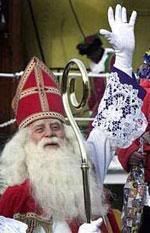
Today is the eve of St Nicholas, the original and only Santa Klaus (sorry). In Holland, Flanders and western Germany, children will have spent the past fortnight or so putting their shoe in front of the fireplace, with a carrot in it. St Nicholas rides the roofs on his white charger, surrounded by Black Peters who do the dirty work of bringing presents. During the night, they wil go down the chimney to collect the carrot and leave a present in the shoe. Children who have been bad will find a bunch of twigs, indicative of punishment. The really bad ones will be taken back to Spain in the sack.

It all starts in mid-November, when St Nicholas arrives in Holland (or one of its towns) in a steamer, well, any boat really, with his posse of Peters. The Peters go off running around, scattering sweeties amidst the assembled children. Towns not near the sea or water will see St Nicholas arriving by train. Or coach if there is no railway station. St Nicholas arrives from Spain, as that is the place where his remains lie interred. Originally, he is from Turkey, but when the Muslims came, the bones were spirited across the Mediterranean to Spain.

I close this post with an image from the island of Vlieland in Holland, where Sinterklaas arrived on a perishing cold day last Friday. Image courtesy VVV Vlieland [Tourist Information]. You can see all images from the VVV on the link.

Saturday, 4 December 2010

Saturday 4 December

The thaw is continuing, but that does not mean that our problems with snow and ice are over. The pavements have degenerated to skating rinks, which at times means you can only walk in the road. And that's not safe either. Went into town this afternoon for another stint in the library, looking for references in the Stornoway Gazette to Finlay Mclean, see previous post. None, which means that my search for the location of his grave carries on. If I cannot find it in the cemetery at Sandwick, which I'll walk through tomorrow, it will mean that he is mostly likely buried in Glasgow. Which has two dozen graveyards at least.

A sad piece of news from Ness this evening. A man was taken to hospital after he collided with a llama whilst riding his motorbike. Now that may sound totally off the wall, but there genuinely are two llamas about in Ness, and you can go on a walk with them. Or you could, as the one that was involved in the crash was killed.
This image dates back to 19 July this year; one llama is clearly visible, the other can just be made out behind it. I don't know which one died (Sam or Nico), but the blog that was kept about them has been cleared of content.

In from the cold

Private Finlay Mclean was one of many soldiers who left the Isle of Lewis to serve in the British Army on the Western Front during the First World War. He was wounded in action and transferred to hospital in Glasgow for treatment, but he died on 5 May 1918, aged 27. Finlay had served with the 10th battalion Cameronians (Scottish Rifles), and had latterly lived at 48 Milton Street, Partick, Glasgow with his wife Catherine, nee Ball.

Finlay was the second WW1 soldier from Lewis that was not on the registers of the Commonwealth War Graves Commission. Norman Morrison's case is still under consideration by the Ministry of Defense, but Finlay has come in from the cold. His name will be inscribed on a memorial for soldiers with no known burial place, at Brookwood, but I am searching for his grave - either in Glasgow or in Lewis. If I manage to locate it, a proper CWGC gravestone will be erected at Finlay's grave.

In memory of Pte Finlay Mclean, 16895 Cameronians (Scottish Rifles), died of wounds 5/5/1918.

Friday, 3 December 2010

Neglected?

Libya's leader, Col Muammar Gadaffi, has accused the Scottish Government of deliberately neglecting the health of Abdul-basset Al-Megrahi, the only man convicted of the Lockerbie bombing. Megrahi was diagnosed with terminal prostate cancer and, according to the Scottish Government, received the best care the NHS could offer. Megrahi was repatriated to Libya on compassionate grounds in August 2009, as he was expected to live for not much longer than 3 months. Megrahi is still alive today.

I don't think it's really very nice of Mr Gadaffi to say things like that, particularly after the compassionate release, in the face of strident objection from the United States. But then, I think we should be mindful of the old adage that a fox may change its colours, but will never change its character.

Friday 3 December

After an overnight low of -20C in eastern Scotland, the Western Isles have seen a thaw. Temperatures here went to +4C overnight, although they are presently declining. When the frost returns, later this evening, this will leave our roads as icerinks. Travel problems elsewhere in the UK appear to be improving slightly, with Gatwick Airport reopening. They say that 150,000 tons of snow have been cleared from the airport. However, another cold blast is due in from the north during the weekend. Oh, a woman in Kent rang the 999 emergency number to report the theft from her front garden of - a snowman.

Monday will see the 93rd anniversary of the Great Explosion at Halifax, Nova Scotia. An ammunition ship, carrying 4,000 tons of TNT, collided with a supply ship and blew up. The results were nothing short of catastrophic. The force of the explosion was so great that a 40-foot tidal wave followed in the wake of the explosion and washed over the main lines of the rail road, sweeping 300 freight cars, 100 passenger coaches and 20 locomotives from the rails, and round houses, damaging most of them beyond repair. 2000 people were killed, 20,000 were left homeless. After the explosion followed the fire, and after the fire came the blizzard. I have copied an article from my local paper, the Stornoway Gazette, on to my local history blog.

Thursday, 2 December 2010

Linda Norgrove

You may recall from October the tragic death of Lewis-based aid worker Linda Norgrove. She had been abducted in Afghanistan on September 26th by an armed group. As fears grew that Linda might be transferred across the border into Pakistan, American forces were sent in to liberate Linda. One of the group of American Navy Seals threw a grenade which exploded near her, causing fatal injuries.

This version of events was today confirmed by UK Foreign Secretary William Hague. Linda's parents, Mangersta residents Lorna and John Norgrove, travelled to London to be informed of the report. Disciplinary action has been taken by the US military against the serviceman who had thrown the grenade, as he had not immediately accounted for his actions, instead (initially) stating that Linda's captors had detonated a suicide vest.

This finally closes a very sad episode for the Norgrove family, and for the island of Lewis where Linda grew up.

Football's not going home

It has been decided to host the Football World Cup 2018 in Russia. That gives that country two major events within four years: the Winter Olympics will be held at Sochi in 2014. England, Spain & Portugal and Holland & Belgium had been rival contenders for 2018, but found themselves finally beaten by the Russians. Disappointment is deep in England, which is hosting the Olympics in 2012. The last time the football world cup was held there was 1966, when the host nation beat Germany 4-2. Reaction in Russia is positive, although some people are wondering if the money for the 14 new stadiums, transport links and hotels could not be better spent on modernising facilities for ordinary people. However, it is to be hoped that the 2018 World Cup will serve as a boost towards further modernisation of Russia.

To quote one of my Russian on-line contacts: "Россия, ура, ура!"

Thursday 2 December

Our wintry spell continues unabated. Over the past hour, I have watched a snow shower moving east across the peninsula of Pairc in the southeast of Lewis (20 miles from Stornoway), as westerly winds herald the arrival of a weather front from the Atlantic. The high clouds are moving in from the west as the sun slides towards the horizon, due to set at 3.40pm. The front will introduce more snow and northerly, rather than easterly winds. The mercury has not crested zero today, after an overnight low of -7C. Altnaharra is at -17C at the moment, after an overnight minimum of -21C.

And Russia is to organise the Football World Cup in 2018.

Wednesday, 1 December 2010

World AIDS Day

Today is World AIDS Day, when we remember those that have fallen victim to the virus over the years. When AIDS first came to prominence in the mid 1980s, it was initially thought to be a disease that only affected homosexuals. Not so. It is a sexually transmitted disease, passed between partners during sexual intercourse. The virus (human immunodeficiency virus HIV) is also passed upon blood-blood contact, like with blood transfusions when the blood has not been checked.

AIDS, the complex of diseases that is brought about by infection with HIV, leads to death because it knocks out parts of the normal immune system, which defends us against bacteria, viruses and other pathogens. Although drugs have been devised that can slow the progression of the disease, AIDS is not curable, and a vaccine is still a long way off. It is 25 years ago today that AIDS came to prominence, and at first there was great awareness of practicing safe sex (using condoms &c), but this seems to be falling by the wayside.

AIDS was first discovered among humans in Uganda in 1959, although the HIV virus, naturally occurring amongst primates (monkeys, apes) will have been around for a lot longer. HIV has counterparts in other species, such as cats. There is, to my knowledge, no cross-over between species - having said that, the close relationship between primates and humans means that the virus was able to cross between the two species groups, something that happened just over a hundred years ago.

World AIDS Day is, to me, about preventing the spread of the disease. This means education.
It is also about ensuring that medication is easily accessible, whilst research continues to find a cure or a vaccine.

Leslie Nielsen

I am not a cinema goer (full stop), and the only films I have gone to see in the last 10 years were Lord of the Rings (I, II and III) and Harry Potter and the Philosopher's Stone (which nearly sent me to sleep).

However, I have always found myself nearly choking with laughter when watching the Naked Gun movies on TV, starring Leslie Nielsen. Modern slapstick, expertly handled (sometimes literally). I was ever so sad to hear that he had passed away after a short illness two days ago. So, let's have a laugh.

Wednesday 1 December

The last month of the year is here, and the early winter is tightening its grip. A fall of snow left an inch of the white stuff here in Stornoway, although the bright sun has served to burn most of it away. We are left with the snow that fell over the weekend, which is slowly evaporating in the sunshine. Our temperature? Well, we reached +1.6C at 1pm.

Temperatures in Altnaharra, in the far north of mainland Scotland, have peaked at -12C this afternoon, after dipping to -20.5 overnight. As darkness falls, the mercury is expected to plumb new depths, down to -22C. And the following night might see it go down to -25C. Altnaharra is located in a valley, where the cold air pools; the snow serves to lose even more 'heat' and down goes the temperature. Residents in the village have been unable to reach the main road, and some have not seen their car since Friday - when it got buried under snow.

Falls of snow are much more of a problem than extreme temperatures. Snow has now reached the south of England, leading to passengers stranded on trains overnight; air passengers unable to fly out of Gatwick or Edinburgh (I know the feeling) and road travellers unable to budge. It is reported that 1 metre of snow (that's 40 inches in old money) has fallen in the northeast of England.

No let up in sight.

Tuesday 30 November

A quiet day in the islands, with a little additional snow after nightfall. Snowfall elsewhere in the United Kingdom is causing mounting problems on the roads, for schools and on the rails.

I went to the library to find more tributes from the First World War and found nearly 20 for the months of April and the first half of May 1918. I also had some positive feedback from a cemetery website in South Uist that had been set up earlier this year. Whether a similar thing will happen in Lewis is questionable. Having put out some feelers here and there, I think people need to warm to the idea. Seeing your loved ones' gravestones on the Internet may not be everybody's cup of tea.

Today is the last day of the northern hemisphere hurricane season, with the exception of the Northwestern Pacific which may generate storms up to New Year. The Eastern and Central Pacific basins have been unusually quiet, with no storms in the Central Pacific, and only seven storms in the Eastern Pacific. The Atlantic season has spawned 19 named storms, with 12 hurricanes. I would not be surprised to see one or two names withdrawn - the most deadly one was Tomas, the last hurricane.

Monday, 29 November 2010

Wikileaks

Website wikileaks.org has been posting confidential memos from the US government. These include notes from its diplomatic missions around the world, and contain some pretty embarrassing comments. US Secretary of State Hilary Clinton has vowed to track down and prosecute those who have leaked the documents, which is the proper thing to do. I was quite intrigued by the reaction from governments around the world to the leaks, which appear to be more one of embarrassment, rather than anger. It is like having your love letters posted on the Internet with a big huge arrow pointing towards the website involved.

I reached this conclusion because the reaction from the Iranian president, Mahmoud Ahmedinajad. He is an implacable enemy of America but also a shrewd politician. He described the leaks as orchestrated by the US government (a statement for home consumption), adding that he would disregard them completely. The latter bit is quite significant. Ahmedinajad knows very well that the American government is severely embarrassed by these leaks, and they had in fact no direct part in their release. It is something that could potentially happen to every government in the world (and they all know it); further more, the leaked documents just puts on public display what the diplomatic community knows secretly about each other.

I have no time for Mahmoud Ahmedinajad's policies, but I make an exception in this instance: ignore the Wikileaks story. It is a lot of hot air, and the only significant impact is to warn governments to tighten up on their security protocols for documentation.

Monday 29 November

A cold but sunny day out here, although massive falls of snow in the east of Scotland have brought havoc to the roads. A lorry driver, speaking on the radio, said he had been stuck for nearly 10 hours on the A9 around Perth. At the moment, the section of the A9 south of Perth appears to be "passable with care". Many other roads at higher levels in the Highlands are closed. And it isn't even formally winter, neither meteorologically nor astronomically. Here in the Outer Hebrides, temperatures are expected to lift towards the end of this week. With the bright sunshine, ice on pavements is turning back to slush. Tonight, the mercury will nosedive to -20C on the mainland.

Tomorrow, it will be St Andrew's Day, but celebrations have been cancelled due to the adverse weather.

I may have another update later today.

Sunday, 28 November 2010

Picture post 27/28 November


The Clearances - a myth debunked

First published on Pentland Road

I quote from Wikipedia on the background to this statue, which was erected near Helmsdale in 2007:

[It] commemorates the people who were cleared from the area by landowners and left their homeland to begin new lives overseas. The statue, which depicts a family leaving their home, stands at the mouth of the Strath of Kildonan, and was funded by Dennis Macleod, a Canadian mining millionaire of Scottish descent. An identical 10 ft-high bronze "Exiles" statue has also been set up on the banks of the Red River at Winnipeg, the city founded by those who left Scotland for Canada.

Mr Macleod has said that the statues celebrate the achievements made by Scots who went to Canada. Well, I would be quite happy to acknowledge the fact that some of the Scots did go on to do great things. But those having departed Helmsdale, and that's what we're talking about, certainly did not do well. I am going through the Napier Commission's Report, which was sitting at Helmsdale on 6 October 1883. The answers to questions 38252 and 38253 actually serve to negate the reasoning for the erection of the statue.

38252. Then you stated that the expatriated people, some of them, found their way to America, where they experienced a worse fate. What ground have you for believing that the emigrants generally experienced a worse fate ?
—The fate of my great-grandfather's family. My great-grandfather's family, except himself, all went out in Lord Selkirk's expedition to the Red River. My grandfather was married before he went out, and I have seen in my grandfather's house and my father's house a pile of correspondence describing the vicissitudes they underwent. They were left exposed on the north coast, and they had to find their way from Hudson's Bay to the Red River settlement; and they were exposed to the rigours of a lengthened winter, and, to crown all, the Indians came in and killed some of them, and the rest fled over the winter's snow to Canada. Only seven or eight managed to survive and settle in Canada afterwards.

38253. Are there many evicted families from this part of the country who cast in their lot with Lord Selkirk's settlement ?
—Yes, and that accounts for the difference between those who settled here and those who were in Kildouan before.

38254. Mr Fraser-Mackintosh.
—Had Lord Selkirk a settlement called Kildonan?
—Yes, and it is called Kildonan to this day. It is near Winnipeg. Fort Garry was the principal town in the old Red River settlement, and it has now become Winnipeg. You will see an account of it in the book called The Great Lone Land, by General Butler.

Sunday 28 November

Day 3 of the cold snap and absolutely no sign of it letting up. In fact, the thermometer plummeted to -18C in Wales last night and -15C at Loch Glascarnoch, a location well-known to travellers between Inverness and Ullapool on the A835 road. Here in Stornoway, we did not go below -2C last night, although the northeasterly wind does make it feel cold when you're exposed to it. Looking at the distant horizon, there is still a bad swell running in the Minch, but ferry operators Calmac say the ferry will sail as normal this afternoon. Images from Stornoway, from yesterday morning, featured on the BBC TV news earlier today, showing the heavy snow showers failing to dampen spirits at the farmers market at An Lanntair. It also showed cars stuck on the steep section of the A859 above Scaladale, where the road climbs up to the pass below the Clisham. 
The Met Office says there is colder air blowing in from Siberia. Over there, they can't use mercury in their thermometers: mercury freezes at -38C, and in extreme instances the temperature goes down to -70C in places.

I'll have a post with pictures later today.

It is bad enough that people who are involved in an accident drive away from the scene without checking on the well-being of others involved in it; it is even worse when the accidents results in someone's death. In Smethwick, Birmingham, a baby boy of 2 months of age died following a hit-and-run crash between two vehicles. The BBC News page carries further details of the fugitive vehicle.

Saturday, 27 November 2010

Evening notes

As I type, the mercury is sinking below freezing, and the slush on the pavements will be turning the town into an ice-rink. It was eerie to read a tribute to a WW1-loss, which was attributable to, yes, icy streets. A sailor slid off the quay by his ship and drowned in Baltimore harbour on New Year's Eve 1917.


The ferry is on its way back across the Minch, and will dock by about half past eight tonight, slightly earlier than timetabled. It has only made one return crossing today. The cold conditions in the UK will persist for well over five days, the normal forecast period.

Saturday 27 November

A very wintry scene, with frequent heavy snow showers leaving a covering on the ground. Last night, the wind got up to galeforce, with gusts to 70 mph up at the Butt of Lewis. It is not nearly as bad now, but as I type, there is another shower passing through, which looks something like


The high winds have also wreaked havoc on the ferry schedule, with the 7 am sailing not departing until 11 o'clock this morning. Whether it will come back is not certain at all. There is a northeasterly wind today, which causes a nasty swell on the Minch. Today, there was to have been a cross-country running championship heat here in Stornoway, which has been called off. Yesterday's evening ferry sailing was cancelled, making it impossible for the bulk of the contestants to come over. Leaving to one side the atrocious driving conditions on the mainland. If I look on some of the traffic monitoring cameras in the Highlands, the roads look pretty horrendous in places.

Friday, 26 November 2010

Friday 26 November

An unpleasant winter's day, which started out with a good covering of the white stuff. It is still lying, with occasional light showers making sure it does not fade altogether. I don't mind snow at all, but the biting northerly wind is less than pleasant. It is a sustained force 5 to 6, with the weatherstation at the Butt of Lewis reporting gusts to 60 mph. It has caused the cancellation of the ferry this afternoon.

Tomorrow morning, the national championships cross country running are to be held in the Castle Grounds here in Stornoway, but as the competitors cannot come on the evening ferry tonight, I do not know whether the run can be held. Leaving any problems with snow to one side. One competitor, who was due to travel from Orkney, was thwarted through two ferry cancellations: one was the Stromness to Scrabster service from Orkney, the other was our ferry link.

A teacher in a local primary school has been struck off the teaching register in Scotland, after she removed the plaster from a boy's arm against medical advice. It is known what prompted the teacher to do this, but it is thought likely that the teacher concerned will be banned from working with children altogether.